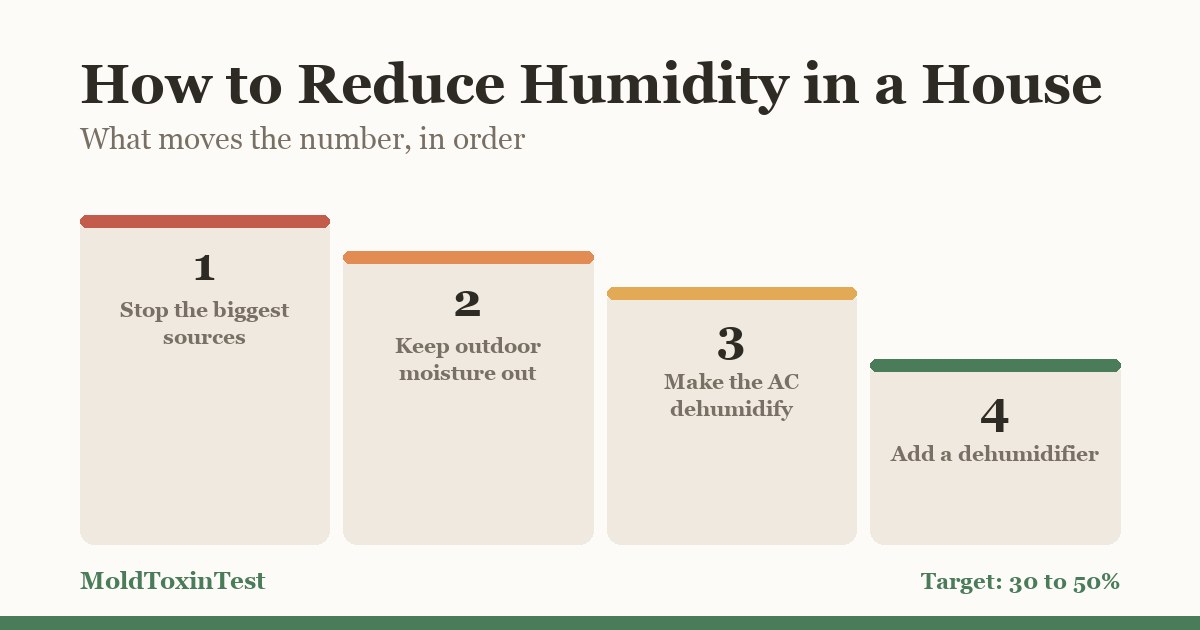
How to Reduce Humidity in a House: What Moves the Number, in Order
Quick answer
Bowls of baking soda, charcoal and hanging moisture absorbers dry a closet, but not a room. A house sits at 60% or more only because water is going into the air faster than it’s leaving. And we need to do more than just these small hacks in this case. In this article, we will discuss how you can use the dryer vented outside, the bath fan and the air conditioner. These are some ways to reduce humidity without a dehumidifier.
When the house still reads above 55% after those, a dehumidifier sized for the space is the next step. We will get to that as well.
Published November 1, 202620 min readEvidence-based
A house is comfortable to live in across a narrow band of indoor humidity, somewhere between 30 and 50%. Inside that band, skin and airways stay comfortable, windows stay clear, wood holds its shape, and dust mites and mold struggle. Above 60%, the house starts to work against the people in it. Bedding feels damp, doors stick, a closet smells, and the cold corner behind a dresser grows a gray fuzz.
Most of the United States east of the Rockies spends a good part of the year outside that band on the humid side. Summer dew points reach the 70s°F from Texas to New Jersey, and rainy spells cross the Midwest and the Northeast in spring and fall. Tight modern houses hold the water their occupants produce. All of it pushes indoor readings into the 60s.
The air conditioner helps less than people expect, and a dehumidifier bought in a hurry often runs all day without winning.
You may have a hygrometer reading 65% in July with the AC on, or a dehumidifier whose tank fills twice a day while the number barely moves. You may have windows that sweat every winter morning, or a house that smells different after three days of rain.
But what reduces humidity in a house by enough to notice, and in what order should you try it before buying another machine?
Note: Mold and mould are the same word, spelled two ways. This article uses the American spelling.
Relative humidity is the share of water the air holds compared with the most it could hold at its temperature. The EPA’s indoor target is below 60% and ideally between 30 and 50%.
Above about 50%, dust mites in bedding thrive. Above 60%, water condenses on cold surfaces in the room, which is where mold starts.
Indoor relative humidity
Under 30%
Too dry
30–50%
The target
50–60%
Dust mites thrive
Over 60%
Mold risk
The number comes from a hygrometer, a small digital gauge that reads temperature and humidity. One in the room that feels worst, read in the morning and the evening for two days, shows both the level and the pattern. A bedroom that reads 50% at bedtime and 64% at dawn has a nighttime source.
A basement that reads 55% in the morning and 68% at four in the afternoon in July is pulling in outdoor air. The best hygrometer guide covers which gauge to trust and where to put it.
Bedroom
Bedtime
50%
Dawn
64%
A nighttime source.
Basement in July
Morning
55%
4 p.m.
68%
Outdoor air is getting in.
The readout on a dehumidifier or a thermostat is a poor substitute. It measures at the machine, next to its own exhaust, with a sensor that drifts. A separate gauge across the room is the one to act on.
Where the water comes from
Indoor humidity is a budget. Water goes in from people, plumbing and weather, and goes out through ventilation, air conditioning and dehumidifiers. The sources are larger than they feel, and knowing their size is what lets you rank the fixes.
University of Missouri Extension puts figures on a household of four. Breathing and perspiration add about 16.8 pounds of water to the air a day, close to two gallons, more than any single appliance except an indoor-vented dryer. A clothes dryer vented indoors, or a vent hose that has come off behind the machine, adds 26.4 pounds a day on laundry days.
Washing clothes adds 4.3 pounds, mopping floors 2.4, cooking on an unvented range 2, a shower or bath 2, dishwashing by hand 1, and houseplants 1. The total comes to about 56 pounds, or 6.7 gallons, in a single day.
Water added to the air in a day, household of four
Pounds per day. Source: University of Missouri Extension.
Clothes dryer vented indoors, laundry days26.4
Breathing and perspiration16.8
Washing clothes4.3
Mopping floors2.4
Cooking on an unvented range2
A shower or bath2
Dishwashing by hand1
Houseplants1
Total55.9 pounds, or 6.7 gallons
The people can’t be removed, so the house has to move their two gallons out every day through ventilation or a machine, whatever else you do. And one dryer venting indoors outweighs every shower, pot of pasta and houseplant in the building combined.
Weather adds to the budget from outside. Humid air enters through open windows and through bath fans that run too long. It enters through leaky ductwork in an attic, through gaps around the attic hatch and plumbing penetrations, and up from a crawl space with bare earth. In a Gulf Coast or Mid-Atlantic summer, that outdoor load can exceed everything the occupants produce.
Step one: stop the biggest indoor sources
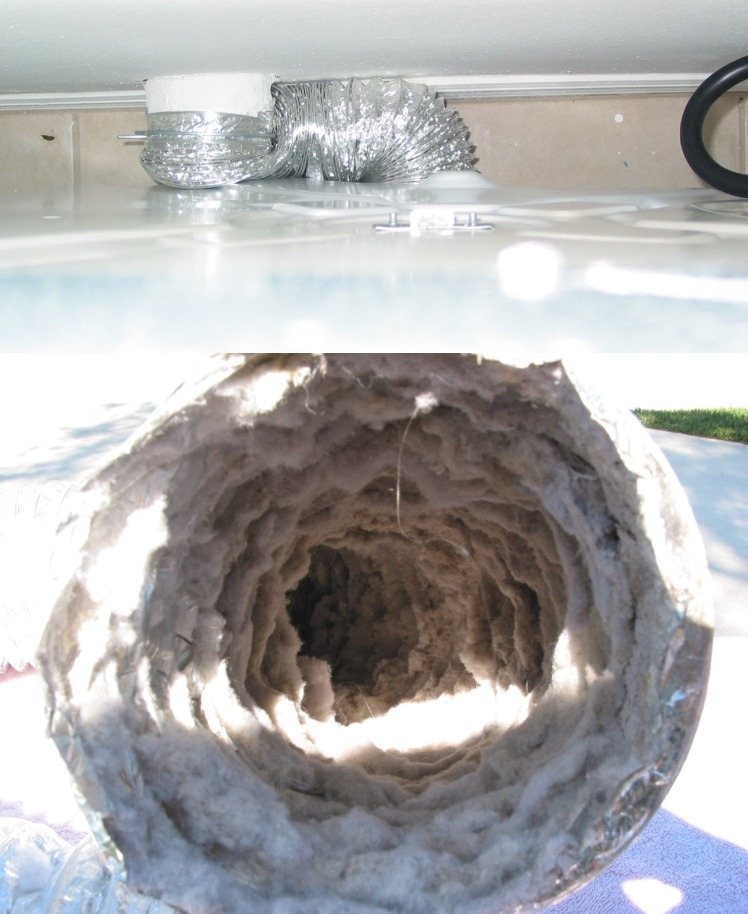
A dryer venting indoors is the largest single source a household controls, so it comes first. A dryer vent that has detached behind the machine puts a gallon or more of water into the house per load. So does a vent run that ends in the garage or the crawl space, or an indoor "lint trap" vent kit sold for apartments.
The vent hose connects to the machine and to the wall, and the outside flap opens when the dryer runs. The duct gets cleaned of lint once a year.
A dryer that takes two cycles to dry a load usually has a blocked duct, which also makes it a fire hazard.
A kinked hose (top) and a duct packed with lint (bottom) both trap the damp air a dryer is trying to push outside. Photo by Rick Harpenau, Wikimedia Commons, CC BY 3.0.
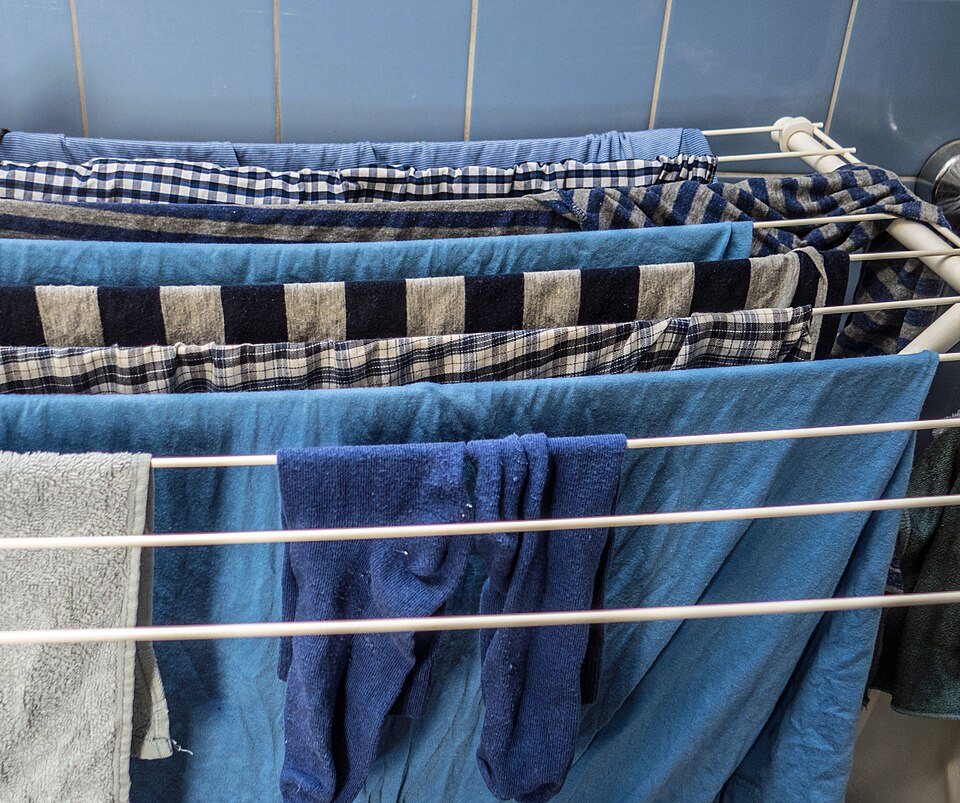
Laundry dried on racks indoors releases the same water into the room, roughly a gallon per large load. In a humid season it goes outside, or into a room with a dehumidifier running beside the rack. The mold on clothes guide covers what happens to clothes that dry too slowly.
A large load drying on an indoor rack releases roughly a gallon of water into the room. Photo by Kotivalo, Wikimedia Commons, CC0.
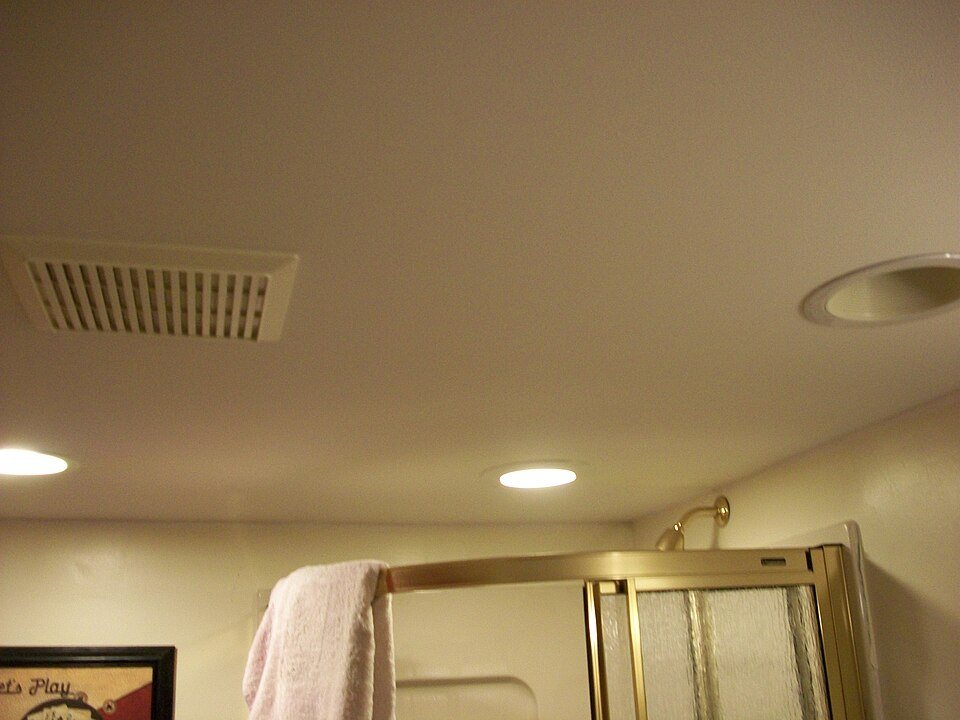
Showers add two pounds each, and the bath fan decides where it goes. The two pounds per shower stays in the house unless the bath fan runs long enough to carry it out. That means 20 minutes or more after the water stops. A fan that only runs while someone is in the room removes a fraction of it.
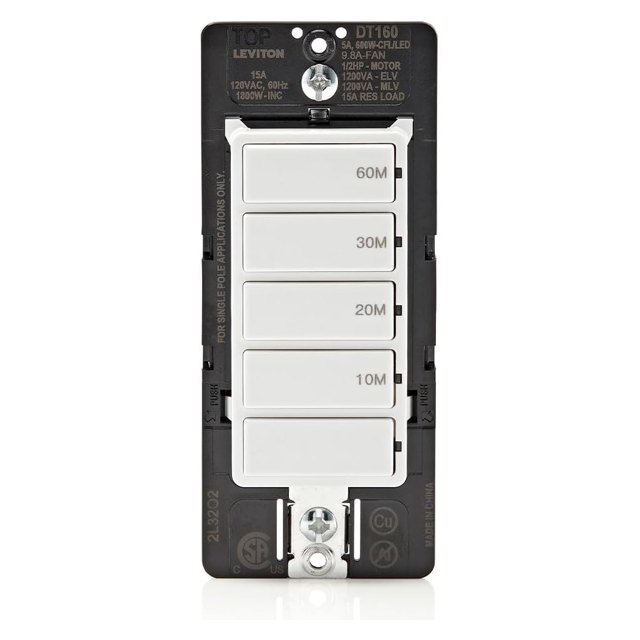
A countdown timer switch in place of the on-off switch solves this without anyone having to remember. Press for 30 minutes and leave. For a bathroom where the fan doesn’t get switched on at all, a humidity-sensing switch turns it on when the room fogs, with a caveat covered below.
The grille above the shower only clears the steam if the fan keeps running for 20 minutes or more after the water stops. Photo by Tomwsulcer, Wikimedia Commons, public domain.
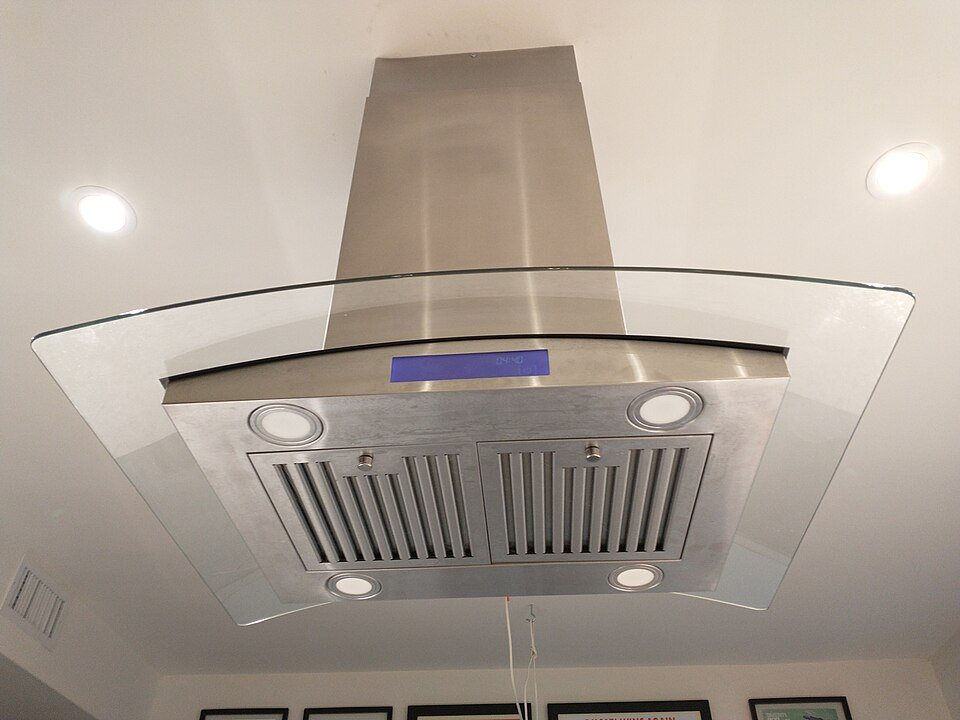
Cooking without a range hood, or with a recirculating hood that filters grease and returns the steam to the kitchen, adds the next pound or two. Lids on pots cut most of it, and a hood that vents outside removes the rest. Dishwashers vent steam at the end of the cycle, and opening the door to air-dry adds a little more.
A hood only removes steam if its duct leads outside. A recirculating model filters the grease and returns the steam to the kitchen. Photo by Stilfehler, Wikimedia Commons, CC BY-SA 4.0.
Houseplants are a small source at normal numbers, about a pound a day for a typical collection, and a large one in a house with dozens. Aquariums, indoor pools and hot tubs are in a different class and need their own ventilation.
Plumbing leaks and seepage sit outside the budget because they’re not supposed to be there at all. A slow drip under a sink, a toilet supply line weeping, or a shower pan that has failed wets the materials around it and feeds the air continuously. A moisture meter on the wall or floor near any fixture finds them.
Step two: stop bringing outdoor moisture in
Opening windows to "air out" a humid house is the most common mistake in the humid half of the country. The dew point decides whether it helps or hurts.
Dew point is the temperature at which the air’s water would start to condense, and it’s a direct measure of how much water the air holds. Most US weather apps show it. When the outdoor dew point is below about 60°F, outside air is drier than a humid house and opening up helps.
Outdoor dew point below about 60°F
Windows open
Outside air is drier than a humid house, so opening up helps.
Outdoor dew point above about 60°F
Windows shut
Outside air carries more water than the house, so it brings water in.
When it’s above 60°F, outside air carries more water than the house does. That describes most summer days from Houston to Boston and most rainy days anywhere east of the Rockies. On those days every open window, every minute of bath fan and every leak in the building brings water in.
Bath fans and range hoods follow the same rule. They exhaust indoor air, and the same volume of outdoor air comes in to replace it. On a 70°F day with a 65°F dew point, a bath fan running for hours on a humidity sensor adds moisture to the house rather than removing it.
Allison Bailes, a building scientist in Atlanta, replaced the humidity-sensing switch in his own bathroom with a countdown timer for that reason. The fan runs long enough to clear a shower and then stops.
Air leaks are windows that stay open all year. Gaps around the attic hatch, recessed lights, plumbing and wiring penetrations, the top plates of walls and the rim joist of a crawl space all leak. Through them, humid attic or crawl space air enters the house all day.
Sealing the large ones with foam and caulk is a weekend job, or a few hundred dollars for a contractor. It cuts the load a dehumidifier then has to cover.
Ducts in an attic or crawl space leak too. A leaky return duct pulls humid, dusty attic air into the system and spreads it through the house. Ducts that leak more on the supply side than the return side push conditioned air out and pull outdoor air in through every crack in the building. Duct sealing is a contractor job, and one of the larger moves available in a humid climate.
The dew point calculator turns your indoor temperature and humidity into the surface temperature at which condensation starts, which is the same arithmetic in reverse.
Step three: make the air conditioner dehumidify
An air conditioner removes water as a side effect of cooling. Warm indoor air passes over a cold coil, water condenses on the coil and drains away, and the air returns cooler and drier. In a humid climate the AC is the main dehumidifier in the house, and the fan setting, the sizing and the airflow decide how much water it removes.
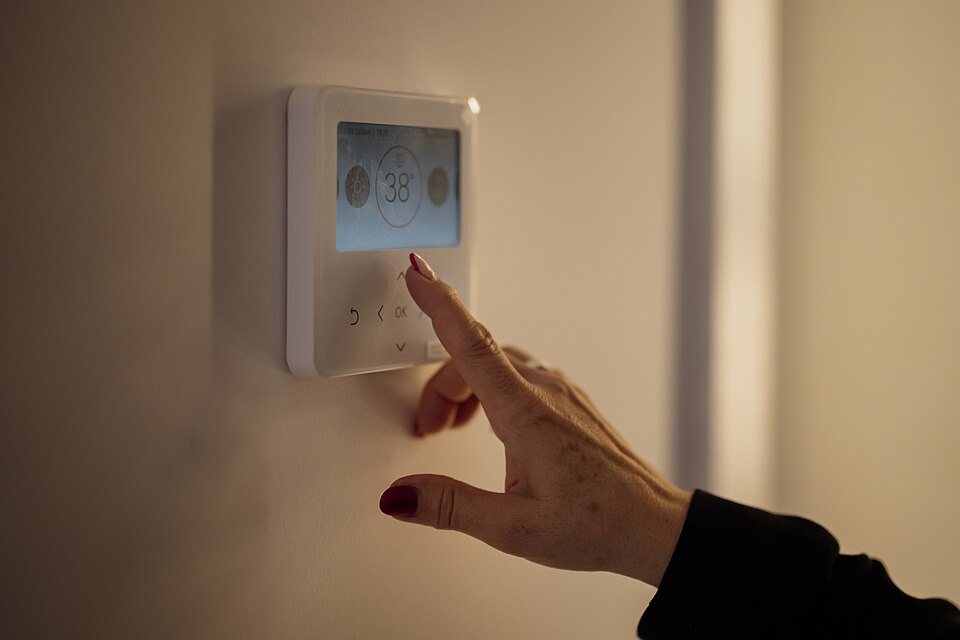
The fan setting does the most damage when it’s wrong. With the thermostat fan set to "on", the blower runs continuously, including when the compressor is off and the coil has warmed up. Air blowing over a warm, wet coil re-evaporates the water sitting on it and sends it back into the house.
Bailes logged this in his own home and watched indoor humidity climb while the fan ran. "Auto" runs the blower only when the compressor runs, so the water on the coil drains instead of evaporating.
Fan on "auto"
The blower stops with the compressor, and the water on the coil drains away.
Fan on "on"
The blower keeps going over a warm, wet coil and sends the water back into the house.
The fan setting on the thermostat costs nothing to change, and “auto” lets the coil drain between cycles. Photo by Shixart1985, Wikimedia Commons, CC BY 2.0.
Sizing is the one you can’t change cheaply. An oversized air conditioner cools the house to the thermostat setting in ten minutes and switches off before the coil has pulled much water out. The house ends up cold and clammy, and the owner lowers the thermostat further, which makes it colder without making it drier.
Many thermostats have a "dehumidify" or "overcool" setting that lets the system run a degree or two past the setpoint when humidity is high. That gives the coil the runtime it needs. If the house was built with, or the system replaced by, a bigger unit than the last one, this is the first thing to try.
Airflow across the coil decides how cold the coil runs. The slower air moves across it, the colder the coil runs and the more water it wrings out. Systems in humid climates are set up for about 350 cubic feet per minute per ton of cooling or less, and a technician can measure and adjust it. A clogged filter cuts airflow too, but by starving the system rather than slowing the air evenly, and it belongs on the monthly checklist.
A heat pump in cooling mode behaves the same way. Mini-split heads often have a "dry" mode that runs the coil cold at low fan speed. It dehumidifies a room well on mild days when full cooling isn’t wanted.
Step four: a dehumidifier sized for the space
Once the sources are cut, the outdoor air is kept out and the AC is doing its share, the house either sits under 55% or it doesn’t. If it doesn’t, the remaining load is the occupants’ two gallons plus whatever the weather pushes in. A dehumidifier is the tool that removes it on the days the AC barely runs.
Sizing is by how damp the space is as much as how big. The dehumidifier size calculator gives the pint rating under the current test standard. A bedroom or a closed living room suits 20 to 30 pints. A basement or an open floor suits 35 to 50, and a wet basement or a crawl space suits a unit built for cold air and continuous drainage.
Bedroom or closed living room
20 to 30 pints
Basement or open floor
35 to 50 pints
Wet basement or crawl space
A unit built for cold air and continuous drainage
Dehumidifier for bedroom covers noise, placement and running one overnight. Dehumidifier for mold covers basements, crawl spaces, pumps and the larger units. Neither set of picks is repeated here.
A dehumidifier adds heat to the room it runs in, a degree or two for a compressor unit. That’s welcome in a basement in May and unwelcome in a bedroom in August. It also stops when its tank fills, so a drain hose to a floor drain or a condensate pump is what lets it run unattended.
What doesn’t work at room scale
The internet’s list of humidity fixes includes bowls of baking soda, charcoal briquettes in socks, buckets of rock salt and hanging moisture absorbers. The arithmetic shows what each can do.
A 16-ounce calcium chloride absorber, the standard DampRid hanging bag, collects around a pint of water over four to eight weeks, which is about a tablespoon a day. A family of four can add six to seven gallons a day. A bag in a bedroom changes the room’s humidity by nothing a hygrometer can detect.
Water in a day, drawn to scale
What a household of four can add6.7 gallons
What one absorber bag collectsAbout a tablespoon
A bag in a closed closet, a cabinet under a sink, a boat cabin or a car does change the air in that small sealed space. That is what the product is for.
Baking soda, cat litter and charcoal absorb less than calcium chloride and release it again when the air dries. A bowl on a shelf cycles water rather than removing it. Rock salt in a bucket works on the calcium chloride principle at a larger scale and makes a mess; a dehumidifier does the same job for less attention.
Houseplants add water rather than removing it. The "plants that absorb humidity" lists online describe species that tolerate humid air, not species that dry it.
Fans move air and don’t remove water. A ceiling fan or a box fan makes a humid room feel cooler by evaporating sweat faster. It also moves air across cold corners so condensation doesn’t settle there. Both are useful, and neither changes the room’s humidity reading.
Lowering humidity in summer and in a rainy spell
Summer in the humid half of the United States has two kinds of day, and they need different handling.
Hot days
The AC runs for hours and does most of the dehumidifying. Fan on auto, windows shut, bath fan on a timer.
Mild, humid days
The AC barely runs and the house drifts upward. Windows stay shut and a dehumidifier holds the line.
On hot days, the air conditioner runs for hours and does most of the dehumidifying on its own. The job is to let it. Fan on auto, windows shut, bath fan on a timer rather than a sensor. The thermostat sits where the house is comfortable rather than as low as it goes.
A house that reads 60% on a 95°F afternoon with the AC running usually has an oversizing, airflow or duct problem from step three, not a source problem.
Mild, humid days are harder, and a rainy spell is a run of them. At 70 to 80°F with a dew point in the mid-60s, the AC barely runs and the outdoor air carries more water than the house. The house drifts upward a point or two a day. Three days of rain in May or September can take a house from 50% to 65% with no one at fault.
A run of mild rainy days keeps the AC off while the air outside carries more water than the house. Photo by Theactivistuk, Wikimedia Commons, CC BY-SA 4.0.
Windows stay shut, fans run only for their job, and this is the weather a dehumidifier was bought for. A 30 to 50 pint unit in the main living space, set to 50% and draining to a hose, holds the house through the spell. It sits idle when the sun returns.
The rainy season in the Gulf states, the Southeast and the Mid-Atlantic is the same pattern stretched across months. A dehumidifier running on a humidistat is the normal cost of a dry house there. Basements and ground floors on slabs feel it first, because the ground is wet and cool and the slab or the walls wick.
Lowering humidity in winter
Winter flips the source of the problem. Outdoor air in a cold climate holds very little water, so humidity inside a heated house comes from the occupants, their showers and their cooking. The question is how fast the house lets it out.
A leaky older house ventilates itself through its gaps and tends to run dry in January. A tight, well-insulated house holds the water in, and that’s where winter condensation lives. Wet windows every morning, frost on the inside of the glass in a cold snap, and mold in the corners of exterior walls and behind furniture.
A homeowner on the Green Building Advisor comment thread described a 50-year-old house whose basement had not passed 55% in decades. A renovation added new windows, spray foam and new HVAC. Afterward the basement sat at 70% in late summer and the upper floors at 60 to 65%.
The safe indoor number in winter is lower than the summer target, because the coldest surface in the house sets it rather than comfort. ASHRAE’s table, reproduced by the EPA, puts the maximum at 35% when it’s 20°F outside, 30% at 10°F, 25% at 0°F and 20% at -10°F. Condensation on double-glazed windows in the morning means the house is above that line, whatever a hygrometer reads mid-room.
Maximum indoor humidity by outdoor temperature
ASHRAE levels, as listed by the EPA.
20°F
35%
10°F
30%
0°F
25%
-10°F
20%
Winter calls for ventilation and warmer surfaces rather than a machine. Bath fans run after every shower, the range hood during cooking, and the dryer vents outside. Any humidifier in the house gets turned down or off when the windows wet.
Drapes stay open during the day so air moves across the glass, and furniture sits a few inches off exterior walls. Insulating window film over single-pane or cold double-pane windows raises the glass temperature enough to stop the condensation. That is what the Duck and 3M window kits are for. A dehumidifier in winter is rarely the answer, since the air outside is dry and a short ventilation period does the same job for nothing.
A house that runs too dry in winter, under 30% with static shocks and cracked lips, has the opposite problem. The humidifier vs dehumidifier guide covers it, including how high a humidifier can safely go in cold weather.
Bedroom, bathroom, basement and apartment
Bedroom
Two sleepers add close to a liter of water to a closed bedroom overnight, and a reading of 50% at bedtime is routinely 60 to 65% at dawn. The door open an inch helps, and so does the AC fan on auto. A 20 to 30 pint dehumidifier holding 45% on low handles the rest without waking anyone.
The dehumidifier for bedroom guide covers noise, placement and overnight drainage. Dust mites in the mattress multiply above 50%, and a sealed mattress protector keeps them off you while the room dries.
Bathroom
A bathroom without a fan, or with a builder-grade 50 cfm fan that barely moves the mirror fog, holds two pounds of water per shower. It seeps into the rest of the house from there. A fan rated for the room on a 30-minute timer clears it. The rule of thumb is about 1 cfm per square foot: 50 cfm as the minimum, 80 to 110 for a bathroom with a separate shower and tub.
Where a fan can’t be installed, a window opened after the shower helps on days when the outdoor dew point is lower than the room’s. A squeegee on the tile and glass and a tub of calcium chloride on a shelf keep the room from staying wet between uses. The mold on bathroom ceiling guide covers what grows when none of that happens.
Basement
A basement is cooler than the rest of the house, so the same air reads a higher humidity there. In summer the walls and floor wick ground moisture as well. Windows stay shut in summer, since open basement windows on a humid day are the single biggest basement humidity mistake.
The dryer vents outside, and a dehumidifier sized for a damp space drains to the floor drain or a pump. Carpet on a slab holds moisture and grows mold underneath; area rugs that lift come off and dry. Mold in basement covers the rest.
Apartment
A renter can’t seal the attic or resize the AC, and often has an unvented bathroom and a shared wall. The moves that remain are the biggest ones anyway. No indoor laundry drying, lids on pots, and the bath fan or the bathroom window after every shower. The AC fan on auto, windows shut when the dew point is high, and a 20 to 30 pint dehumidifier in the main room.
A hygrometer reading documented over a few weeks is also the evidence a landlord responds to when the problem is a leak or a missing vent.
When it isn’t indoor moisture
Sometimes the sources are cut, the windows are shut, the AC is set up properly, and the house stays humid. Then it is taking on water from the building or the ground.
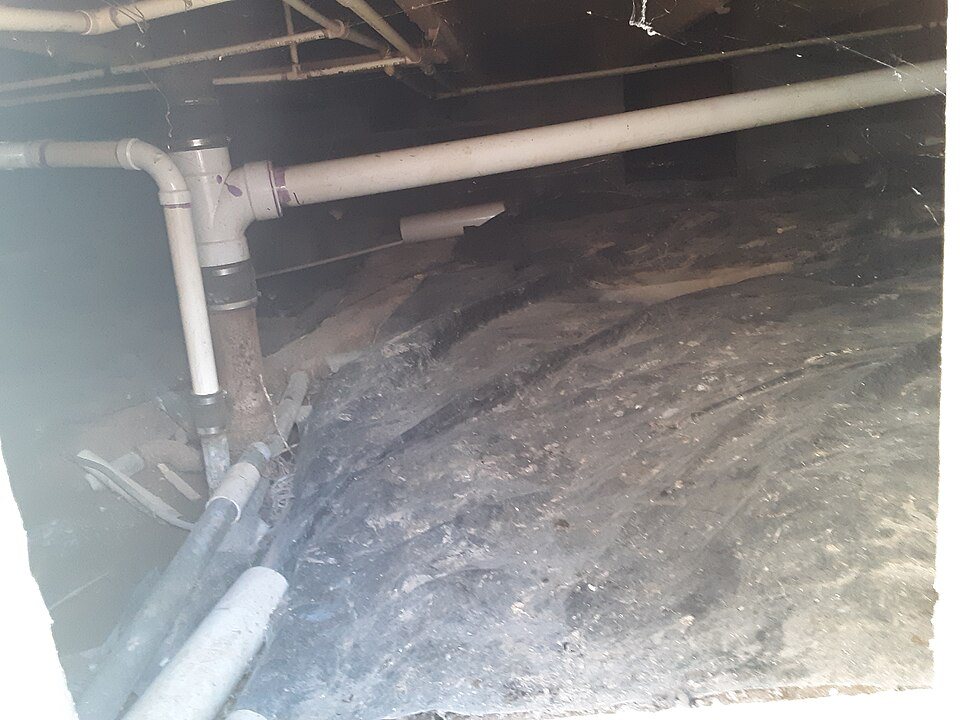
A crawl space with bare earth under the house evaporates ground water upward all summer, and the house above pulls that air in through the floor. The fix is a vapor barrier: 6-mil polyethylene laid over the soil and lapped up the walls. In humid climates, a sealed crawl space with its own dehumidifier does better. A crawl space that smells musty from the hatch is already growing something.
Bare earth like this evaporates water upward all summer until 6-mil polyethylene covers it. Photo by TradeCrawlspaces, Wikimedia Commons, CC BY-SA 4.0.
Grading that slopes toward the foundation, downspouts that empty at the wall, and clogged gutters put water against the basement walls. The walls wick it into the house. Regrading, downspout extensions and clean gutters solve more basement humidity than any machine.
A slab floor with no vapor barrier beneath it wicks continuously, and carpet or vinyl laid directly on it traps the moisture. A moisture meter reading on the slab, compared with a reading on an interior wall, shows whether the floor is the source.
A leak inside a wall, a roof or a window flashing wets the framing and feeds the air long before a stain shows. The musty smell in house guide traces a smell to its source. A moisture meter maps the wet area, and the mold detector tells from a photo whether what you find is growth.
The products that help
Each item here does one job in the plan above. None of them replaces a dehumidifier in a room that needs one, and the dehumidifiers themselves are reviewed on the two pages linked earlier. Ratings are from the live Amazon listings in November 2026.
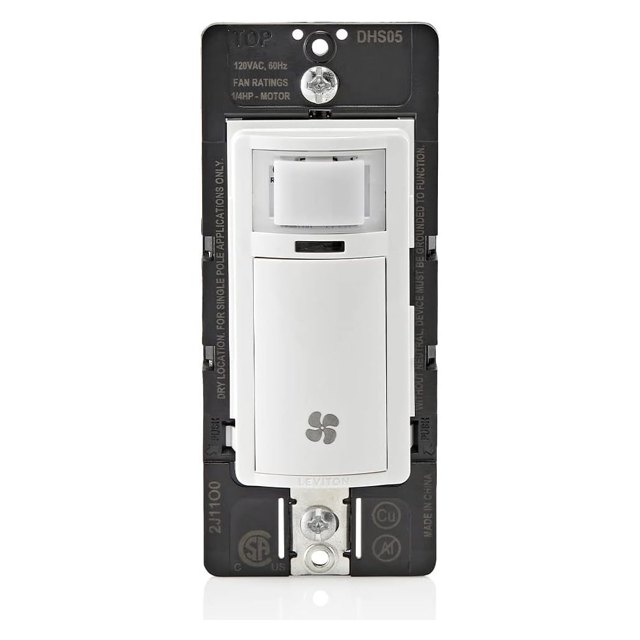
Leviton 60-minute countdown timer switch
Best bath fan control
Buttons
10, 20, 30, 60 min
Neutral wire
Not needed
Fits
Single-pole box
Rating
4.6 (700+)
The timer switch replaces the bath fan’s on-off switch and gives four buttons: 10, 20, 30 and 60 minutes. Press 30 after a shower and the fan clears the room and stops on its own. A building scientist chose a Leviton countdown timer for his own house over a humidity sensor. It leaves the fan off on a muggy afternoon when no one has showered.
It fits a standard single-pole box with no neutral wire needed. Rated 4.6 stars from more than 700 buyers.
The humidity-sensing switch turns the fan on when the bathroom’s humidity jumps and off when it falls, with an adjustable threshold. It’s the right control for a bathroom where the fan doesn’t get switched on: a kids’ bathroom, a rental, a guest bath.
On mild humid days it can run the fan when no one has showered, so the threshold goes high. A basement or a very humid climate suits the timer instead. Rated 4.5 stars from more than 1,000 buyers.
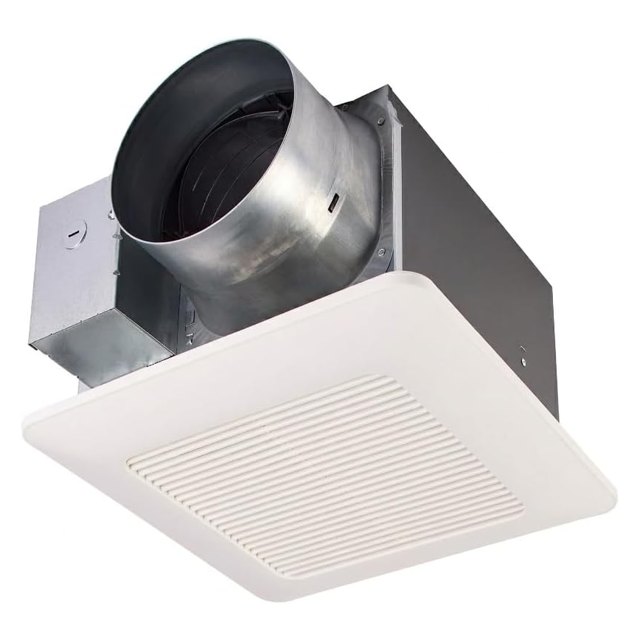
For a bathroom with no fan, or with a 50 cfm fan that leaves the mirror fogged, the WhisperCeiling is the replacement. It moves 110, 130 or 150 cfm at a selectable setting. It runs quietly enough that people leave it on. It’s Energy Star rated and designed to hold its airflow against the resistance of a long duct run.
Installation is a ceiling-and-attic job for a handy owner or an electrician, and the duct has to terminate outside rather than in the attic. Rated 4.4 stars from more than 380 buyers.
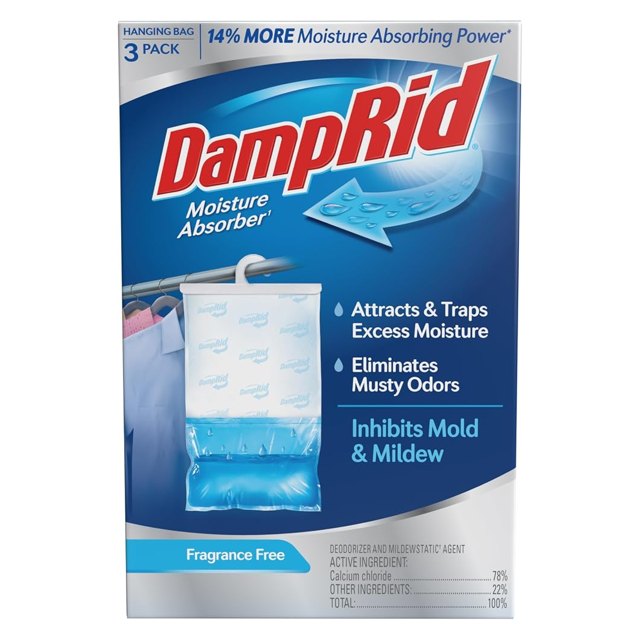
The DampRid bag hangs from a closet rod and collects water from the closet air into a sealed pouch. It holds around a pint after one to two months in a humid season. It’s for a closet on an outside wall, a wardrobe that smells, or a coat closet by a damp entry. In open room air it does nothing you’d measure.
The fragrance-free version avoids adding a scent to the clothes. Rated 4.7 stars from more than 5,000 buyers.
These are hanging bags on a hook, sold in a larger pack for several small spaces at once. They suit a rail in a bathroom cabinet, a closet, an RV or a boat over winter. Each holds around 14 ounces of calcium chloride and shows how much water it has collected, with the same scale caveat as DampRid. Rated 4.6 stars from more than 1,500 buyers.
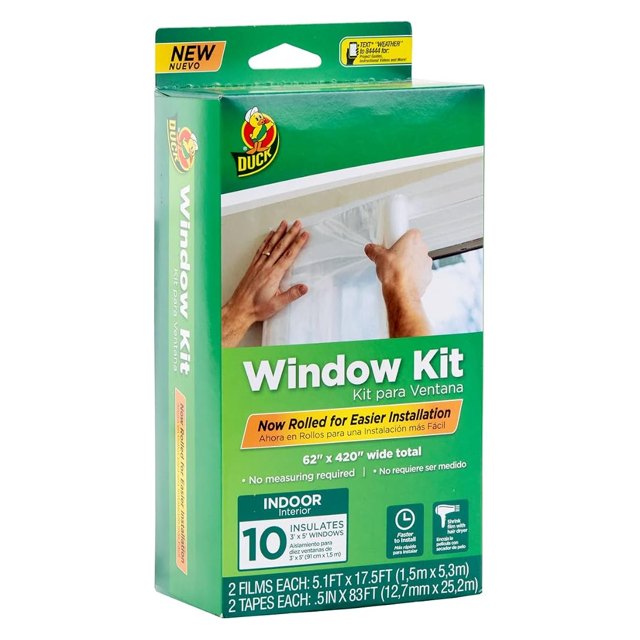
Clear shrink film taped over a window frame and tightened with a hair dryer adds a still air layer that keeps the inside glass warm. On single-pane and cold double-pane windows that is enough to stop winter condensation. One kit covers up to ten windows, and it comes off easily in spring.
It’s the cheapest fix for wet windows in a house that reads a reasonable 35% but still sweats on the coldest glass. Rated 4.5 stars from more than 5,800 buyers.
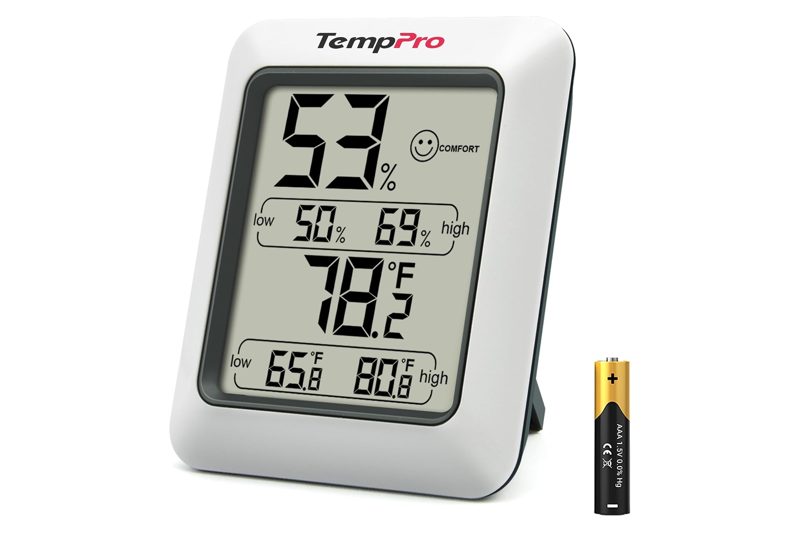
The TempPro TP50 hygrometer reads temperature and humidity with a dry, comfortable or wet indicator and a min and max memory. Every step above starts from its reading. Rated 4.6 stars from more than 155,000 buyers.
Only when the outdoor dew point is lower than the indoor one, roughly below 60°F. On most summer days and rainy days in the eastern United States the dew point is higher than that, and open windows raise indoor humidity. Most weather apps show the dew point.
Do fans reduce humidity?
Ceiling and box fans don’t; they move air without removing water, though they make a humid room feel cooler and keep condensation off cold corners. Exhaust fans in bathrooms and kitchens do, by sending wet air outside, as long as the air they pull in to replace it is drier.
Does air conditioning reduce humidity?
Yes, as long as it runs long enough. An AC removes water on its cold coil while the compressor runs. An oversized unit that cools the house in ten minutes removes little, and a blower fan set to "on" re-evaporates water off the coil. Fan on auto, a dehumidify or overcool setting on the thermostat, and airflow set for humid climates let the AC do its share.
Should the AC fan be on "on" or "auto" for humidity?
Auto. With the fan on continuously, air blows across the wet coil after the compressor stops and carries the water back into the house. Green Building Advisor’s Allison Bailes measured indoor humidity rising in his own house with the fan set to on.
How do you reduce humidity in a house without a dehumidifier?
The dryer vents outside and laundry dries outdoors, the bath fan runs 20 to 30 minutes after every shower, pots get lids and the hood vents outside. Windows stay shut when the outdoor dew point is above 60°F, the AC fan sits on auto, and the attic and crawl space leaks get sealed. Those steps remove most of the controllable load. The two gallons a day a family breathes out still has to leave through ventilation or the AC.
How do you lower humidity in a house in winter?
By ventilating rather than dehumidifying. Bath fans after showers, the range hood when cooking, the dryer vented outside, any humidifier turned down, and air moving across windows and exterior walls. The safe indoor level drops with the outdoor temperature, and the EPA’s ASHRAE table gives 35% at 20°F outside, 30% at 10°F and 25% at 0°F. Wet windows in the morning mean the house is above that line.
Why does humidity go up in the house when it rains?
Rainy air is near saturation, often with a dew point above 60°F, and it enters through every leak and every open window. Mild temperatures during rain keep the AC off, so nothing is removing water. A run of rainy days lifts a house a point or two a day, and a dehumidifier on a humidistat is what holds it.
What humidity causes mold in a house?
Sustained readings above 60% let mold grow on cool surfaces with no leak at all. A cold exterior wall or window can condense at a room reading of 50%. Below 50% most growth stops. The EPA puts the indoor target below 60% and ideally between 30 and 50%.
DampRid or a dehumidifier?
DampRid for a closet, a cabinet, a car or a boat. A dehumidifier for a room. A 16-ounce calcium chloride bag collects about a pint over weeks; a household can add six gallons a day. The bag can’t change a room’s reading, and a dehumidifier can’t fit in a wardrobe.
Does baking soda absorb humidity in a room?
Not at a scale that changes the room. A bowl of baking soda, cat litter or charcoal picks up a few grams of water and releases it when the air dries. It’s a deodorizer with a minor side effect, not a dehumidifier.
How do you reduce humidity in a bedroom?
The door open an inch and the AC fan on auto. Then a 20 to 30 pint dehumidifier on low set to 45%, six feet from the bed with a drain hose. Two sleepers add close to a liter of water overnight, so a bedroom reads highest at dawn. The dehumidifier for bedroom guide covers noise and placement.
How do you reduce humidity in an apartment?
Laundry dried outside or beside a dehumidifier, lids on pots, and the bath fan or the bathroom window after every shower when the outdoor dew point allows. The AC fan on auto and windows shut on humid days. A 20 to 30 pint dehumidifier in the main room covers the rest. A hygrometer log over a few weeks is the evidence to bring a landlord if the cause is a leak or a missing vent.
What if the house is too dry instead?
Readings under 30% in winter, with static, cracked lips and nosebleeds, are the dry-air problem, common in heated homes in cold climates and in the Southwest. The humidifier vs dehumidifier guide covers which humidifier type and how high it can go before windows condense.