Best Hygrometer for Home: Which readings to Trust and 6 options we liked
Quick answer
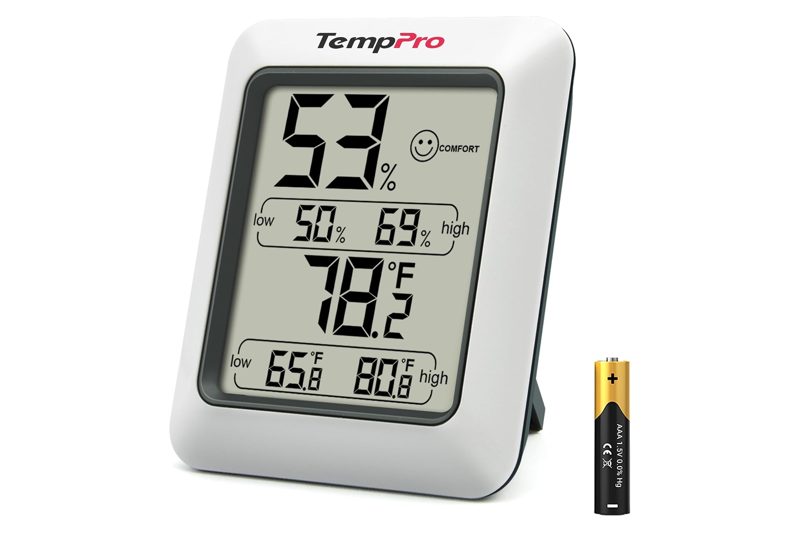
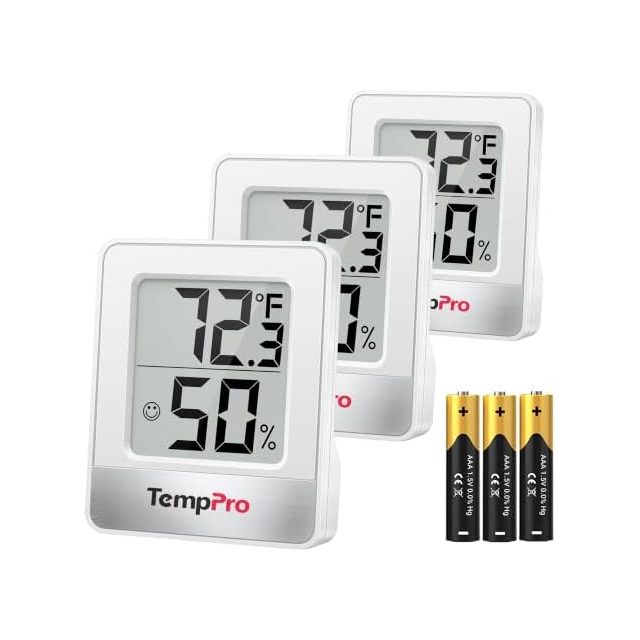
For one room, we noticed TempPro TP50 is the best hygrometer for home use. It has a large display, a min and max memory, ±2 to 3% accuracy, and a comfort icon that reads at a glance. For a whole house, the TempPro TP49 three-pack puts one in the bedroom, the basement and the wardrobe. For readings you can check from your phone and graph overnight, the Govee H5075 adds Bluetooth logging for little more.
Whichever you buy, a salt test once a year and a spot at chest height in the middle of the room keep it accurate. Windows, vents and outside walls skew the reading. The reading at dawn in a bedroom, or late afternoon in a basement, is the one that decides whether you need a dehumidifier.
Published October 26, 202617 min readEvidence-based
The air in a house carries water, and the amount decides more about the building and the people in it than the temperature does. Too much and windows stream, wardrobes smell and dust mites multiply in the bedding. Too little and skin cracks, static builds and a cold takes longer to shake.
Humidity is invisible and the body is a poor judge of it. A room can feel dry because it’s cold, or stuffy because it’s warm, while the water content sits anywhere from 25 to 65%. The only way to know is a hygrometer, the small digital humidity meter that reads temperature and relative humidity.
You may have been told to "keep it under 50%" by a mold guide, a dehumidifier box or an allergist. Then the gauge you bought read differently from the one on the dehumidifier, which read differently from the one on the thermostat.
But which home hygrometer gives a number you can act on? And how do you know whether the one on the shelf is right?
Note: Mold and mould are the same word, spelled two ways. This article uses the American spelling.
A humidifier and a dehumidifier do opposite jobs, and the symptoms that send people to buy them overlap. A blocked nose, a cough, a child who wakes congested and allergies that don’t settle appear on both lists. The reading is what separates them, and a gauge that costs less than a takeout meal saves the price of the wrong machine.
The thresholds are narrow. Above 60%, water condenses on cold surfaces, which is where mold begins, and dust mites breed fast in bedding. Above 50%, mites survive well enough to keep an allergy going.
The lines a reading is measured against
Under 30%
Too dry
Airways dry, static, wood shrinks
30–40%
Fine
EPA range
40–50%
Comfortable
Where a house sits best
50–60%
Mites thrive
Allergy keeps going
Over 60%
Mold
Cold surfaces condense
Below 30%, airways dry, static builds and wood shrinks. The 40 to 50% band is where a house sits comfortably, and the EPA’s indoor target is 30 to 50%.
A reading of 44% in a bedroom that feels damp means the problem is a cold surface rather than wet air. A reading of 62% in a bedroom that feels fine means the mattress and the wall behind the headboard are at risk whatever the room feels like. In both cases the number changed the decision, and the humidifier vs dehumidifier guide walks through what each reading calls for.
What the accuracy rating means at 50% and 60%
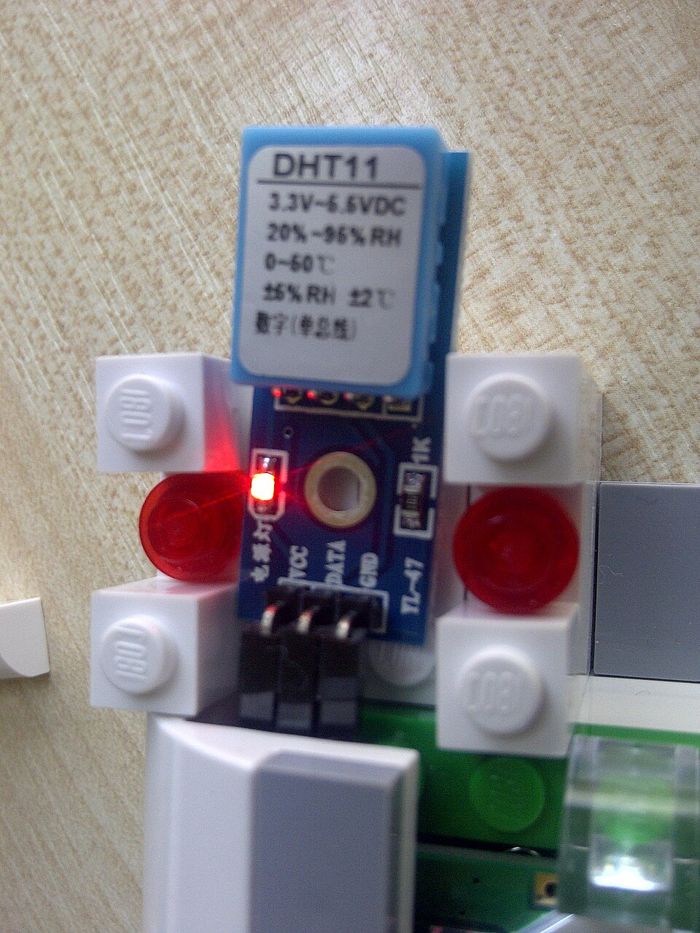
A digital hygrometer carries a capacitive polymer sensor, a thin film whose electrical charge changes with the water it absorbs. The good ones in consumer gauges are rated ±2 to 3% relative humidity. The cheap ones are rated ±5%, or carry no rating at all, and some read 10 points off out of the box.
A DHT11, one of the cheapest humidity sensors made, carries its ±5% RH rating on the label. The gauges below are rated ±2 to 3%. Photo by Crackopl, Wikimedia Commons, CC BY-SA 3.0.
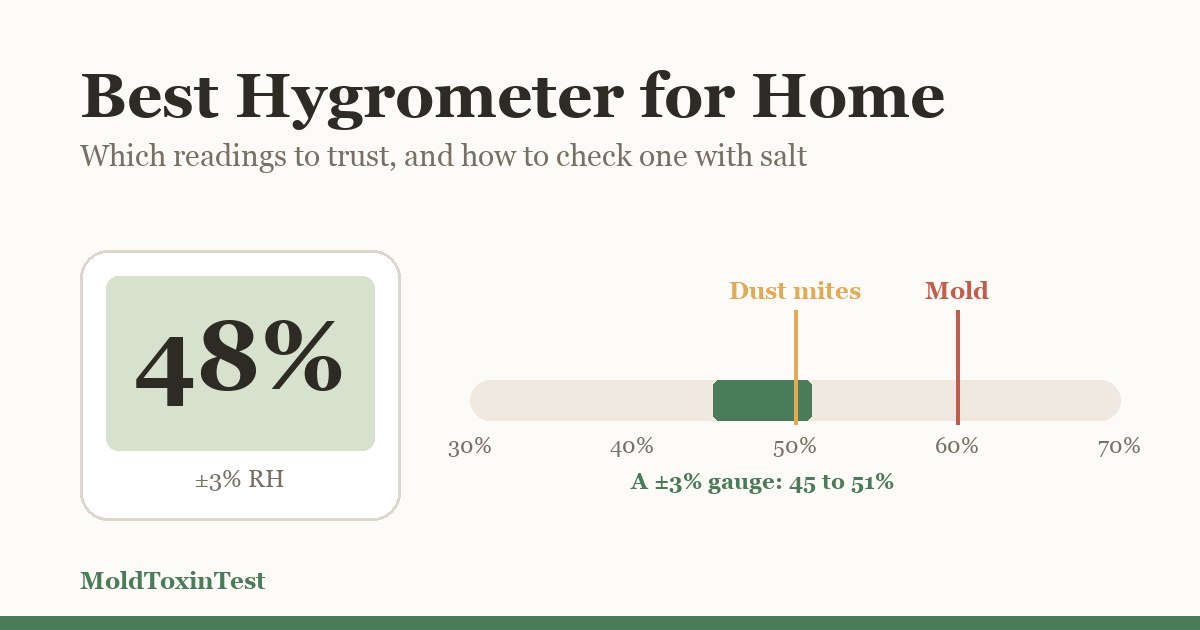
The rating is a band, not a promise. A gauge rated ±3% that shows 48% is reporting a room somewhere between 45 and 51%. Two gauges rated ±3% can disagree by 6 points and both be in spec. Since 50% is the dust mite line and 60% the mold line, a single reading of 52% means "near the line," not "over it."
48%
Real room: 45 to 51%
Straddles the 50% mite line
54%
Real room: 51 to 57%
Same room, second gauge, still in spec
A reading a few points past a threshold, held for days, means more than a single reading an inch past it. When a decision rests on the number, a second gauge beside the first settles whether either has wandered.
Response time is the other spec. Most gauges update every 10 seconds and need 15 to 30 minutes in a new spot to settle, longer if they’ve come in from a cold car. A reading taken five minutes after unboxing is a reading of the packaging.
Drift, and the salt test that catches it
Capacitive sensors age. The sensor makers’ own specifications put long-term drift at under 0.25% RH per year from aging alone, which would be fine. The same specifications exclude contamination, and kitchen grease, smoke, dust and long spells above 80% humidity shift a sensor by several points, in either direction. The cheap circuit board around the sensor drifts more than the sensor does.
Owners find this out when two gauges stop agreeing. In an April 2021 Piano World thread, a member held his piano room at 40% with a humidifier and a dehumidifier. His gauge read lower and lower, and three new gauges of the same brand read 20 points higher than the old one while agreeing with each other. He had spent months humidifying a room that was already near 50%.
Replies suggested buying several cheap gauges and keeping the ones that read the average, calibrating every six months, or checking with salt.
The salt test is the home standard.
Table salt dissolves in water until the water can hold no more. The air above that saturated solution, in a sealed container at room temperature, settles at 75% relative humidity.
1
A teaspoon of plain table salt in a bottle cap
2
A few drops of water, to a wet slurry that doesn’t fully dissolve
3
Cap and hygrometer sealed in a zip bag, little air
4
Eight hours or overnight at room temperature
Reading after eight hours
68%: 7 points low72–78%: passed82%: 7 points high
Plain table salt is the reference. Low-sodium salt contains potassium chloride and settles at a different level. Photo by Edal Anton Lefterov, Wikimedia Commons, CC BY-SA 3.0.
A teaspoon of salt goes into a bottle cap with a few drops of water, enough to make a wet slurry that doesn’t dissolve completely. The cap and the hygrometer go into a zip bag, sealed with as little air as possible, and sit at room temperature for eight hours, or overnight.
A gauge that reads 72 to 78% has passed. One that reads 68% is 7 points low and will read 7 points low in the room as well. A gauge with a calibration button or an app offset can be corrected to 75%; one without is used with the correction in mind, or replaced.
Potassium carbonate does the same job at 43%, closer to the range a house sits in. Sealed calibration packs sold for cigar humidors give 75% without the mess.
Low-sodium salt contains potassium chloride and settles at a different level, so the test needs plain table salt. A bag that isn’t sealed doesn’t settle at all.
Where to put a hygrometer, and why two readings beat one
Humidity varies within one room by more than the gauge’s error. The air an inch from a cold outside wall is cooler than the air mid-room, and cooler air at the same water content reads a higher relative humidity. That corner is where condensation starts and where mold grows behind a wardrobe. A gauge in the middle of the room doesn’t see it.
Two readings in one bedroom, winter
Cold outside wall
61%
Behind the headboard the risk number
51%
Mid-room, chest height the room number
An illustration of a typical gap: the cold corner often reads around 10 points higher than mid-room.
For the room’s number, the gauge goes at chest height, near the middle, on a shelf or a nightstand. Windows, heating vents, radiators, the bathroom door and direct sun all skew it. Not on the floor, where cold air pools and reads high, and not on top of a dresser against an outside wall.
For the risk number, a second reading in the coldest spot tells you what the wall is doing. A gauge left for an hour on the floor behind the headboard, or inside a wardrobe on an outside wall, often reads 10 points higher than mid-room. Winter widens the gap. The dew point calculator turns the mid-room reading into the surface temperature at which that wall starts to sweat.
The gauge built into a humidifier or dehumidifier reads at the machine’s own intake, beside its own exhaust, with a sensor no better than the cheapest standalone unit. The machines’ humidistats are for switching the machine on and off, and a separate gauge across the room is the reading to trust.
When to read it: the daily pattern in each room
Bedroom
Climbs through the night, peaks at dawn
10 p.m.6 a.m.
Bathroom
Spikes after a shower, should fall within an hour
7 a.m.10 a.m.
Basement in summer
Peaks in the late afternoon
8 a.m.8 p.m.
Illustrative curves. Dashed lines mark 50% (amber) and 60% (red).
A bedroom climbs through the night. Two sleepers add close to a liter of water to a closed room. A reading of 48% at bedtime is routinely 60% at 6 a.m. The dawn reading decides whether the bedroom needs a dehumidifier.
A bathroom spikes after a shower and should fall back within an hour. One that stays above 60% for two hours has a ventilation problem.
A basement runs the other way in summer. Warm outside air leaks in through the day, cools against the walls and floor, and the humidity peaks in the late afternoon. In winter a basement with a furnace running can be the driest room in the house.
Basic, calibratable, Bluetooth, WiFi or precision
A hygrometer for a house comes in five forms, and the room decides which. A basic gauge shows the current reading, usually with a min and max, on a display you can read from across the room. It’s the right buy for one room, and three of them placed around a house cost less than one smart unit.
Basic
Current reading with a min and max, readable across the room. One room, or three of them around a house.
Calibratable
A button or menu to set it to 75% after the salt test. For keeping a gauge for years.
Bluetooth
Display plus an app that logs and graphs when the phone is in range. For a bedroom or basement pattern.
WiFi
Readings through your router, alerts from anywhere. For a second home, rental or crawl space. Needs 2.4 GHz.
Precision
Higher-grade element around ±1.5 to 2%, dew point included, several times the price. For a humidor or instrument room.
A calibratable gauge adds a button or a menu that lets you set it to 75% after the salt test. It’s the buy for anyone who’ll check the gauge once a year and wants to keep it rather than replace it.
A Bluetooth gauge keeps the display and adds an app that logs readings whenever the phone is in range, draws a graph, and exports the data. It’s the buy for a bedroom or a basement where the overnight or afternoon pattern is the question.
A WiFi gauge sends readings through your router, so the app works from anywhere and can alert you when a basement crosses 60% while you’re away. It’s the buy for a second home, a rental, a crawl space or a server cupboard. WiFi units need a 2.4 GHz network and have the most setup complaints of any type.
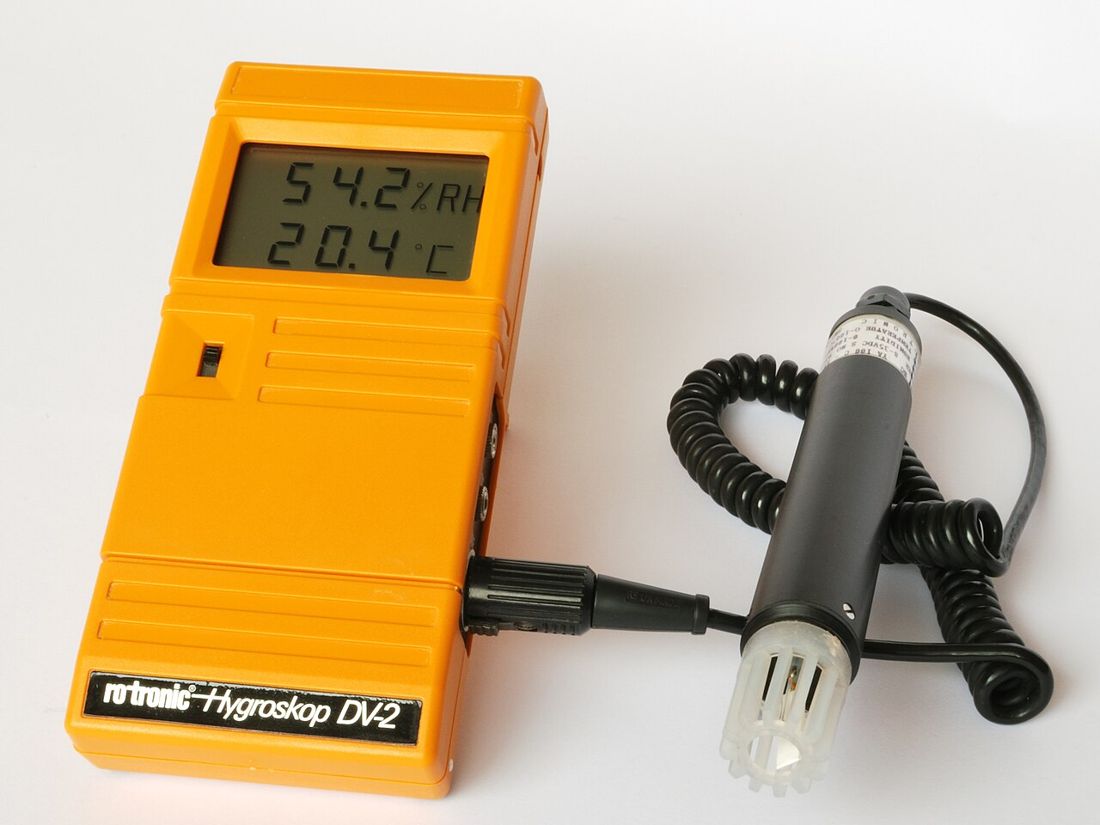
A precision sensor is the most accurate hygrometer a household can buy. It uses a higher-grade sensing element, rated around ±1.5 to 2%, with faster response and a dew point calculation. It costs several times a basic gauge, and it suits a humidor, an instrument room or anyone who has been burned by a drifting cheap one.
Laboratory-grade thermohygrometers use a separate probe and a higher-grade element. Consumer precision sensors borrow the same idea in a smaller package. Photo by Harke, Wikimedia Commons, public domain.
An analog gauge, with a needle driven by a coil or a hair, is the old technology. Factory tolerance is often ±5 points or more, and it needs a screw adjustment after a salt test. It suits a humidor’s decor and little else.
What a hygrometer can’t tell you
A hygrometer measures the air. It can’t tell you whether a wall, a floor or a mattress is wet.
Whether a material is wet
A moisture meter reads the wall, floor or joist.
Whether mold is already growing
Growth from a damper season can still be there.
What’s in the air
Spores, dust and pollen take a different measurement.
A moisture meter does that, with pins pushed into the material or a pinless pad held flat against it, and it’s the tool a mold inspector carries. For a stain on drywall or a damp patch of subfloor, a hygrometer in the room says nothing useful. A pinless moisture meter says whether the material is at 12% or 25%.
A hygrometer also can’t tell you whether mold is already growing. A room that now reads 45% may have spent last winter at 65%, and the growth from then is still behind the wardrobe. The mold detector tells from a photo whether a mark is growth, and a musty smell that outlasts a dry reading is the sign to go looking.
It can’t tell you what’s in the air, either. Spores, dust and pollen take an air purifier and a different measurement.
How we chose
Each gauge here uses a capacitive digital sensor rated ±3% RH or better and holds a min and max, on the unit or in an app. Where it has a display, the display reads from across a room. We looked for a calibration method, a stand and a magnet or hook, and a refresh of 10 seconds or faster. The review base had to be large enough to show the pattern on drift and disagreement between units.
We haven’t tested these against a reference instrument. The notes draw on the sensor makers’ specifications, the owner patterns in forum threads where people depend on the reading, and buyer reviews on each listing. Ratings and review counts are from the live Amazon listings in October 2026.
The 6 best hygrometers for home
1. TempPro TP50
Best for one room
Accuracy
±2–3% RH
Memory
24 h min/max
Calibration
No
Rating
4.6 (155,000+)
The TP50 is the gauge on the nightstand in several of this site’s guides, and the reason is the display. Large digits, a comfort face that reads dry, comfortable or wet from across the room, and a min and max for the last 24 hours. The sensor is rated ±2 to 3% RH and ±1°F and refreshes every ten seconds.
It stands on a desk, hangs on a wall or sticks to a fridge with its magnet, and runs a year on a AAA battery. It has no calibration button, so a unit that fails the salt test gets used with the correction in mind, or replaced. At this price, replacing is the usual answer.
It’s the most-reviewed hygrometer sold. Rated 4.6 stars from more than 155,000 buyers.
The TP49 is the TP50’s smaller sibling, sold in threes, and the pack is the way to learn how a house behaves. One in the bedroom, one in the basement and one inside a wardrobe on an outside wall show three different numbers. The differences are what you’re buying. The same comfort face and ±2 to 3% sensor, a smaller display, a stand and a magnet on each.
The pack also gives you the Piano World method: if two agree and the third doesn’t, you know which one has drifted. Rated 4.6 stars from more than 8,000 buyers.
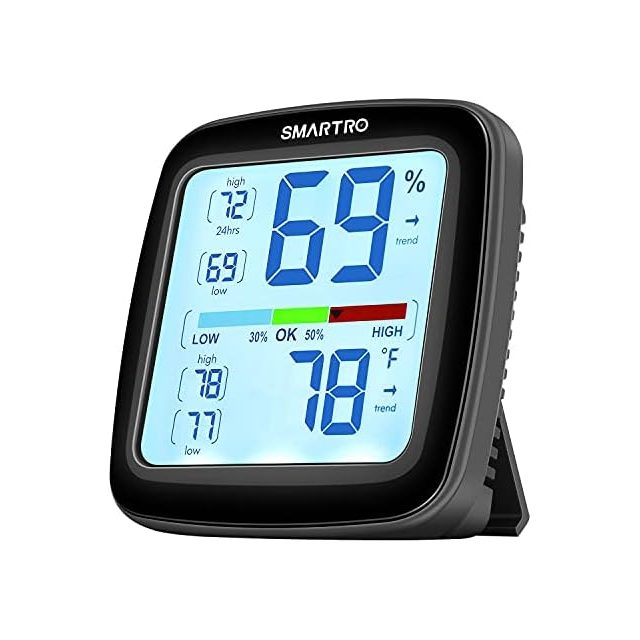
The SC42 is the gauge to buy if you’ll do the salt test and want to keep the gauge afterwards. It has a calibration mode that lets you set the humidity reading after the test. It also has a min and max, a comfort indicator and a backlit display, with a stand and a magnet.
Its accuracy rating is in the same ±2 to 3% band as the TempPro units; the difference is that this one can be brought back when it drifts. Rated 4.5 stars from more than 7,000 buyers.
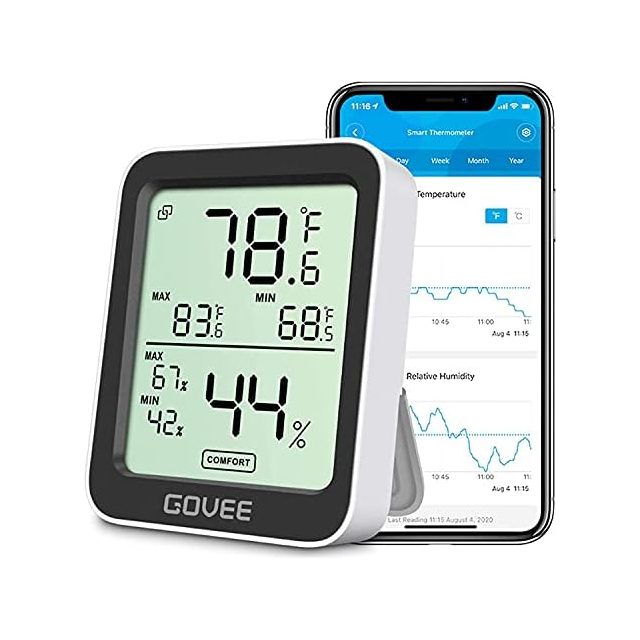
The H5075 shows the reading on its own display and logs it to the Govee app whenever a phone is within Bluetooth range. The app draws a graph of the past hours, days or two years and exports the data. The sensor is Swiss-made and rated ±3% RH, and the app lets you enter a calibration offset after a salt test.
For a bedroom, the overnight graph is the reason to own it: the climb from bedtime to dawn is visible in one night. For a basement, the afternoon peak in summer shows the same way. The limit is Bluetooth range; the app only updates when the phone is in the house. Rated 4.5 stars from more than 48,000 buyers.
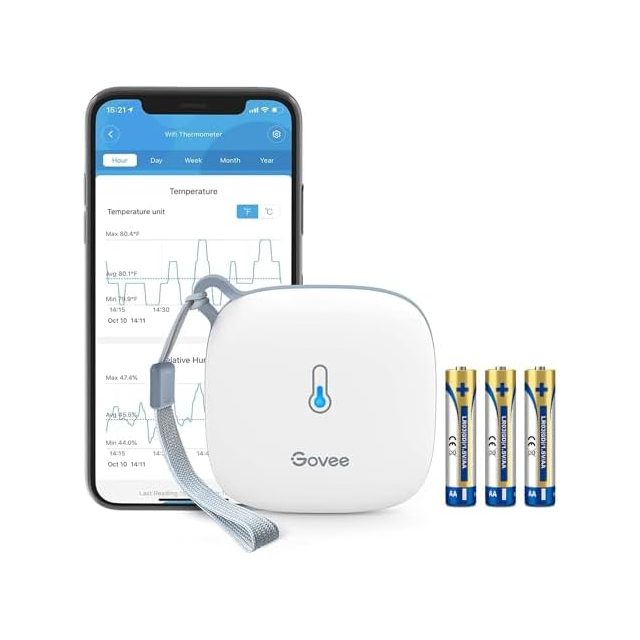
The H5179 does what the H5075 does and sends the readings through your router. The app then works from anywhere and sends an alert when a room crosses a line you set. It’s the gauge for a basement you don’t visit, a crawl space, a holiday home or a rental between tenants.
It needs a 2.4 GHz WiFi network, and setup is where the complaints come from. The rating is lower than the Bluetooth unit’s for that reason rather than the sensor. Rated 4.3 stars from more than 7,900 buyers.
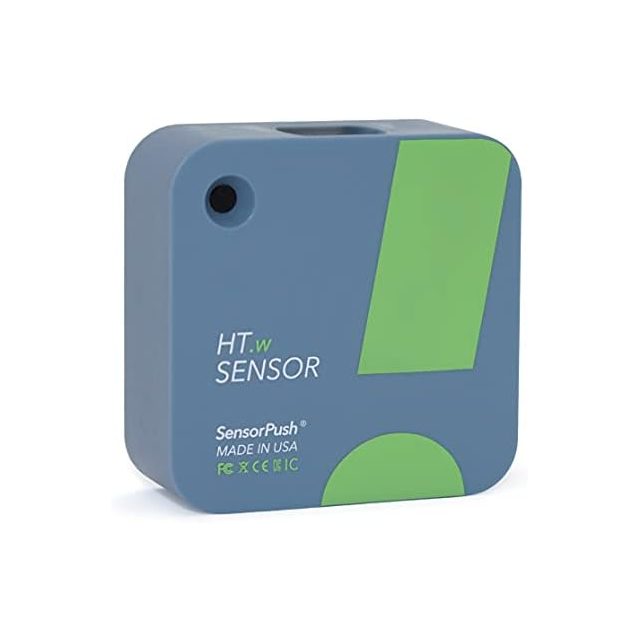
The SensorPush is a sensor rather than a gauge. It’s a small water-resistant puck with no display that logs to a phone over Bluetooth, with an optional gateway for WiFi. Its Swiss-made sensing element is rated ±2% RH typical and ±0.2°C, the tightest temperature spec here, with fast response. The app calculates dew point and shows the whole history with no limit.
It’s made in the USA, runs about two years on a coin cell, and costs several times a basic gauge. It’s the pick for someone who has been burned by drifting cheap units and wants one number they trust. A humidor, an instrument room or a cellar is the other home for it. Rated 4.6 stars from more than 1,600 buyers.
As an Amazon Associate we earn from qualifying purchases, at no extra cost to you.
Which hygrometer for which room
A bedroom. The TP50 on the nightstand, or the Govee H5075 if you want to see the overnight climb. Read it at dawn.
A whole house. The TP49 three-pack, placed in the bedroom, the basement and the wardrobe or closet on the coldest wall.
A basement or crawl space. The Govee H5179 for alerts while you’re elsewhere, or the H5075 if you’re home most days. Read it in late afternoon in summer.
A nursery. The TP50, at crib height on a shelf away from the window, with the humidifier or dehumidifier across the room from it.
A wardrobe, closet or under-stairs cupboard. One TP49 on the shelf. Anything that reads above 60% for a week gets a renewable mini dehumidifier.
A humidor, instrument room or wine cellar. The SensorPush, or the SMARTRO SC42 calibrated after a salt test.
A rental or a second home. The Govee H5179 WiFi, with alerts set at 60%.
What to do with the number
Under 30% through the heating season
Under 30% through the heating season means dry air, and a humidifier set no higher than 40% in cold weather. The humidifier vs dehumidifier guide covers which type and the winter condensation limit.
Between 30 and 50%
Between 30 and 50% means the air is fine. A room that still feels damp or smells has a cold surface or old growth, and the musty smell in house guide tracks the source.
Between 50 and 60%
Between 50 and 60% means dust mites are comfortable and a cold wall is at risk. A dehumidifier for the bedroom holding 45% overnight is the fix for a bedroom; a mattress protector or encasement deals with the mites already in the bed.
Above 60% sustained
Above 60% sustained means mold can grow with no leak at all. The reduce humidity in house guide ranks the fixes by how much water each one moves. The dehumidifier size calculator gives the pint rating for the room, and the dehumidifier for mold guide covers basements and crawl spaces, where the reading is usually highest.
The best hygrometer for home is the one that’s in the room, read at the right time, and checked once against salt. After that, the number does the deciding.
The screening runs in your browser and takes about fifteen minutes from calibration to result.
For one room, the TempPro TP50: ±2 to 3% accuracy, a min and max memory, and a display readable from across the room. For several rooms, the TP49 three-pack. For a graph of the overnight pattern, the Govee H5075.
How accurate are cheap hygrometers?
The better ones are rated ±2 to 3% relative humidity, which means a reading of 50% could be 47 to 53%. Unrated ones and analog dials can be off by 5 to 10 points. A salt test shows the error of any gauge in a night.
How do I calibrate a hygrometer?
A bottle cap of table salt wetted to a slurry, sealed in a zip bag with the gauge for eight hours, settles the bag at 75%. Whatever the gauge reads is its error. Gauges with a calibration button or an app offset can be set to 75%; others are used with the correction in mind. The method is a hobbyist standard from humidor and reptile-keeping forums and matches the saturated-salt references used in labs.
Why do my two hygrometers read differently?
Each is rated to a band, usually ±3%, so two can disagree by 6 points and both be within spec. A larger gap means one has drifted. A salt test on both shows which, and buying three cheap ones and trusting the two that agree is a workable alternative.
Where should I put a hygrometer in a room?
At chest height, near the middle of the room, away from windows, vents, radiators and outside walls, out of the sun. For the mold risk, a second reading in the coldest corner, behind furniture on an outside wall, shows what that wall is doing.
What humidity should my house be?
The EPA puts the indoor target below 60% and ideally between 30 and 50%. In freezing weather, 30 to 40% keeps windows and walls from condensing.
What humidity causes mold?
Sustained readings above 60% let mold grow on cool surfaces with no leak at all, and a cold wall can condense at a room reading of 50%. Below 50% most growth stops; below 40% it stops on the coldest surfaces too.
Do I need a smart hygrometer?
Only if you want the pattern rather than a reading. A bedroom’s overnight climb and a basement’s afternoon peak show on a graph in one day. A basic gauge with a min and max catches the extremes without an app.
Is the humidity reading on my dehumidifier accurate?
Treat it as a switch rather than a measurement. It reads at the machine’s intake, beside its exhaust, with a sensor no better than a cheap gauge, and it drifts. A standalone gauge across the room is the reading to act on.
Hygrometer or moisture meter for mold?
A hygrometer measures the air and tells you whether a room can grow mold. A moisture meter measures a wall, floor or joist and tells you whether it’s wet now. For a stain or a suspected leak, the moisture meter; for a room that feels damp, the hygrometer.
How long does a hygrometer last?
The sensor’s own aging is rated under 0.25% a year by sensor makers such as Sensirion. Kitchen fumes, smoke and long spells above 80% humidity shift it faster. A yearly salt test, and replacement or recalibration when the error passes 5 points, keeps the reading useful.
What’s the best hygrometer for a baby’s room?
The TempPro TP50 at crib height on a shelf away from the window, read at dawn. A nursery sits best between 40 and 50%, with the humidifier or dehumidifier across the room from the gauge so it reads the room rather than the machine.
What is the most accurate hygrometer for home use?
The SensorPush HT.w, rated ±2% RH typical with a ±0.2°C temperature spec, is the most precise humidity meter here. The ±2 to 3% gauges from TempPro, SMARTRO and Govee are accurate enough for the 50% and 60% decisions once a salt test has shown they haven’t drifted.