Humidifier vs Dehumidifier: Which One Your Room Needs, and How to Tell in a Day
Quick answer
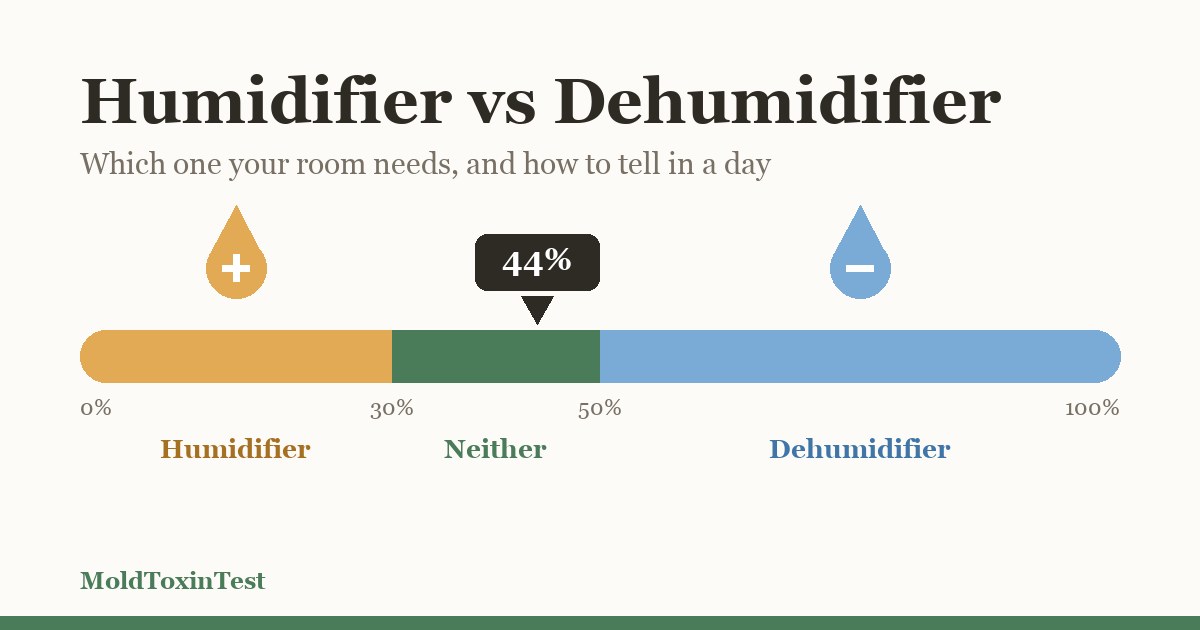
A humidifier adds water to the air and a dehumidifier removes it, so the choice comes down to one number. A room that reads below 30% relative humidity needs a humidifier. A room that reads above 50% needs a dehumidifier. Between 30 and 50% it needs neither, whatever the symptoms feel like.
A hygrometer on the shelf for two days gives you that number for a few dollars. For the humidifier side, the Honeywell HCM-350 evaporative unit is the one to buy for a bedroom. For the dehumidifier side, the dehumidifier for bedroom guide has the picks.
Published October 20, 202617 min readEvidence-based
The amount of water in the air inside a home decides how it feels to live in. It affects how well you sleep, whether the windows stream, and whether the wardrobe smells. The healthy band is narrow, and a house drifts out of it in both directions through the year.
Heating in winter dries indoor air to desert levels in cold climates. Summer, a basement, a bathroom without a fan, or a wet climate pushes it the other way. The two machines sold to fix this do exactly opposite jobs, and the signs that you need one overlap with the signs that you need the other.
You may have a stuffy nose, a cough that lingers, a child who wakes congested, or skin and lips that won’t stop cracking. You may have condensation on the glass every morning, or a musty smell you can’t place.
But do you need a humidifier or a dehumidifier, and how do you know before you’ve spent the money on the wrong one?
Note: Mold and mould are the same word, spelled two ways. This article uses the American spelling.
A one-gallon tank can raise a closed bedroom from 25% to 40% in an evening.
Dehumidifier
Removes water from the air
A 25-pint unit can pull a damp bedroom from 65% down to 45% in a few hours.
A humidifier puts water vapor into a room. It does this by blowing air through a wet wick, by shaking water into a fine mist with an ultrasonic plate, or by boiling it. A one-gallon tank can raise a closed bedroom from 25% to 40% in an evening and hold it there through the night.
A dehumidifier takes water vapor out. Almost all household units pull air over a refrigerated coil, where the moisture condenses the way it does on a cold drink. The water drips into a tank or out through a hose. A 25-pint unit can pull a damp bedroom from 65% down to 45% in a few hours, then cycle on and off to hold it.
The two machines fight each other if they share a room. They coexist well in one house. A dehumidifier in a wet basement and a humidifier in a dry upstairs bedroom in January is a normal setup, because the two rooms have different problems.
Neither machine cleans the air. Spores, dust and pollen are an air purifier’s job, and the air purifier for mold guide covers that choice.
The number that decides: measure before you buy
Relative humidity is the share of water the air holds compared with the most it could hold at that temperature. The EPA, Mayo Clinic and Energy Star all put the indoor target between 30 and 50%, and the reasons sit at the two ends.
What the reading tells you to buy
Under 30%
Humidifier
Dry nose, static, cracking wood
30–50%
Neither
The healthy band
Over 50%
Dehumidifier
Mites, condensation, mold
Above 60%, dust mites in bedding multiply and water starts to condense on any surface colder than the room, which is where mold begins. Below 30%, the lining of the nose and throat dries out, static builds, and wood furniture and floors shrink and crack. The 40 to 50% band keeps clear of both.
A hygrometer, the small digital gauge that reads temperature and humidity, is the only reliable way to know where a room sits. Two days of readings in the room that bothers you, morning and evening, show the pattern.
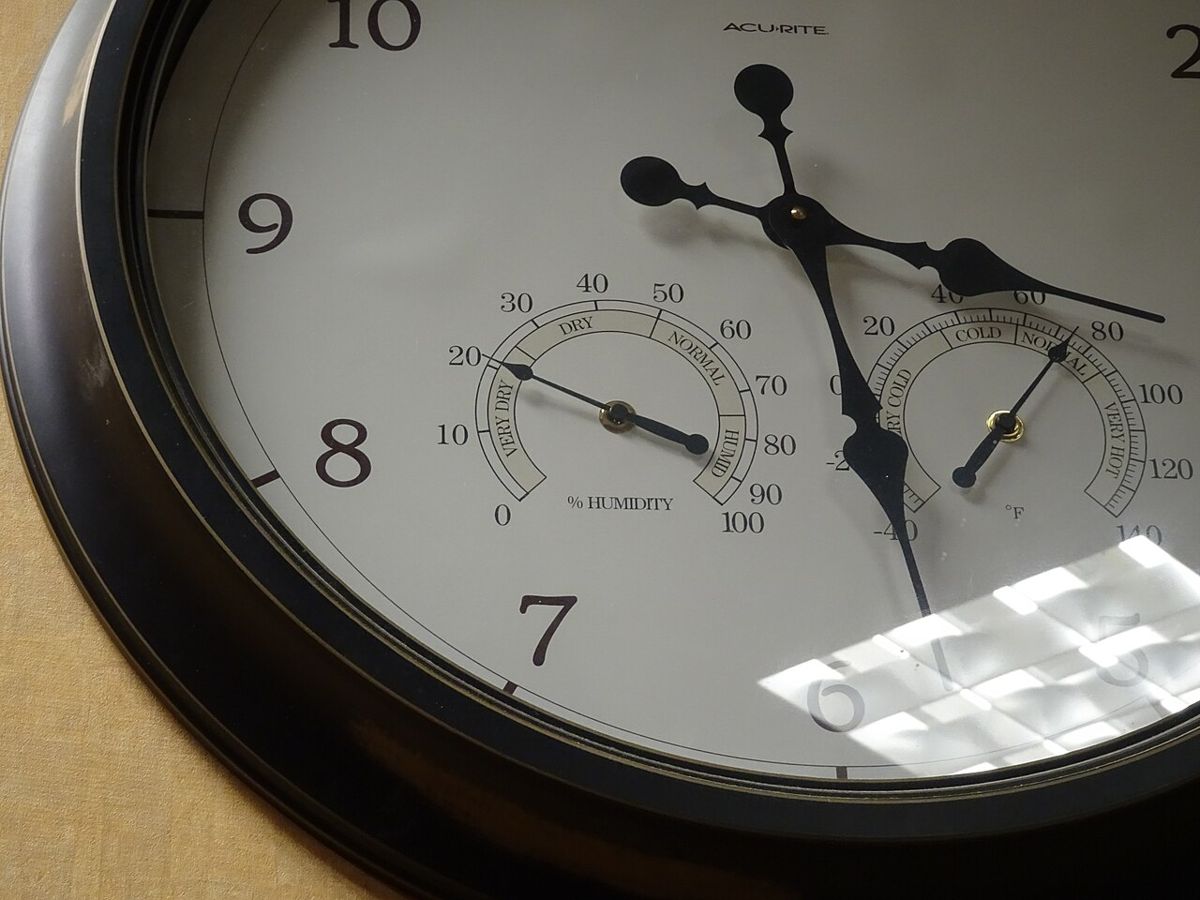
A hygrometer dial in a heated store in winter reads under 20%, well below the 30% floor where a humidifier starts to help. Photo by B137, Wikimedia Commons, CC BY-SA 4.0.
A bedroom that reads 28% at 7 a.m. with the heating on wants a humidifier. One that reads 62% wants a dehumidifier. One that reads 44% wants neither, and the symptom has another cause.
The gauge built into a humidifier or dehumidifier is a poor substitute for a separate one. In an April 2021 Piano World thread, an owner holding a room at 40% with both machines found his hygrometer reading 20 points low. The error had him running the humidifier for months in a room that was already near 50%. Three new gauges disagreed with the old one and agreed with each other.
Signs the air is too dry
Dry air shows in ways damp air doesn’t. Static shocks from door handles and a crackle when you pull off a sweater start around 40% and become daily below 30%. Lips crack, the inside of the nose feels raw, and dry heated air is the usual first suspect when a child gets winter nosebleeds.
The house shows it too. Hardwood floors open gaps between boards, doors that fit in summer rattle in their frames, and a piano or guitar goes out of tune faster. Houseplants brown at the leaf edges.
Dry air also has a health cost beyond comfort. A 2019 study from Akiko Iwasaki’s lab at Yale kept mice at 10 to 20% humidity or at 50%. The dry-air mice cleared influenza from their airways more slowly and fell more ill. The drying of the mucus layer that traps and moves particles out of the lungs was the mechanism. The study was in mice, so the authors framed it as a likely explanation for winter flu rather than proof.
Dry air comes from heating cold outdoor air. Air at 20°F outside, holding all the moisture it can, reads under 15% once it’s indoors and warmed to 70°F. Forced-air furnaces, wood stoves and electric heaters all produce the effect, and older houses that leak outdoor air feel it most.
If the hygrometer confirms the room sits below 30% through the heating season, a humidifier is the right machine. The section on humidifier types below covers which one.
Signs the air is too damp
Damp air shows on surfaces first. Condensation on the inside of windows in the morning is the common one. A line of black spots along the bottom of a window frame or in the corner of an outside wall means the same thing. So does a bathroom mirror that stays fogged for an hour. The air holds more water than the coldest surfaces can cope with.
Morning condensation on the inside of the glass is the most common sign a room holds more water than its coldest surfaces can take. Photo by Doggo19292, Wikimedia Commons, CC BY-SA 4.0.
A musty smell is the next sign, and it means growth has already started somewhere. Behind a wardrobe on an outside wall, under a carpet on a slab, on the underside of a mattress, inside a closet. The musty smell in house guide tracks it to the source.
Damp air feels clammy rather than warm, and bedding that doesn’t feel fully dry is a bedroom-specific sign. Clothes take a day longer to dry indoors. Salt clumps in the shaker, crackers go soft overnight, and doors swell and stick in summer.
Above 60%, dust mites in the mattress and pillows breed fast, and their droppings are the most common indoor allergen. A sealed mattress protector keeps them off you while the air dries out. Mold spores that land on a cool, damp wall can germinate within a day or two.
Damp air comes from people, since two sleepers add close to a liter of water to a bedroom overnight. It comes from cooking and showering without extraction, from drying laundry indoors, from a basement or crawl space wicking ground moisture, and from a humid climate in summer. If the hygrometer reads above 50% for most of the day, a dehumidifier is the right machine. Fixing the source alongside it keeps the unit from running flat out.
Symptoms that point both ways
A blocked nose, a dry cough, itchy eyes, a child who wakes congested, asthma that’s worse at home, and allergies that don’t let up appear on both lists. They’re on the "buy a humidifier" list and the "buy a dehumidifier" list, and both lists are right some of the time.
Dry air irritates the airway lining directly and makes a cold feel worse. Damp air feeds the mites and mold that trigger allergic rhinitis and asthma. Both produce congestion and coughing, so the symptom on its own can’t tell you which machine to buy.
A congested child, bedroom reads
25% in January
Needs: Humidifier
Moisture added eases a dry airway.
The same child, bedroom reads
60% in August, musty wardrobe
Needs: Dehumidifier
A humidifier here feeds the mites and mold.
The reading can. A congested child in a bedroom reading 25% in January needs moisture added. The same child in a bedroom reading 60% in August, with a musty wardrobe, needs it removed. Buying a humidifier for the second child makes the mites and mold worse, and the congestion with them.
For a baby’s room, pediatric advice leans toward a cool-mist humidifier in winter. Dry air makes a newborn’s narrow airways work harder, and a steam unit on a nursery floor is a scald risk. The same advice assumes a dry room. A nursery over a damp basement, or in a humid climate, is a dehumidifier room, with the unit well away from the crib.
Allergies deserve one more distinction. Pollen and pet dander are airborne particles, and neither machine removes them. Dust mites and mold are humidity problems, and a dehumidifier holding 45% starves both. If allergy symptoms are year-round and worst in bed, the reading and a look under the mattress tell you more than the symptom does.
Winter and summer: why the answer flips
The same house can need a humidifier in January and a dehumidifier in July. Cold air holds little water, so the heating season dries a house out. Warm air holds a lot, so summer and a wet climate load it up.
In winter the 50% ceiling drops. That figure assumes the walls and windows are warm. When it’s 20°F outside, the inside face of a window or a poorly insulated wall can be cold enough that air at 40% condenses on it. At 0°F, 30% is enough to frost single glazing and wet the corners of exterior walls.
Frost on the inside of a window frame in a Minnesota winter: indoor air humid enough to feel comfortable can still freeze on glass this cold. Photo by Tony Webster, Wikimedia Commons, CC BY-SA 2.0.
A workable rule for a house kept around 70°F: no higher than 40% when it’s 20 to 40°F outside. At 10 to 20°F, 30 to 35% is the limit, and in a hard freeze, 25%. Condensation on the glass in the morning means the humidifier is set too high for the weather, whatever the hygrometer reads in the middle of the room.
Highest safe indoor humidity in winter, house at 70°F
Outside 20 to 40°F40%
Outside 10 to 20°F30–35%
Outside around 0°F25%
In a December 2013 thread on the Bob Is The Oil Guy forum, a New Hampshire homeowner asked about buying a humidifier for his son’s winter nosebleeds. Every window in the house was already streaming and the skylight frames had rotted. The replies split by climate.
One Illinois member keeps 30% all winter because anything higher wets his windows. A Virginia member runs two dehumidifiers to hold 35%, in a house that came with a furnace humidifier he has not switched on. A New England member’s single-room humidifier uses a gallon and a half a night to hold 40 to 45%, in a house that otherwise sits under 15%. Every one of them told him to measure before buying.
Summer. In summer, air conditioning removes water as it cools. A house with the AC running most of the day can read 35 to 40% in July and feel dry, and that room needs neither machine. A humidifier there fights the AC and raises the bill. Rooms the AC doesn’t reach, a basement, a closed spare room, a bathroom, are where the dehumidifier belongs.
The dew point calculator shows, for your room temperature and humidity, the surface temperature at which condensation starts. It’s the quickest way to see whether a winter setting is safe for your windows.
Which humidifier type: evaporative, ultrasonic or warm mist
Once the reading says humidifier, the type decides how much work it makes and what it puts into the air besides water.
Evaporative
Power:
20–40 W
Dust:
None, minerals stay in the wick
Care:
Wick every 1–3 months, rinse the tank
Best for:
A bedroom on tap water
Ultrasonic
Power:
20–40 W
Dust:
White dust on tap water
Care:
Empty daily, clean every three days
Best for:
Anyone using distilled water
Warm mist (steam)
Power:
250–400 W
Dust:
Scale on the element
Care:
Weekly vinegar soak
Best for:
A sick-room week, adults only
Evaporative. A fan draws air through a wet wick and the air carries off water vapor, the way a wet towel dries. Minerals in tap water stay in the wick, so there’s no white dust. Output falls as the room approaches saturation, so it’s hard to over-humidify a closed room.
The costs are fan noise, a wick that needs replacing every one to three months, and a tank to rinse. For a bedroom on tap water this is the type to buy.
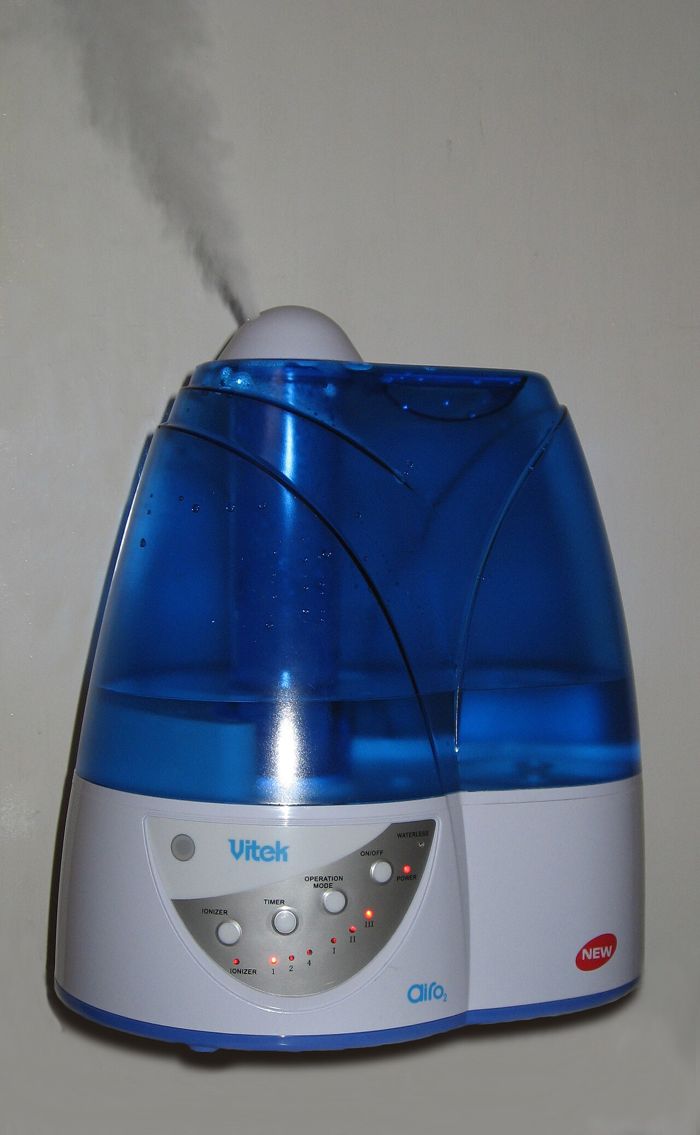
Ultrasonic. A vibrating plate shatters water into a visible cool mist with almost no noise and very little power. Everything in the water goes into the air with it. Calcium and magnesium from tap water settle as white dust on dark furniture and electronics, and anything growing in an uncleaned tank goes airborne too.
An ultrasonic humidifier turns water into visible mist, and whatever is dissolved in the tank water travels into the room with it. Photo by MaxSem, Wikimedia Commons, public domain.
Distilled water solves the dust. Daily emptying and a clean every three days, which is Mayo Clinic’s advice for cool-mist units, keeps the tank from becoming the problem. Many ultrasonic units have a humidistat and an auto mode, which evaporative units often lack.
Warm mist (steam). A heating element boils water and releases cooled steam. Boiling kills most of what grows in a tank, there’s no wick to buy, and the output is high, which suits a sick-room for a week.
The element draws 250 to 400 watts against 20 to 40 for the other two types. The unit is hot to the touch and a tipped tank is a scald risk, so it stays off nursery floors and out of reach of toddlers.
Which dehumidifier
A compressor dehumidifier suits any room above about 60°F, and sizing for one bedroom or living room is 20 to 30 pints a day under the current standard. A cold basement or an unheated room below 60°F suits a desiccant unit, which keeps working where a compressor’s coil frosts.
The dehumidifier for bedroom guide covers noise in real decibels, placement away from the bed, overnight drainage, and six picks sized for one room. The dehumidifier for mold guide covers basements, crawl spaces, pumps and larger units. The dehumidifier size calculator gives the pint rating for your room and how damp it is.
Running cost and heat go with the choice. A 25-pint compressor unit draws around 300 watts while extracting and nothing while cycled off at target. It returns the air a degree or two warmer than it took it in.
Running both in one home, and what each costs to run
Owning both is normal in a climate with cold winters and humid summers, or in a house with a damp basement and dry bedrooms. One room gets one machine, and each is set to a target rather than a speed. The hygrometer moves between rooms, since the machines’ own readings can’t be trusted.
A humidifier and a dehumidifier in the same room cancel each other out and double the electricity. If a room swings from dry to damp through the day, the cause is usually a moisture source rather than the weather: a shower, a dryer vent, cooking. A bathroom or kitchen fan fixes that for less than either machine.
Power draw while running
Evaporative or ultrasonic humidifier20–40 W
Warm-mist humidifierabout 300 W
25-pint compressor dehumidifier, while extractingabout 300 W
Running costs, at typical US electricity prices, favor the humidifier side. An evaporative or ultrasonic unit draws 20 to 40 watts, so a night’s running costs a few cents. A warm-mist unit at 300 watts costs about as much per hour as a compressor dehumidifier. A dehumidifier pulling a damp room down runs hard for the first day and then cycles.
A week of holding 45% in a bedroom costs a dollar or two.
Water is the other running cost. A humidifier in a dry climate goes through a gallon or more a night, which means a daily refill. A dehumidifier’s tank fills in six to ten hours in a damp room, which means a drain hose for overnight use.
The humidifiers we’d buy, and the hygrometer that decides
The humidifier side needs an evaporative unit for a bedroom on tap water and a quieter evaporative unit with a humidistat. It also needs an ultrasonic for people who’ll use distilled water and want an app, and a warm-mist unit for a sick-room week. The four below fill those roles. Ratings are from the live Amazon listings in October 2026.
We haven’t tested these in a lab. The notes draw on the manufacturer’s specifications, independent reviews where they exist, and the pattern in buyer reports.
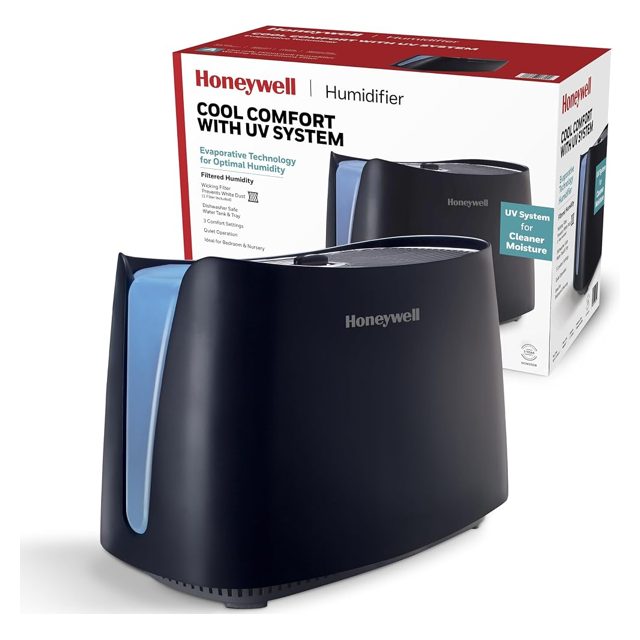
1. Honeywell HCM-350 evaporative
Best for a bedroom
Type
Evaporative
Tank
1.1 gal
Humidistat
No
Rating
4.4 (3,700+)
The HCM-350 has been a reviewer favorite among evaporative humidifiers for most of a decade. A 1.1-gallon tank feeds a wick, a quiet fan on the low setting does the rest, and there’s no white dust whatever comes out of your tap. The tank and tray are dishwasher-safe, which is the difference between a humidifier that gets cleaned and one that doesn’t.
It has no humidistat, so it runs until the tank is empty or you switch it off. In a closed bedroom that’s a feature: evaporative output falls as the room approaches the wick’s limit, so it won’t push a room to 60%. Wicks are a recurring cost, around every two months in hard-water areas.
Owners describe it as quiet on low, easy to fill and clean, and dull to look at. Rated 4.4 stars from more than 3,700 buyers.
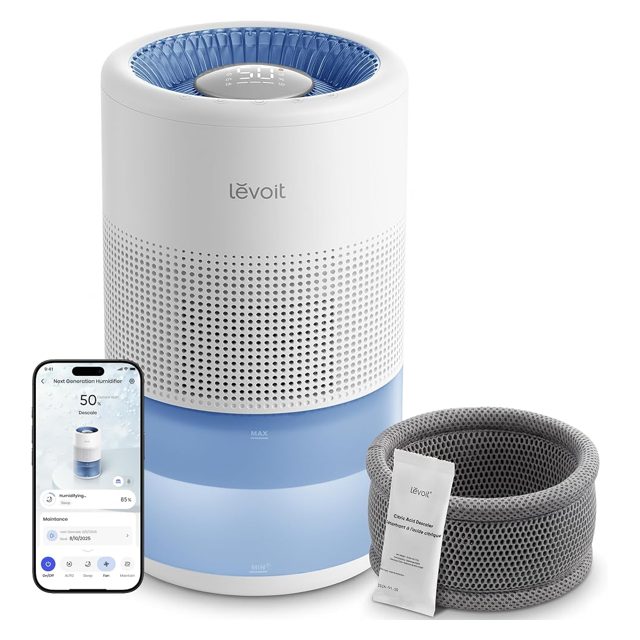
Levoit’s Superior Studio is an evaporative unit with the controls ultrasonic owners are used to. It has a humidistat, an auto mode that holds a set target, an app, and a self-clean cycle. The 4.5-liter tank runs a night and a day, the filter frame and tray go in the dishwasher, and the maker claims 19 dB on the lowest setting.
It’s a new listing with a small review base, so the long-term picture isn’t in yet. The reason to choose it over the Honeywell is the auto mode, which stops the unit at 45% instead of running the tank dry. Rated 4.4 stars from around 300 buyers.
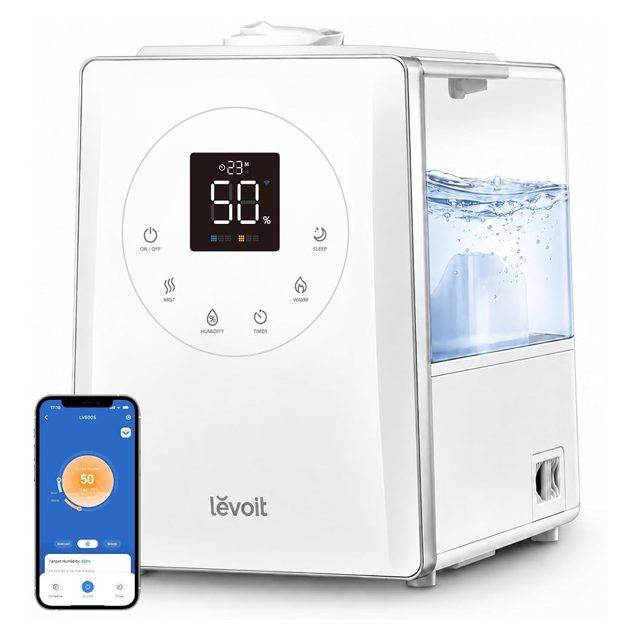
The LV600S is the ultrasonic for a large bedroom or an open-plan floor. It has a 6-liter top-fill tank, warm or cool mist, a humidistat with auto mode, and app control. It’s near silent and raises a big room faster than any evaporative unit here.
On tap water it leaves white dust on dark surfaces within a week; on distilled water it doesn’t. The tank wants emptying daily and a clean every few days. For someone who’ll do that, it’s the most capable unit on the page. Rated 4.4 stars from more than 45,000 buyers.
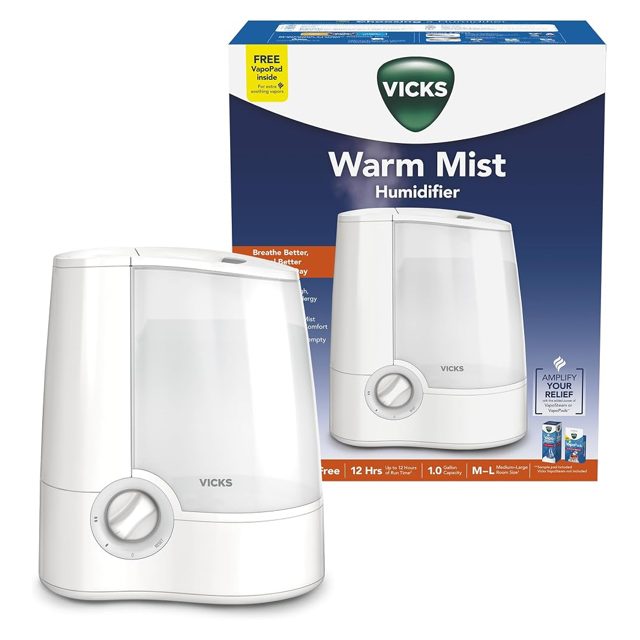
The Vicks warm mist is the sick-room unit. It has a one-gallon tank, no wick or filter, boiled output, a medicine cup for vapor rub, and auto shut-off when the tank empties. For a week of a bad cold in a dry bedroom it does the job for very little money.
It draws around 300 watts and runs hot, and a tipped tank is a burn risk. It belongs on a dresser in an adult’s room rather than a nursery floor. Mineral scale builds on the element and needs a vinegar soak weekly. Rated 4.3 stars from more than 27,000 buyers.
TempPro TP50, the hygrometer that settles the question
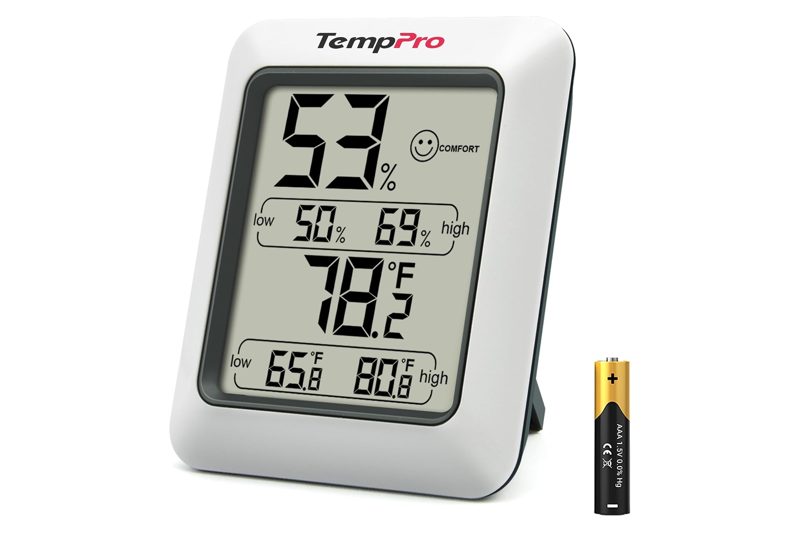
The TempPro TP50 reads temperature and humidity on a large display with a dry, comfortable or wet indicator. Two days with it in the room that bothers you tells you which machine to buy, or that you need neither. Rated 4.6 stars from more than 150,000 buyers.
As an Amazon Associate we earn from qualifying purchases, at no extra cost to you.
When neither machine fixes it
A room that holds 40 to 50% on the hygrometer and still feels wrong has a problem the air’s water content doesn’t explain.
Condensation that keeps returning on one window or one wall corner, in a room that reads 40%, means that surface is cold rather than the room wet. Better glazing, a radiator under the window, or furniture pulled off the wall fixes it. A dehumidifier running in a room that’s already dry doesn’t.
A musty smell in a room that now reads 45% means growth that started when the room was damper is still there. Drying the air stops it spreading and doesn’t remove it. Behind the headboard, under the carpet and the underside of the mattress are the usual places. Mold on a mattress is the one that affects sleep most directly, and the mold detector tells from a photo whether a mark is growth or a stain.
The humidifier vs dehumidifier question has a clean answer once you have a reading. When the reading is fine and the symptoms aren’t, the next step is finding what else the room is holding.
The screening runs in your browser and takes about fifteen minutes from calibration to result.
A hygrometer answers it in two days. Below 30% relative humidity, a humidifier. Above 50%, a dehumidifier. Between the two, neither, and the symptom has another cause. The EPA puts the indoor target below 60% and ideally between 30 and 50%.
Humidifier or dehumidifier for allergies?
Usually a dehumidifier. Dust mites and mold, the two year-round indoor allergens, both need humidity above about 50 to 60% to thrive, and a dehumidifier holding 45% starves them. A humidifier helps only when the air is below 30% and the irritation is from dryness rather than an allergen. Pollen and pet dander are an air purifier’s job.
Humidifier or dehumidifier for sinus problems or a cough?
The reading decides, because both dry and damp air cause congestion. In a room under 30%, a cool-mist humidifier eases a dry, irritated airway, and Mayo Clinic notes cool mist helps a stuffy nose during a cold. In a room over 50%, a dehumidifier removes the mites and mold that keep sinuses inflamed.
Humidifier or dehumidifier for a baby’s room?
In a dry winter room, a cool-mist humidifier, kept clean and set so the room stays under 50%. A steam unit on the floor is a scald risk. In a damp room, a humid climate, or over a basement, a dehumidifier placed away from the crib. A hygrometer in the nursery decides.
Humidifier or dehumidifier in winter?
A humidifier in most heated homes, since heating cold air drops indoor humidity below 30%. The ceiling is lower than 50% in cold weather: condensation on the windows means the setting is too high for the outdoor temperature. Homes with a wet basement or poor ventilation can still need a dehumidifier in winter.
Humidifier or dehumidifier in summer?
A dehumidifier where the air is damp, which is most places without air conditioning and any basement. Rooms with AC running are already being dried and often need neither.
Can you use a humidifier and dehumidifier at the same time?
In different rooms, yes, and it’s common: a basement dehumidifier and a bedroom humidifier in winter. In the same room, no. They cancel each other and double the cost.
What humidity should a house be?
30 to 50%, with 40 to 50% the comfortable middle in mild weather and 30 to 40% in freezing weather to protect windows and walls. The ASHRAE Handbook describes 40 to 60% as the range that minimizes biological contaminants, widened down to 30% for cold climates where higher levels cause condensation.
Why does my humidifier make the windows wet?
Because the glass is colder than the dew point of the room air. In cold weather, the safe indoor humidity drops with the outdoor temperature. Around 40% is the limit at 20 to 40°F outside, 30 to 35% at 10 to 20°F, and 25% near 0°F. Lowering the humidistat until the morning condensation stops is the fix.
What is the white dust from my humidifier?
Calcium and magnesium from tap water, aerosolized by an ultrasonic humidifier and settling as a fine powder. Distilled or demineralized water stops it. Evaporative humidifiers trap the minerals in the wick and don’t produce it.
Air purifier vs humidifier vs dehumidifier: what’s the difference?
A humidifier adds water to the air and a dehumidifier removes it. An air purifier removes particles such as dust, pollen, smoke and mold spores while leaving the humidity alone. A damp, musty room needs the dehumidifier first and a purifier second. A dry room needs a humidifier. A room with pollen or pet allergies needs the purifier.
Are combination humidifier-dehumidifier units any good?
The portable "2-in-1" units sold under that name are usually a small thermoelectric dehumidifier with a mist function bolted on, and they do neither job at room scale. A separate dehumidifier and humidifier, each sized for the room, cost little more and work.