Best Mattress Protector: These are Waterproof and without the Sweat
Quick answer
The SafeRest is the best mattress protector for most beds: a cotton terry face over a thin membrane, quiet, and guaranteed for ten years if washed warm and dried low. Hot sleepers do better with the PlushDeluxe bamboo viscose or the Bedgear Dri-Tec, which pair a thin TPU membrane with a wicking face.
Dust mites and bed bugs need a six-sided zippered encasement such as the SureGuard, because they live inside the mattress where a fitted protector leaves the underside open.
Published October 21, 202616 min readEvidence-based
A mattress can be the most expensive thing in most bedrooms and the hardest to clean. Sweat, skin, spills and the occasional accident go into it from the first night, and a mattress warranty is usually void the moment a stain appears.
A good protector disappears under the sheet. The bad ones crinkle when you turn over, hold heat against your back, and leak after their third wash.
You may have bought one before, found it clammy and pulled it off after a week. Or an allergist told you to cover the mattress, and the shops offered a wall of "hypoallergenic" labels that mean nothing in particular.
But which mattress protector keeps water out without turning the bed into a sauna, and when is a protector not enough? And which one, most importantly, helps you avoid mold?
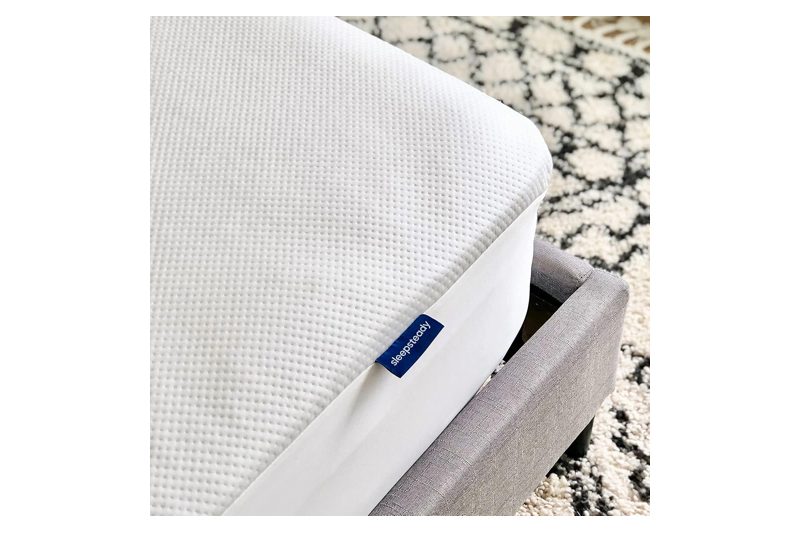
A mattress protector is a thin fitted layer between the sheet and the mattress. A waterproof one has a membrane inside it that stops liquid reaching the mattress. A non-waterproof one is a washable fabric barrier against skin flakes, dust and sweat vapor, and nothing more.
The protector keeps the mattress clean, which keeps it dry, which is what stops the smell, the yellowing and the growth that an unprotected mattress collects over years. A protector also keeps a warranty valid. Mattress warranties exclude stained mattresses, and a sweat mark counts.
Protector
Changes the feel as little as possible. Keeps liquid and dirt out.
Mattress pad
A thin quilted layer for softness. May or may not be waterproof.
Topper
Changes the feel of the bed by an inch or three.
A protector is not a mattress pad or a topper. A pad adds a thin quilted layer for softness and may or may not be waterproof. A topper changes the feel of the bed by an inch or three. A protector changes the feel as little as possible.
It also can’t fix a mattress that’s already wrong. A sagging mattress sags through a protector. A moldy one keeps growing under it. Mold on a mattress is a separate problem with its own page.
Why waterproof protectors sleep hot, and which ones don’t
A waterproof membrane blocks liquid water, and it blocks most water vapor too. Sweat that would have passed through the sheet into the mattress now stops at the membrane. It sits in the fabric under you instead of evaporating from a larger area. That’s the clammy feeling, and it’s physics rather than a defect.
How hot a given protector feels comes down to two things: the membrane and the face fabric.
Membranes compared: heat and noise
Vinyl or PVC
Thick, blocks vapor completely. Hospital and old-fashioned protectors.
Heat
Noise
Polyurethane (PU) laminate
Thinner, breathes a little.
Heat
Noise
Thermoplastic polyurethane (TPU)
Thinnest and most flexible, lets more vapor through.
Heat
Noise
Relative ranking from the construction of each membrane, not a lab measurement.
Vinyl and PVC membranes are the worst. They’re thick, they block vapor completely, and they’re what hospital and old-fashioned protectors are made from.
Polyurethane (PU) laminate is thinner and breathes a little. Thermoplastic polyurethane (TPU) is thinner again, more flexible, and lets more vapor through while staying waterproof. A protector that names TPU on the label is usually the cooler of two otherwise similar products.
The face fabric decides what the sweat does before it reaches the membrane. Cotton terry absorbs it and spreads it so it can evaporate sideways. Bamboo viscose and Tencel lyocell wick it faster and feel cool to the touch. A thin polyester knit does little, and a polyester knit over a PU membrane is the combination that gives waterproof protectors their reputation.
Cotton terry
Absorbs sweat and spreads it so it can evaporate sideways.
Bamboo viscose or Tencel lyocell
Wicks faster than cotton and feels cool to the touch.
Thin polyester knit
Does little. Over a PU membrane it gives waterproof protectors their hot reputation.
"Cooling" on a protector label describes the surface yarn. A phase-change or cool-touch finish feels cold for the first minute in bed, which is pleasant and is also where its effect ends. The membrane under it behaves the same as any other. For a hot sleeper, a thin TPU membrane under an absorbent natural-fiber face does more than any cooling finish.
For a very hot sleeper who doesn’t need waterproofing, a non-waterproof cotton or Tencel protector solves the heat entirely, at the cost of the spill protection. The six-sided cotton encasement on the non-toxic mattress page is that option.
The crinkle: where the noise comes from
The plastic-bag rustle some protectors make when you turn over comes from a stiff membrane bonded to a thin face. Vinyl crinkles most, PU less, TPU least, and a thick terry or quilted face muffles whatever is left.
Noise is hard to judge from a listing, since every protector is described as noiseless. The reliable signs are a TPU membrane named in the materials and a face fabric with some weight to it: terry, bamboo viscose, a quilted top. Buyer reviews that mention turning over, rather than the first impression, are the other one.
Fitted mattress protector or zippered encasement
A fitted protector covers the top and the sides, with an elastic skirt that tucks under the mattress like a fitted sheet. A zippered encasement wraps all six sides and closes with a zipper. The problem you’re solving decides which you need.
Fitted protector
Top and sides, elastic skirt underneath
Solves
Spills and sweat
Bedwetting and pets
Incontinence
On and off in a minute, which counts when it needs washing twice a week.
Zippered encasement
All six sides, closed with a zipper
Solves
Dust mites inside the mattress
Bed bugs, during and after treatment
A dorm or rental mattress
Harder to fit, warmer if waterproof on every side, and a two-person job on a king.
Spills, sweat, bedwetting, pets and incontinence come from above, so a fitted waterproof protector handles them. It goes on and off in a minute, a real advantage when it needs washing twice a week.
Dust mites and bed bugs live inside the mattress, so a fitted protector leaves them a way out through the open underside. An encasement seals them in.
For bed bugs, an encasement is standard advice during and after treatment. It traps the bugs inside the mattress, where they die, and makes new ones easy to see on the white surface. The zipper is the weak point: a good encasement has a tiny-toothed zipper with a fabric flap or a seal at the closure.
Encasements are harder to fit, warmer if they’re waterproof on all six sides, and a two-person job on a king. Many people run both: a waterproof encasement that stays on for years and a fitted protector on top that comes off for washing.
For a mattress on a solid platform or the floor, an encasement with a waterproof underside also traps the moisture that condenses under a mattress overnight. Slats or a breathable underlay solve that better than any cover.
Protectors and allergies: what the evidence says
The case for covering a mattress against dust mites rests on fabric pore size. Mite droppings, the allergen, are around 10 to 40 microns across. A 1999 study in the Journal of Allergy and Clinical Immunology tested bedding fabrics. Pores under 10 microns blocked mite allergen, and pores of 6 microns or less also blocked the smaller cat allergen. Waterproof membranes have no pores at all, so any waterproof protector blocks allergen through its top surface.
10–40 µm
Size of mite droppings, the allergen
Under 10 µm
Pore size that blocks mite allergen
6 µm or less
Also blocks the smaller cat allergen
Covering the mattress lowers the allergen you lie on. Whether that improves asthma is a different question, and the answer from trials is disappointing. A 2008 Cochrane review pooled 54 randomized trials of dust mite control measures, including 26 that tested mattress covers. It found no effect on asthma symptoms, peak flow or medication use.
Allergy bodies still recommend encasements as one part of allergen avoidance, and they help some people with rhinitis noticeably. They aren’t a treatment on their own.
The practical rule: a dust mite encasement with a pore size under 10 microns, or any waterproof encasement, covers the mattress. Pillows need the same treatment, since a pillow is closer to your face for longer. Bedding washed hot every week or two removes the skin flakes mites feed on. Keeping bedroom humidity under 50% does more than all of it, because mites can’t survive dry air, and a dehumidifier for the bedroom holds that line overnight.
The allergies comparison page separates dust mite allergy from mold allergy, which produce similar symptoms and need different fixes.
Fit, depth and the beds that need something different
Pocket depth is the measurement that goes wrong most often. A protector’s skirt needs to reach under the mattress by a few inches, so the pocket depth has to exceed the mattress height plus any topper. A 12-inch mattress with a 3-inch topper needs a 15-inch pocket at least, and most of the picks below stretch to 18.
Working out pocket depth
Mattress 12″+Topper 2″+Tuck under 3″=Pocket 17″
A protector that’s too shallow rides up overnight and bunches under the sheet. One that’s far too deep hangs loose and shifts. Elastic all the way round the skirt, rather than at the corners only, holds better on both counts.
Memory foam and latex mattresses take any protector, and a thin one preserves the contouring feel. A thick quilted pad on top of memory foam changes how it feels, which some people want and some bought the mattress to avoid.
Adjustable bases bend the mattress, so the protector needs stretch in the skirt and a deep pocket. An encasement works better than a fitted protector there because it moves with the mattress.
Crib mattresses take a crib-size waterproof protector, fitted tightly with nothing loose on the sleeping surface. Bunk beds and dorm beds are twin or twin XL. A dorm mattress is the one place a six-sided encasement is the first purchase rather than the second, since its history is unknown.
Washing a protector without killing it
A waterproof protector fails in the wash, not on the bed. The membrane is a thin plastic film laminated to fabric, and heat separates the two. Once that happens the protector leaks and crinkles, and nothing brings it back.
Warm or cold water
Normal cycle, ordinary detergent
Dry on low or on a line
Bleach
Fabric softener
A hot dryer
Washing warm or cold, on a normal cycle, with ordinary detergent, is safe for every protector here. Bleach and fabric softener attack the membrane and go in the no column. Drying on low, or on a line, keeps the film flat; a hot dryer is the single most common reason a protector that was waterproof stops being waterproof.
Every one to two months is a reasonable washing rhythm for a protector under a sheet, more often for allergy sufferers, and immediately after any accident. A protector that has been wet through goes back on only after a wash and a full dry. A damp protector on a mattress grows mold on its underside within days.
Held up to a window after a wash, a healthy membrane shows no cracks or pinholes. Light coming through a crazed, white-lined film means the protector has finished its job. Cheap protectors last a year or two of regular washing. Guaranteed ones, like the SafeRest and SureGuard below with ten-year guarantees, last longer when kept out of the hot dryer.
How we chose
Each protector here is waterproof, names its membrane and face fabric, comes in a full size range, and washes in a household machine. We looked for a TPU or thin PU membrane, an absorbent or wicking face, and elastic round the whole skirt. The fitted ones needed a pocket depth of 18 inches.
We haven’t poured water on these in a lab. The notes draw on the manufacturers’ material specifications and on independent testing roundups where they cover the same construction. A read-through of buyer reviews supplied the pattern on heat, noise and durability. Ratings and review counts are from the live Amazon listings in October 2026.
The organic cotton options, Naturepedic and Avocado, and the cotton-only National Allergy encasement are reviewed on the non-toxic mattress page and aren’t repeated here. Saatva, Bear, Helix, Purple and Coop sell their protectors through their own sites rather than Amazon, so they aren’t linked.
The 6 best mattress protectors
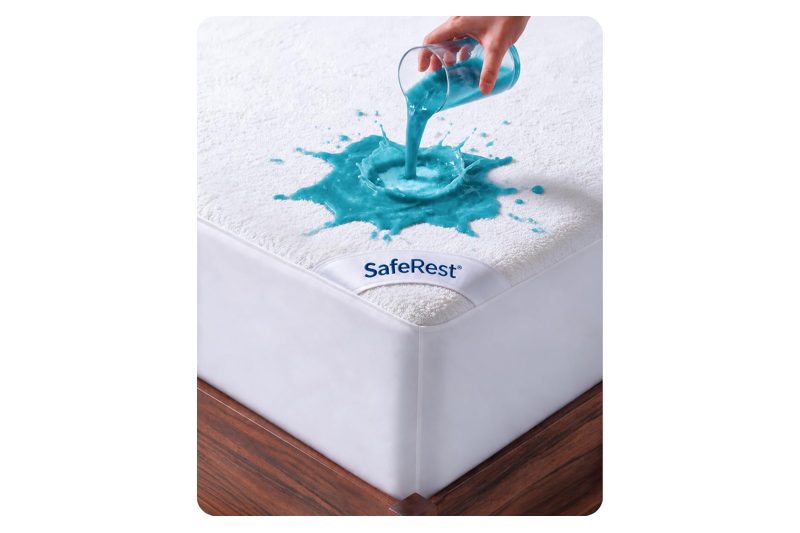
1. SafeRest waterproof mattress protector
Best overall
Face
Cotton terry
Membrane
Thin PU
Pocket
Up to 18″
Rating
4.6 (280,000+)
SafeRest’s protector is the reference point for the category. A cotton terry face sits over a thin polyurethane membrane, the skirt is elastic all the way round, and the pocket stretches to 18 inches. It’s quiet, it absorbs rather than pools, and it runs cooler than its construction suggests because the terry spreads sweat for evaporation.
Buyer reviews on the listing follow a pattern. One May 2026 reviewer who had avoided waterproof protectors for heat and crinkle reported neither after a month. Others describe pet accidents and worse soaked up with nothing reaching the mattress, with the note that it takes longer to dry than a sheet. Several buyers have the same one on every bed in the house.
It comes with a ten-year guarantee, conditional on washing warm and drying low. Rated 4.6 stars from more than 280,000 buyers.
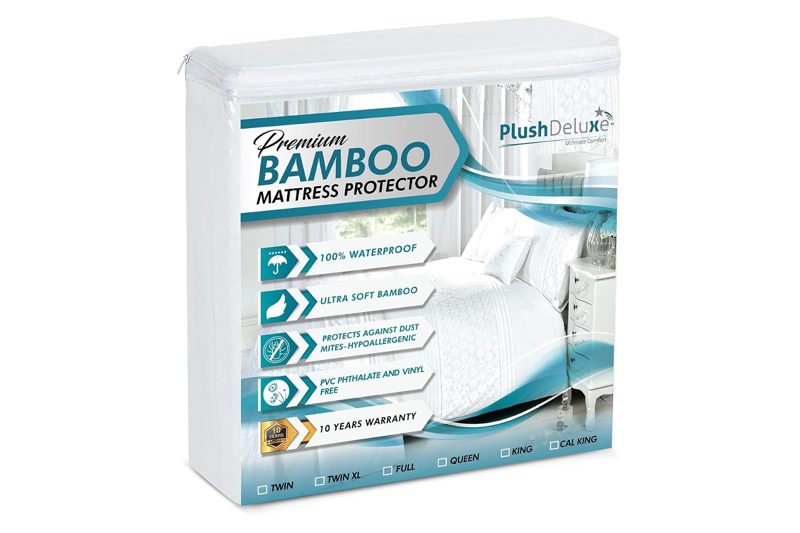
The PlushDeluxe swaps terry for a bamboo-derived viscose face over a thin TPU membrane. Viscose wicks faster than cotton and feels cooler to the touch, so this is the protector for someone who found a terry one warm. The pocket stretches to 18 inches and the skirt is elastic all round.
Viscose pills over time and this one is no exception; buyers who wash it inside a pillowcase or on gentle report it lasting longer. It’s as quiet as the SafeRest and a little thinner. Rated 4.6 stars from more than 43,000 buyers.
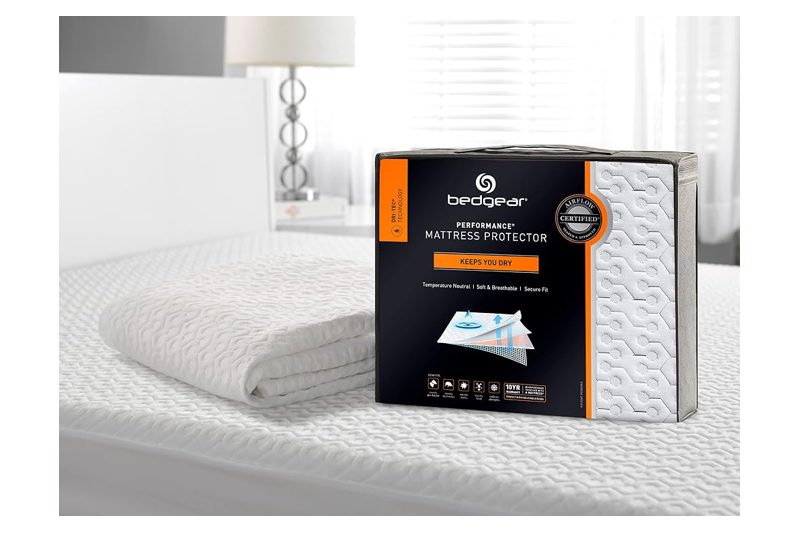
Bedgear makes performance bedding, and the Dri-Tec is its waterproof protector. A moisture-wicking knit face moves sweat away from the body and spreads it for evaporation, over a waterproof layer. It’s the pick for a hot sleeper who wants waterproofing and is prepared to pay more than the two above.
The pocket fits up to 18 inches and the stretch suits an adjustable base. The review base is small, a few hundred buyers, so the long-term durability picture isn’t in yet. Rated 4.6 stars from more than 400 buyers.
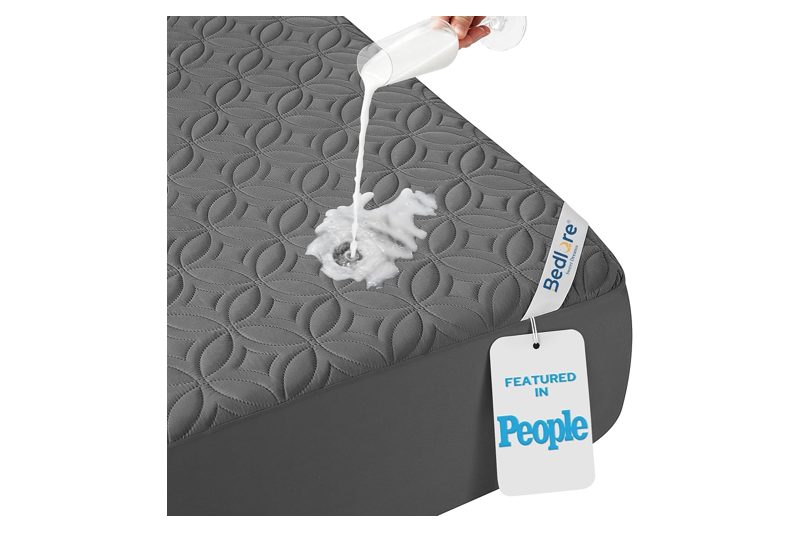
The BEDLORE is a waterproof protector with a quilted top, for anyone who wants a little softness over a firm mattress along with the spill protection. The fill sits between the face and a TPU membrane, which also makes it the quietest construction here, since the quilting muffles the film.
Quilted protectors are warmer than thin ones and the fill can shift after many washes. The pocket fits 6 to 18 inches. Rated 4.6 stars from more than 28,000 buyers.
Tencel lyocell, spun from eucalyptus pulp, is the coolest-feeling natural face fabric sold on protectors, and it wicks moisture faster than cotton. This Tencel protector pairs it with a waterproof membrane and an 18-inch pocket. It’s the one for someone who wants the feel of the direct-to-consumer Tencel protectors at an Amazon price.
Tencel can pill, and the brand is smaller than the others here, so the review base is in the low thousands. Rated 4.5 stars from more than 1,300 buyers.
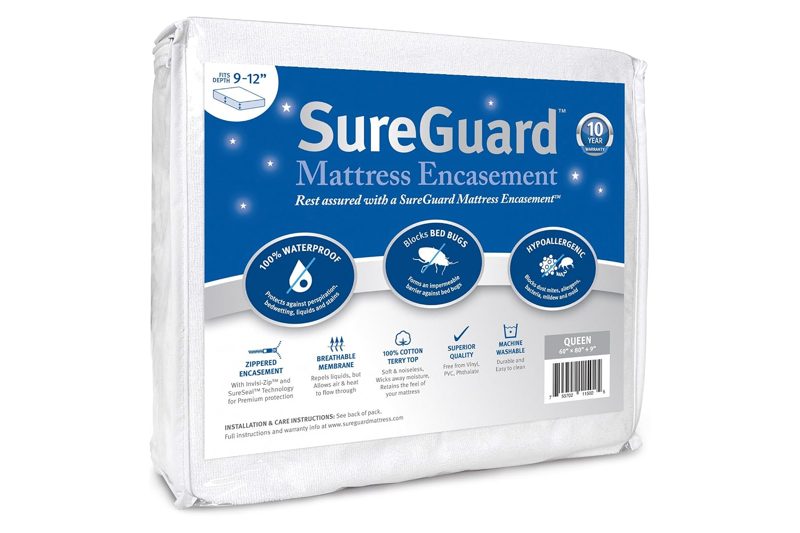
The SureGuard encasement wraps all six sides of the mattress and is waterproof on every face. It closes with a fine-toothed zipper and a seal at the end that bed bugs can’t pass. The top is cotton terry, the same quiet, absorbent surface as a fitted protector, so it doesn’t feel like sleeping on a bag.
It’s sold by mattress depth, with 9 to 12 inches the common size and deeper versions listed separately, so measuring comes first. It’s a two-person job to fit on a queen or king.
Owners commonly run a fitted protector over it for easy washing and leave the encasement on for years. Ten-year guarantee. Rated 4.6 stars from more than 16,000 buyers.
As an Amazon Associate we earn from qualifying purchases, at no extra cost to you.
Which protector for which sleeper
A new mattress you want to keep the warranty on. The SafeRest. Quiet, cool enough, and it survives years of washing on a warm cycle.
A hot sleeper. The PlushDeluxe bamboo viscose for value, the Bedgear Dri-Tec for a step up. A thin TPU membrane and a wicking face beat any cooling finish.
Children, pets or incontinence. The SafeRest or the PlushDeluxe, and two of them, so one is on the bed while the other dries. A waterproof encasement underneath catches what a protector misses at the edges.
Dust mite allergy. Any of the waterproof protectors blocks allergen from the top; the SureGuard encasement blocks it from all six sides. Pillow encasements, hot bedding washes and bedroom humidity under 50% do the rest.
Bed bugs. The SureGuard encasement, fitted and left on for a year or more, with a fitted protector over it.
Someone who wants a softer bed. The BEDLORE quilted protector, accepting a little more warmth.
An organic or chemical-free bedroom. The Naturepedic and Avocado protectors and the National Allergy cotton encasement on the non-toxic mattress page.
A dorm or a rental mattress. The SureGuard encasement first, a fitted protector second.
Protectors and mattress mold
Mattress mold usually starts in one of two places, and a protector helps with only one of them.
From above
A protector stops it
Sweat and spills soak into foam, which holds water for days.
From below
Slats or an underlay stop it
Moisture condenses where a warm mattress meets a cold, solid base.
From above, sweat and spills soak into foam, which holds water for days. A waterproof protector stops that entirely, and it’s the single most useful thing a protector does for the life of a mattress. A damp protector is its own risk. One that’s been wet through and put back on, or left unwashed on a mattress in a humid room, grows mold on its underside. The smell appears before the spots do.
From below, moisture condenses where a warm mattress meets a cold, solid base, and no protector on the top surface changes that. Slats, a ventilated underlay, or a mattress lifted off the floor fix the underside. A six-sided waterproof encasement on a solid base can make it worse by holding that condensation against the mattress.
Bedroom humidity ties the two together. Above 60%, a mattress on any base stays damp enough to grow mold, and a hygrometer on the nightstand is the way to know. The mold on mattress guide covers finding it, cleaning it and deciding when a mattress has to go.
The best mattress protector is the one that stays on the bed, which means one you don’t notice. A quiet waterproof one on top, an encasement underneath if mites or bugs are the issue, and a warm wash with a cool dry will outlast the mattress.
The screening runs in your browser and takes about fifteen minutes from calibration to result.
For any mattress you’d rather not replace early, yes. It keeps sweat, skin and spills out of the foam and keeps the warranty valid, since most exclude stained mattresses. It washes in an hour when the mattress can’t be washed at all.
Does a waterproof mattress protector make you sweat?
It can. The membrane blocks water vapor, so sweat stays in the fabric under you instead of passing into the mattress. A thin TPU membrane under cotton terry, bamboo viscose or Tencel keeps that to a minimum. A vinyl or thick PU membrane under polyester is what produces the clammy feeling.
What is the best mattress protector for hot sleepers?
A thin TPU membrane with a wicking natural-fiber face. The PlushDeluxe bamboo viscose and the Bedgear Dri-Tec are the two here built that way. Cooling finishes change the first minute in bed; the membrane and face fabric change the night.
What is the difference between a mattress protector and a mattress pad?
A protector is a thin barrier that changes the feel of the bed as little as possible. A pad adds a quilted layer for softness and may not be waterproof. The BEDLORE above is a protector with a pad’s quilted top.
Mattress protector or encasement for dust mites?
An encasement, because mites live inside the mattress and a fitted protector leaves the underside open. Any waterproof protector still blocks allergen through the top surface, and the 1999 JACI study found fabric pores under 10 microns block mite allergen too.
Do mattress protectors help with allergies?
They lower the allergen on the mattress surface, which helps some people with rhinitis. A 2008 Cochrane review of 54 trials found mite-control measures, covers included, didn’t improve asthma outcomes on their own. Encasements, pillow covers, hot bedding washes and humidity under 50% together do more than any one alone.
How do I wash a waterproof mattress protector?
Warm or cold water, normal cycle, ordinary detergent, no bleach or fabric softener. Dry on low or on a line. Heat delaminates the membrane, and a hot dryer is the usual reason a protector starts leaking.
How often should I wash a mattress protector?
Every one to two months under a sheet, every two to four weeks for allergy sufferers, and straight away after any accident. It goes back on fully dry.
How long does a mattress protector last?
One to two years for a cheap one washed often, five to ten for a guaranteed one kept out of the hot dryer. Cracks or pinholes visible against a window mean it’s done.
Does a mattress protector stop bed bugs?
A fitted protector doesn’t. A six-sided encasement with a sealed zipper traps bugs already in the mattress, where they die, and keeps new ones on the outside where they’re visible.
Can a mattress protector cause mold?
A protector left damp can grow mold on its underside, and a fully waterproof encasement on a solid base can hold condensation against the mattress. Washing and drying the protector fully, and giving the underside of the mattress airflow, prevents both.
What pocket depth do I need?
Mattress height plus topper height plus three inches. A 12-inch mattress with a 2-inch topper needs 17 inches, and an 18-inch stretch pocket covers almost every bed sold.