Ultimate Basement Mold Treatment Guide: 3 Things to Know
Toxic mold can be anywhere from roof to bathroom to kitchen and bedroom. But somehow basement becomes most common area for a fungal growth due to less exposure to sun and air movement. And this can lead to serious mold toxin exposure and other problems.
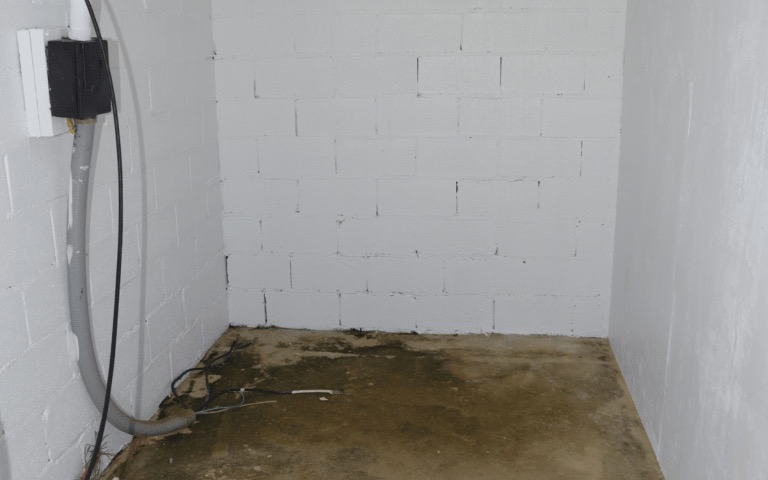
Water staining along the joint between a block wall and the slab, the place basement growth starts. Photo by the Federal Bureau of Investigation, Wikimedia Commons, public domain.
Basement mold comes from condensation more often than leaks. It often peaks in summer, and the humidity number that stops it returning.
And here is an important part: Basement mold rarely stays in the basement. Warm air rises through a house and leaves through the upper floors, and the air replacing it gets pulled up from the lowest level. So the spores and the musty gases from a damp cellar end up in the rooms where you sleep.
Such mold growth often peaks in July rather than January, which catches people out. Warm outside air holds a great deal of moisture. Below-grade walls sit at around 60°F all year because the earth around them does. Warm humid air touches that cold concrete, cools past its dew point, and drops its water onto the wall. At 72°F and 50% humidity, any surface below 52°F starts collecting condensation, and basement walls spend the whole summer below that line.
You would probably open a window to air it out. In summer, that is what feeds it. The fix runs the other way: close the basement up, pull the moisture out of the air mechanically, and hold the room under 50% humidity.
Basement mold comes from condensation more often than leaks.
Such mold growth often peaks in July rather than January, which catches people out.
Close the basement up, pull the moisture out of the air mechanically, and hold the room under 50% humidity.
Note: Mold and mould are the same word, spelled two ways. This article uses the American spelling.
Why basements grow mold when the rest of the house does not
A basement breaks three of the rules that keep the rest of a house dry.
The walls stay cold. Soil temperature at basement depth holds near 55 to 60°F through the year, and the foundation wall sits at whatever the soil around it does. Every other wall in the house warms up with the room. That one never quite does.
The air moves slowly. Rooms above ground get air changes from doors opening, windows cracking, extractor fans running and people walking about. A basement can go weeks without any of that, so moisture that arrives has nowhere to go.
Concrete holds water. Block and poured concrete are both porous and wick moisture from the soil by capillary action. Poured concrete looks solid and is not, and untreated block is worse.
Put those together and you get a room that is cold, still, and permanently supplied with moisture from the ground. Growth follows without any leak at all.
Where basement moisture comes from
Basement mold problems are often not the direct result of the room itself. We need to understand this a little deeper.
Condensation is the most common and the least suspected. It needs no leak, no crack and no plumbing fault. Humid indoor air simply meets a surface colder than its dew point and gives up its water. You will find it on the lower half of walls, on cold water pipes, on the underside of ductwork, and on the concrete floor under anything stored flat against it.
Capillary rise through the slab and walls pulls groundwater up through the concrete itself. The tell is a damp patch that never quite dries and often carries a white mineral crust, since the water leaves minerals behind as it evaporates.
Surface water from outside arrives when ground slopes toward the house, gutters overflow, or downspouts discharge next to the foundation instead of several feet away. It shows up after rain and dries between storms.
Plumbing and appliance leaks produce the familiar concentrated patch, often with a brown tidemark. Water heaters, washing machines and the condensate line from the furnace or air handler are the usual suspects down there.

Telling condensation from a leak decides everything that follows. The same diffuse-versus-concentrated pattern in bathroom mold also applies upstairs or a downstairs basement. Growth spread thinly across a whole wall, worst at the bottom, points at humidity. Growth concentrated in one area with a stain around it points at water arriving from somewhere.
And often this problem looks like the white powder on the basement walls.
White powder on the wall: efflorescence or mold
Something white and powdery on a basement wall is usually not mold. Efflorescence is mineral salt left behind when water moves through concrete and evaporates off the surface, and it looks close enough to white mold to worry anyone.
Efflorescence dissolves when you spray it with water, while mold does not. Efflorescence also feels gritty and crushes to powder between your fingers, where mold smears.
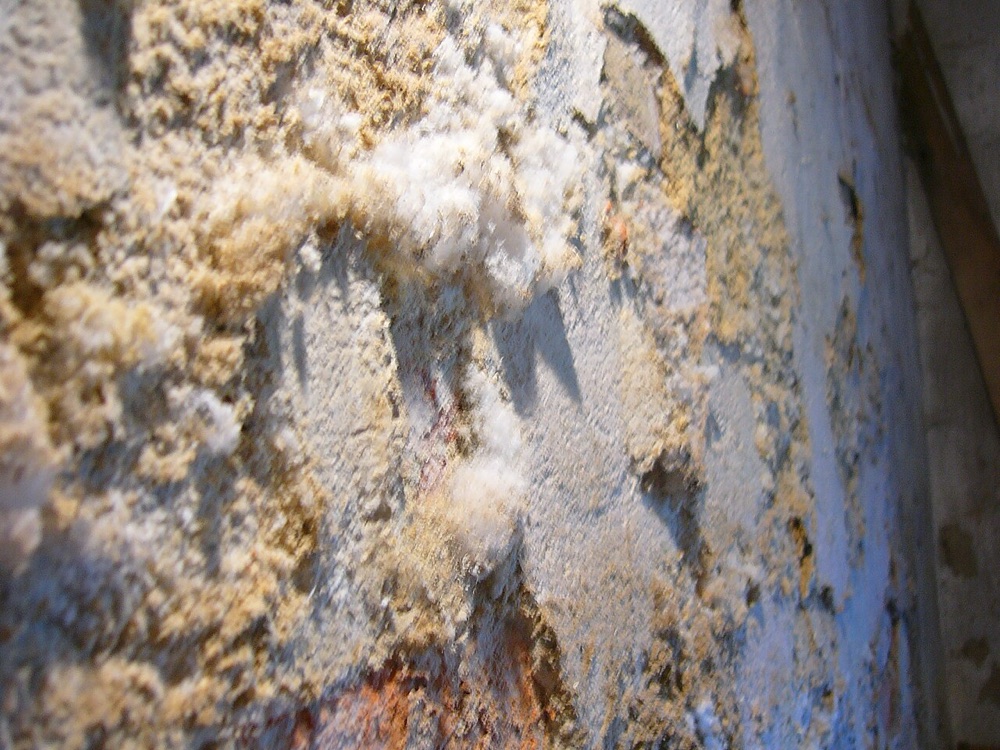
If you are not sure if it is mold or efflorescence here is another clue: efflorescence sits only on masonry, so white growth on wood, cardboard or fabric might not be it. But if you are seeing something getting into the pours of the wood or material or it seems sticky and returning it is a mold.
Efflorescence is harmless in itself and still tells you something important, because it proves water is moving through that wall. However, where you find it, you have found your moisture route. This is really a time to pay attention. Our guide to white mold covers the growth it gets confused with.
What is growing down there
Basement growth tends toward a predictable set of species, and the surface gives you a decent guess.
| Species | Where it turns up | What it looks like |
|---|---|---|
| Cladosporium and Penicillium | Concrete block, painted masonry, cold lower sections of walls | Dark green to black speckling. Both are common allergens, and neither needs standing water to establish. |
| Aspergillus penicillioides | Stored cardboard, books, leather, clothing | Grows at humidity as low as 70% with no liquid water present, which suits a basement precisely. |
| Stachybotrys chartarum | Paper-faced drywall, cardboard boxes, wet wood framing | Appears where something cellulose has been wet for a week or more. It does not grow on bare concrete. |
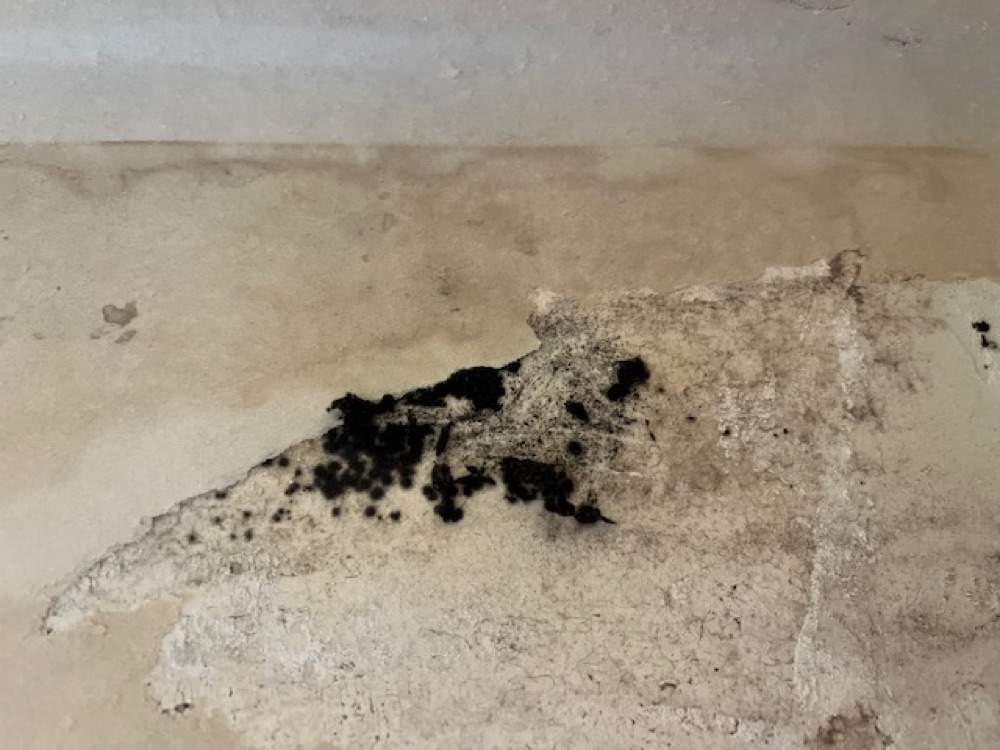
Species matters less for the cleaning than for what it tells you about how long the water has been there. Our mold identification guide covers the five that matter most for health and how dust testing detects them.
Removing mold from basement walls and floors
Most mold in a basement sits on bare masonry, which is the easiest surface in the house to clean. Nothing roots into concrete the way it roots into drywall.
- 01Sealing the room comes first. Close the door to the stairs and tape plastic over any HVAC returns down there. A box fan in a window blowing outward sends air out of the building rather than up the stairs. Wear an N95, non-vented goggles and gloves before you start.
- 02Mist the growth with plain water so the spores stay put instead of going airborne. A HEPA vacuum over the area afterwards lifts what is loose, and a household vacuum without a true HEPA filter will blow spores straight back into the room.
- 03For the cleaning itself, 3% hydrogen peroxide left for 10 to 15 minutes handles most basement growth on concrete and block. Undiluted white vinegar works too, given a full hour of contact. Scrub with a stiff brush, since biofilm on masonry needs physical action rather than chemistry alone.
- 04Wipe everything away with disposable cloths and bag them in the room. Dead mold still triggers allergies, so leaving the residue on the wall leaves the problem.
- 05Borax, at one cup per gallon of warm water applied and left without rinsing, is the one finish that keeps working afterwards. It raises the surface pH and discourages regrowth, which suits a room that will stay damp-prone whatever you do.
As we explained in the natural black mold removal this sets out the concentrations and the mixtures that are dangerous to combine.
Experiencing Mold Exposure? Take 15-mins screening testFinished basements: what cleans and what comes out
A finished basement is where this gets expensive, because the materials people finish basements with are the materials mold likes best.
Drywall with growth on it comes out rather than gets cleaned. The paper facing is cellulose and the hyphae go through it, so surface cleaning removes what you can see and leaves the colony. Cut 12 to 18 inches past the visible edge. When you replace it, paperless board such as DensArmor removes the food source entirely, which is the right specification below grade.
Carpet and underlay over a concrete slab hold slab condensation against an organic backing. Anything that has been wet more than 48 hours generally goes. Here you can understand it in more detail: mold in carpet guide.
Ceramic tile or luxury vinyl plank on sealed concrete is the better long-term answer of basement mold in most cases. Since this stuff remains in the basement for a long term it slowly picks up different fungal development over time. Same applies to wood panelling and studwork.
Understand that wood panelling and studwork can often be saved if you scrub with a stiff brush, treat, and check with a moisture meter that the framing reads below 16% before closing anything back up.
Unfortunately, stored cardboard might get destroyed in the basement much earlier than other products. Boxes in a basement act as both food and sponge, and moving to plastic bins with lids removes a whole category of problem.
Getting the humidity down
A dehumidifier is the tool for this, and sizing matters more than brand. A unit too small runs constantly and never reaches the setpoint, and a basement generally needs more capacity than its square footage suggests because of the cold surfaces. Our dehumidifier size calculator works out the pint capacity for the room, and the dehumidifier buying guide covers nine units tested in the conditions mold actually needs.
Running it to a drain saves emptying it. A unit with a full bucket has stopped working, and buckets fill fast in summer.
You can use dew point calculator to get the temperature at which your current air will condense. Compare that with how cold the walls feel and you will see the problem in numbers rather than guesswork.
Air movement helps the dehumidifier reach the whole room. A cheap oscillating fan running low, pointed along the wall rather than at it, is enough.
The plastic sheeting problem
Plastic vapor barrier taped straight onto a concrete basement wall is common advice and it causes the thing it is supposed to prevent.
Concrete below grade is often releasing some moisture inward. It is best to seal a sheet of polythene against it and that moisture has nowhere to go, so it condenses on the back of the plastic and sits against the wall. Pull back the poly in a basement finished that way and the black growth behind it is routine.
Framing a stud wall tight against bare block runs into the same trouble with fibreglass batts and a poly vapour retarder on the warm side. The wood ends up in a permanently damp cavity with no drying path in either direction.
If you are finishing a basement, rigid foam fixed directly to the masonry is the approach that works. Being air-impermeable, it keeps the wall surface above the dew point rather than trapping moisture behind a membrane. Smart vapour retarders that let the assembly dry inward are the other option. Bare poly against concrete is the one to avoid.
Keeping basement mold from coming back
One of mold's most challenging issues is that it returns if we do not treat moisture properly. Keeping mold in a basement from returning is moisture work.
Here are some important things to pay attention to:
- ·Keep the windows closed during summer. Outdoor air in July carries more water than your basement air does, and every hour the window is open dumps that moisture onto cold walls. Ventilation helps a basement in cold dry weather and harms it in warm humid weather.
- ·Downspouts do more good discharging further out. Discharging within a foot of the foundation soaks the soil against the wall, and extending them six feet costs very little.
- ·Ground should fall away from the house, roughly six inches over the first ten feet. Soil that has settled into a dip against the wall sends every storm into the foundation.
- ·Also look for pipe positions. Cold water pipes and any ductwork running through the space benefit from insulation. Both sweat all summer and drip onto whatever sits below them.
- ·Stored items do better up on shelving or pallets, a few inches clear of external walls so air can move behind them.
- ·If a sump pump is fitted, test it before the wet season and fit a lid. An open sump pit evaporates water into the room continuously.
Regrowth inside a month means moisture is still arriving, and no further cleaning helps until that changes. A HERTSMI-2 dust panel at around $150 to $200 gives you a measurement rather than an impression.
When to call someone for mold treatment
As we covered in our black mold remediation guide, growth over about 10 square feet, or anything that has reached the framing, sits beyond a weekend job. We encourage you to read it to understand how you can treat it by yourself or if you require a professional help as otherwise this article will become too long. There we have covered everything including mold remediation cost and so on.
Also, standing water, a failed sump or anything following a sewage backup needs a professional regardless of how much growth is visible.
Persistent efflorescence, bowing walls or visible cracks are structural signals rather than cleaning problems, and they want a waterproofing contractor before any remediation happens.
Symptoms that ease when someone leaves the house and return when they come back point at the building rather than at the wall. The symptoms linked to mold exposure cluster in recognisable ways, and our free VCS test screens for the visual contrast deficit associated with biotoxin exposure in about fifteen minutes.
The screening runs in your browser and takes about fifteen minutes from calibration to result.
Start the test nowFAQs on basement mold treatment
Is mold in a basement dangerous?
It depends on how much there is, how long you have been exposed and who you are. Spores are allergens, and species like Stachybotrys produce mycotoxins. Basement growth matters more than its location suggests, because air moves upward through a house and carries the spores into the rooms above.
Why does my basement smell musty with no visible mold?
The smell comes from gases a colony gives off while feeding, and they travel further than the growth does. Common hiding places are behind stored boxes, under carpet, inside stud cavities and behind any plastic sheeting on the walls.
Should I open basement windows to reduce mold?
Warm outdoor air holds far more moisture than cool basement air, and it condenses the moment it touches a cold wall. Opening up helps in cold dry weather and makes things worse in warm humid weather. A dehumidifier with the windows shut is the reliable version. See if the moisture outside and calculate it properly because it might work in opposite direction.
What humidity should a basement be?
Between 30 and 50%. Above 60% sustained, growth becomes possible with no leak at all. A hygrometer costs a few dollars and settles the question.
Does a dehumidifier get rid of basement mold?
It stops new growth by holding the air below the level mold needs, and it will not clean what has already established. Clean the existing growth first, then run the dehumidifier to keep it from returning.
Is the white stuff on my basement wall mold?
Usually efflorescence, which is mineral salt left behind by water passing through concrete. It dissolves when sprayed with water and crushes to gritty powder, where mold smears and does neither. It is harmless in itself, though it proves water is moving through that wall. So pay attention to it and treat it as soon as possible.
Can I put plastic on basement walls to stop mold?
Polythene taped against bare concrete traps the moisture the wall releases inward, and mold grows on the back of it. Rigid foam fixed directly to the masonry keeps the surface above the dew point instead, which is the approach that works below grade.
How much does basement mold removal cost?
According to most users, DIY supplies for bare masonry run $50 to $150 in most of the United States. However, it varies based on your country and location if you are from somewhere else. Professional remediation generally starts around $500 and runs to several thousand where drywall, framing or flooring come out. Waterproofing work to fix the source sits separately and usually costs more than the mold work.
Can basement mold affect the rest of the house?
Yes. Warm air rises and escapes through the upper floors, drawing replacement air up from the lowest level of the building. Spores and microbial gases travel with it, which is why a damp basement often produces symptoms in bedrooms two floors up.
Will basement mold go away on its own?
No. Drying the room stops growth spreading, and the existing colony stays where it is along with the allergens it produces. It needs physically cleaning off, followed by moisture control so it has nothing to restart on.
Have a look at the tracking a musty smell guide if the smell is there with nothing visible.