Mold on Bathroom Ceiling: Ultimate Guide to Identify and Fix
Bathroom ceiling mold is the most common indoor mold problem in any modern home. The ceiling is the coldest surface in the room, warm shower air rises straight into it, and the moisture condenses there before it settles anywhere else. Here is everything you need to know about identifying what is growing, removing it safely, and stopping it from returning.
Most people scrub the fungus off and watch it come back within weeks, because cleaning removes the growth without touching the moisture that produced it. Until the amount of water reaching the ceiling changes, a moldy bathroom ceiling regrows on the same schedule it always did.
Note: Mold and mould are the same thing, spelled differently on either side of the Atlantic, so mould on a bathroom ceiling and mold on a bathroom ceiling describe the same problem. This article uses the American spelling throughout.
Why mold grows on a bathroom ceiling
Every hot shower releases several litres of water into the air as vapour. That warm, saturated air rises, meets the ceiling, and cools. Air holds less moisture as it cools, so the excess condenses onto the surface as liquid water, and the ceiling stays damp long after the mirror has cleared.
The ceiling is the coldest surface in the room for structural reasons. Above it sits either an unheated loft, a roof void, or an uninsulated cavity, so it loses heat faster than the walls. The coldest points of all are the perimeter where the ceiling meets an outside wall, and any spot where insulation above is thin or missing, which is why mold on a bathroom ceiling so often appears in corners and along edges before it reaches the middle.
Emulsion paint, plasterboard, wallpaper paste, and the film of soap residue and skin cells that settles on any bathroom surface all feed fungal growth. Warmth, moisture, and food together mean a colony can establish in a few days on a ceiling that never fully dries between showers.
Condensation or a leak? What creates the moldy surface
Two entirely different problems produce mold on a bathroom ceiling.
Spreads diffusely across the ceiling, often heaviest in corners and along the edges. Worse in winter when surfaces run coldest and windows stay shut. The fix is ventilation, heating, and insulation.
Concentrated growth in one defined area, usually with a yellow or brown ring or a water stain at its centre. Persists year round and often worsens after rainfall. No amount of cleaning touches it until the leak is repaired.
Look at the shape of what you have. Scattered speckling across a wide area, worse in the corners and above the shower, points at condensation. A single dark patch with a stained halo, particularly one that appears after heavy rain or sits directly below a bathroom on an upper floor, points at a leak from a roof, a pipe, or the bathroom above.
Timing and texture settle any remaining doubt. Condensation growth follows a seasonal rhythm, appearing or worsening in winter. Leak growth persists year round regardless of season. Pressing the affected area also tells you a great deal: plasterboard that feels soft, spongy, or sagging has been wet for a long time from a genuine leak rather than a nightly dew.
If damp has been present long enough to smell before it was visible, our guide to tracking down a musty smell works through finding growth in the places a leak reaches first.
Is it black mold on the ceiling, or something else?
Black mold on a ceiling triggers more alarm than any other household growth, and in a bathroom that alarm is usually misplaced.
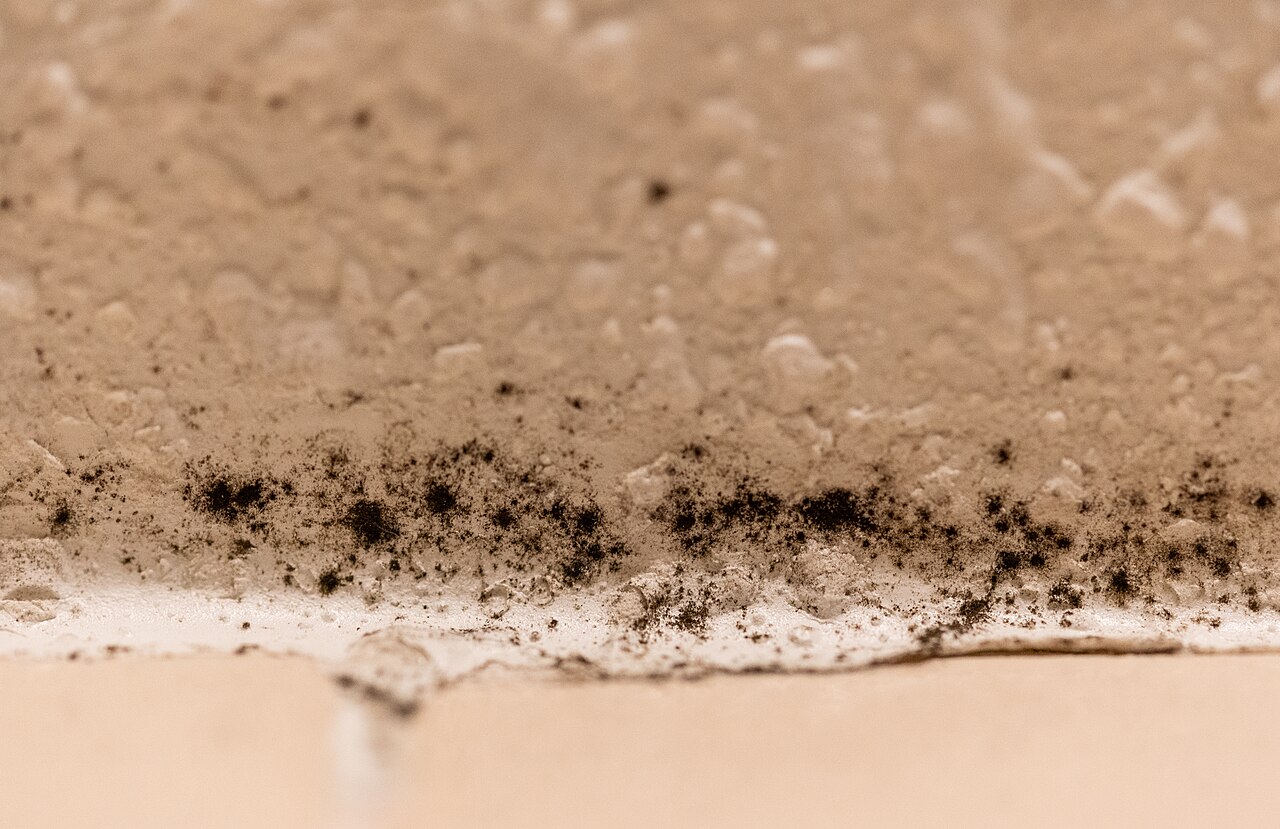
Most dark growth on a bathroom ceiling is Cladosporium, the most common indoor mold in the world. It ranges from olive to a green-black that reads as black at a glance, it tolerates the intermittent damp of a bathroom rather than needing saturation, and it grows readily on painted surfaces. It is a genuine allergen, so it deserves removal, but it is not the notorious species people fear.
Stachybotrys chartarum, the species meant by toxic black mold, needs material to stay properly wet for days or weeks and prefers cellulose such as the paper facing of plasterboard. Condensation from showers rarely delivers that. Where Stachybotrys does appear on a ceiling, it is almost always alongside a long-running leak, which loops back to the diagnosis above. It looks slimy or wet rather than powdery, and it usually sits on plasterboard that has already softened.
Other regulars include Aspergillus niger, which shows a white base with black spore heads, and Alternaria, a dark green to brown allergen common around showers and windows. Pink or orange slimy growth is more often Aureobasidium or Serratia bacteria than mold at all.
A photo of the patch in the free mold detector weighs these groups against soot, water staining and the other lookalikes common on bathroom ceilings.
Note that we also have mildew on a bathroom ceiling. What people call mildew is shallow, surface-stage growth that has not penetrated the paint, which wipes away cleanly, while growth that has rooted into the plasterboard beneath smears, stains, and returns. Our guide to black mold versus mildew covers the wipe test that separates them, and what each spot in the bathroom is telling you works through the shower, the grout, and the caulk alongside the ceiling.
Is mold on a bathroom ceiling dangerous?
For most healthy adults, a modest patch of surface growth on a bathroom ceiling is an allergen rather than a serious hazard. The typical effects are congestion, sneezing, irritated eyes, throat irritation, and coughing, and they tend to worsen with time spent in the room.
Risk of exposure rises with three things: the size of the affected area, whether growth has penetrated into the plasterboard rather than sitting on the paint, and who is breathing it. Children, older adults, anyone with asthma or an existing respiratory condition, and anyone immunocompromised react at lower exposures and with worse outcomes. A bathroom used daily by an asthmatic child deserves faster action than the same patch in a guest bathroom used twice a year.
Symptoms that ease when you spend a few days away from the house and return within a day of coming back point at the property rather than a passing illness. Comparing what you are experiencing against the symptoms associated with mold toxicity is a sensible next step if that pattern sounds familiar.
If you have been around mold and you have symptoms without an obvious cause, the Visual Contrast Sensitivity test is a free, at-home way to check for one measurable sign of biotoxin exposure. It takes under 15 minutes and needs no equipment beyond your screen. Screening tools are not a diagnosis, and anything concerning is worth raising with a qualified healthcare provider.
How to remove mold from a bathroom ceiling
Ceiling work is harder and messier than cleaning a wall, because gravity puts the cleaning solution and everything you dislodge directly onto your face and forearms. Protective equipment matters more here than anywhere else in the house.
We have covered the general method in our guide to removing mold from walls, and the mold removal resources collect the rest by surface. Let us understand the ceiling procedure specifically here.
Open the window and run the fan throughout the job so airborne spores leave the room rather than settling elsewhere.
An N95 respirator, safety goggles rather than glasses, nitrile gloves, and long sleeves. A paper dust mask does not filter spores and offers nothing here. Goggles matter specifically because solution drips downward while you work overhead.
Lay plastic sheeting or old towels over the floor, the bath, and any surface underneath the working area to catch drips and debris.
Emulsion paint on a bathroom ceiling can lift when wet. Treat a discreet corner and wait ten minutes before committing to the whole area.
Spray or sponge it on rather than scrubbing dry growth, since dry scrubbing throws spores into the air. Leave it in contact with the surface for at least an hour, because dwell time is what kills the colony rather than smearing it.
Use a cloth or soft sponge on a pole and work in one direction, removing residue rather than grinding it into the paint. Aggressive scrubbing damages emulsion and drives spores deeper.
Wipe with clean water, then dry the ceiling with a towel or leave the fan running for an hour, because leftover moisture restarts the growth you just removed.
Seal cloths, sheeting, and used sponges in a bag before carrying them through the house.
The best mold remover for a bathroom ceiling
There are many options right now in the market including the natural and artificial ones. Tea tree, white vinegar and baking soda are commonly used in the house. However, the right choice depends on whether the ceiling is painted, and painted plasterboard is what most bathroom ceilings are.
The strongest all-round option for a painted ceiling. It kills a broad range of household mold species, penetrates slightly into porous paint rather than sitting on top, and does not bleach the surface. Spray it undiluted, leave it a full hour, then wipe.
Hydrogen peroxide at 3 percent works well as an alternative, with mild bleaching action that helps on stubborn staining. Test it first on coloured paint.
Detergent and warm water handles light surface growth and is often enough for a fresh patch caught early. The EPA's position on household mold cleanup is that detergent and water plus thorough drying is adequate for most small areas.
Chlorine bleach is an option, and the weakest one here. Bleach leaves its active ingredient on the surface while its water content soaks into the paint and plasterboard, which can feed the growth underneath and produce a clean-looking ceiling that darkens again in weeks. It also releases fumes in a small enclosed room where you are working directly beneath it, and it must never be mixed with any other cleaner. Our guide to natural methods for removing black mold grades the household options against the evidence.
For a branded product, our comparison of seven black mold removal sprays shows which ones permit painted surfaces and which are limited to tile.
Tea tree oil at a 2 percent dilution is an effective antifungal for spot treatment, though it is expensive for a whole ceiling and unsafe in homes with cats. The full guide to tea tree oil for mold covers the mix, the dwell time, and the pet risk in detail.
When the ceiling needs replacing instead of cleaning
Cleaning works when growth sits on the paint. It stops working once the plasterboard beneath has been colonised, and three signs tell you that line has been crossed.
Plasterboard that feels soft, spongy, or crumbly under light pressure has been saturated long enough to lose structural integrity, and no surface treatment restores it.
Growth that returns within two or three weeks of a thorough clean, with the moisture source addressed, indicates the colony is living inside the material rather than on it.
Visible sagging or bulging, or a ceiling that has begun to bow, means water has been sitting above it, and that is a repair job rather than a cleaning one.
The size of the patch carries the same weight, since the EPA suggests professional help for mold covering more than roughly 10 square feet, and a ceiling reaching that size usually indicates a leak rather than condensation. Our black mold remediation guide covers containment and material removal when a job reaches that point.
How to stop mold coming back on the bathroom ceiling
Removal without prevention buys a few weeks. Everything below targets the condensation that put the growth there.
The fan should be sized to change the room's air at least eight times per hour, and it needs to run during the shower and for a further 20 to 30 minutes afterwards. Most people switch it off with the light, which is precisely when it is needed most. A simple timer switch or humidity-sensing fan solves this permanently.
Closing it during the shower stops moisture spreading to bedrooms, and opening it afterwards helps the room dry once the fan has done its work.
Condensation forms because the ceiling is cold. Heating the bathroom before and during a shower raises the surface temperature above the dew point, and in many homes this alone stops the problem.
Where the ceiling sits below a cold loft, adding or topping up insulation raises its surface temperature and removes the cold spot that growth was exploiting.
Clearing water off tiles and glass and wiping down surfaces after a shower removes the moisture before it can evaporate into the room and land on the ceiling.
Keeping indoor relative humidity between 30 and 50 percent is the threshold at which mold struggles to establish, and a cheap hygrometer tells you where you actually are instead of guessing.
It prevents new growth taking hold on a clean surface and does nothing to a colony already present underneath.
Two free tools on this site do the arithmetic behind these steps: the dew point calculator shows the humidity your ceiling temperature can tolerate before it condenses, and the dehumidifier size calculator sizes a unit for the room when ventilation alone will not hold the range.
Common bathroom ceiling mold questions and answers
What causes mold on a bathroom ceiling?
Warm, humid air from showers rises and condenses on the ceiling, which is the coldest surface in the room because it borders an unheated loft or roof void. That moisture, combined with emulsion paint and soap residue as a food source, lets mold establish within days. Concentrated growth with a brown ring points instead to a leak from above rather than condensation.
How do I get rid of mold on my bathroom ceiling?
Ventilate the room, wear an N95 respirator, goggles, gloves, and long sleeves, then apply undiluted white vinegar or 3 percent hydrogen peroxide and leave it for at least an hour before wiping rather than scrubbing. Dry the ceiling thoroughly afterwards, then fix the ventilation and warmth that caused the condensation, or the growth returns.
Is black mold on a bathroom ceiling dangerous?
Most dark growth on a bathroom ceiling is Cladosporium rather than toxic Stachybotrys, and it acts as an allergen causing congestion, coughing, and eye irritation. Risk increases with the size of the area, whether growth has penetrated the plasterboard, and the presence of children, older adults, or anyone with asthma or a weakened immune system.
Should I use bleach on a moldy bathroom ceiling?
Bleach is the weakest sensible option for a painted ceiling. Its active ingredient stays on the surface while its water content soaks into the paint and plasterboard, which can feed the growth underneath, and it produces fumes in a small room where you are working directly beneath the spray. White vinegar left to dwell for an hour outperforms it on porous surfaces.
Why does mold keep coming back on my bathroom ceiling?
Because the moisture is still arriving. The usual causes are an extractor fan that is undersized or switched off too early, a cold ceiling under poorly insulated loft space, and surfaces left wet after showers. If growth returns within two or three weeks despite good ventilation, the colony is likely rooted inside the plasterboard and the material needs replacing.
Can mold in a bathroom ceiling spread to the rest of the house?
Spores travel readily on air currents, so an open bathroom door during and after a shower carries both moisture and spores into adjoining rooms, which is one route by which mold appears on a bedroom ceiling. Keeping the door closed while showering and running the fan afterwards limits it considerably.
What are the tiny white specks moving near ceiling mold?
Those are usually mold mites, minuscule insects that feed on fungal growth and appear where colonies are well established. They are not dangerous in themselves, though they can trigger allergic reactions, and they disappear once the mold they feed on is removed.
Do I need to replace the ceiling or can I just clean it?
Clean it when growth sits on the paint and the plasterboard beneath is firm, which covers the majority of cases. Replace it when the board feels soft, spongy, or sagging, when growth returns quickly despite fixing the moisture, or when the affected area exceeds roughly 10 square feet. Most mold on a bathroom ceiling is a condensation problem that cleaning and better ventilation will end for good, and the cases needing new plasterboard are the ones where water has been sitting above it.
Test Yourself Against Mold Toxicity
The Visual Contrast Sensitivity test measures a neurological effect of biotoxin exposure that most people cannot notice on their own. Free, online, and under 15 minutes.