Black Mold Remediation: Complete Guide to Safe Removal
Black mold exposure can be hazardous for health. The World Health Organization found sufficient evidence linking indoor dampness and mold to asthma attacks, persistent coughing, wheezing and recurring sinus infections. Children, older adults, and anyone with asthma or a weakened immune system react at lower exposures and take longer to recover.
Black mold removal looks like a job for a scrubbing brush and an afternoon. But disturbing a colony without containment pushes spores into every other room in the house. Here is a complete step-by-step procedure for remediation and prevention from black fungus growth that can turn into CIRS or mold toxicity.
What is "a black mold"
The dark patch on your wall could be any of several species of fungus.
Stachybotrys chartarum is the one that gets the headlines. It looks greenish-black and slimy rather than fuzzy, and it produces trichothecene mycotoxins, satratoxin H and G among them, which are toxic to cells at low concentrations. It also needs material held near saturation for a week or two before it establishes, so finding it means water has been running somewhere for a long time.
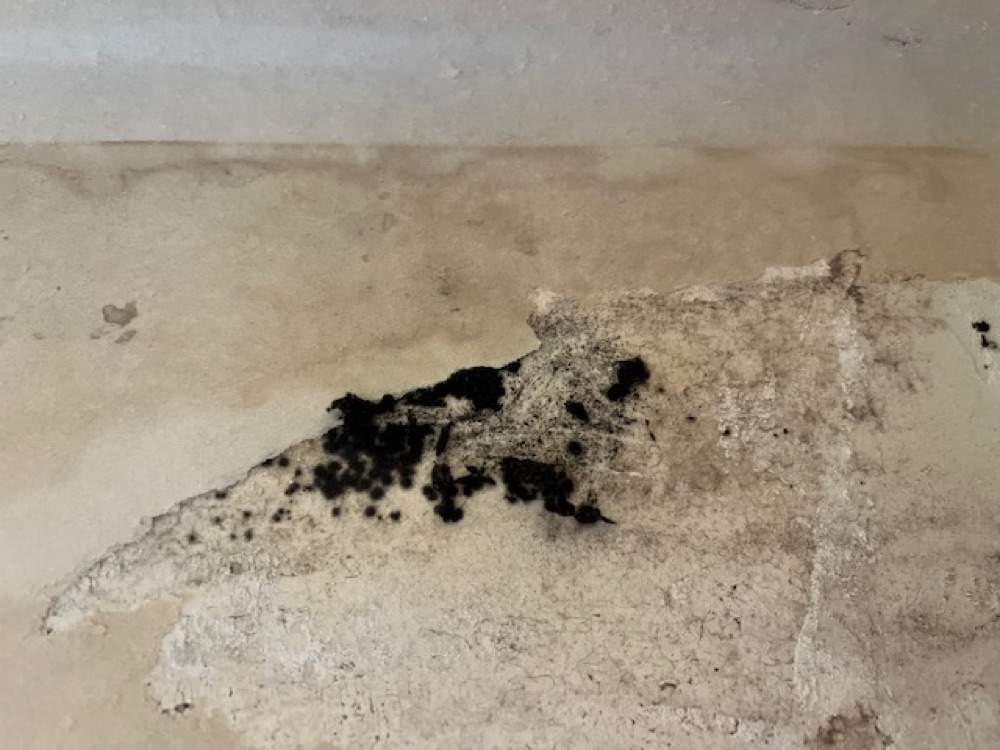
It is not the only species that causes trouble. Aspergillus niger produces ochratoxin A under some conditions and can infect the lungs of anyone immunocompromised. Chaetomium shows up in the same water-damaged buildings and is linked to similar symptoms. Alternaria is a significant asthma trigger. Cladosporium is the most common dark mold indoors and the least concerning of these molds, and it is what most bathroom growth turns out to be.
If you are not yet sure whether growth is sitting on the surface or has rooted into the material, start with black mold vs mildew, or the version for wood if it is on framing, a deck or furniture.
Experiencing Mold Exposure? Take 15-mins screening testWhat causes black mold
Spores are present in every building and always have been. Water is what turns a dormant spore into a mold colony, so the cause is always a moisture source somewhere.
Plumbing leaks are the most common. Slow drips at supply line compression fittings are the ones that go unnoticed longest, because water travels along the pipe and pools at a distance from the fitting itself.
Roof and flashing failure puts water into wall cavities. Roof valley flashing in particular can send water 10 to 15 feet horizontally inside a wall before it shows as a ceiling stain. The visible damage rarely sits under the actual defect.
Window and door flashing that has failed lets water in only during specific wind directions, making the source difficult to trace and easy to dismiss as condensation.
HVAC condensate drain blockages produce standing water inside the unit with no visible evidence outside the equipment.
Sustained humidity above 60% grows mold with no leak at all. Condensation forms on the cold surfaces in a room, window frames, exterior wall sheathing, cold water pipes, and growth follows on whatever those surfaces are made of.
Flooding and sewage saturate everything porous within hours. Category 3 water carries its own biohazard protocols and is not a DIY situation.
Blocked ventilation does it slowly. A bathroom extractor venting into a loft moves the moisture problem rather than solving it. Furniture pushed flat against an external wall stops air moving over the coldest surface in the room.
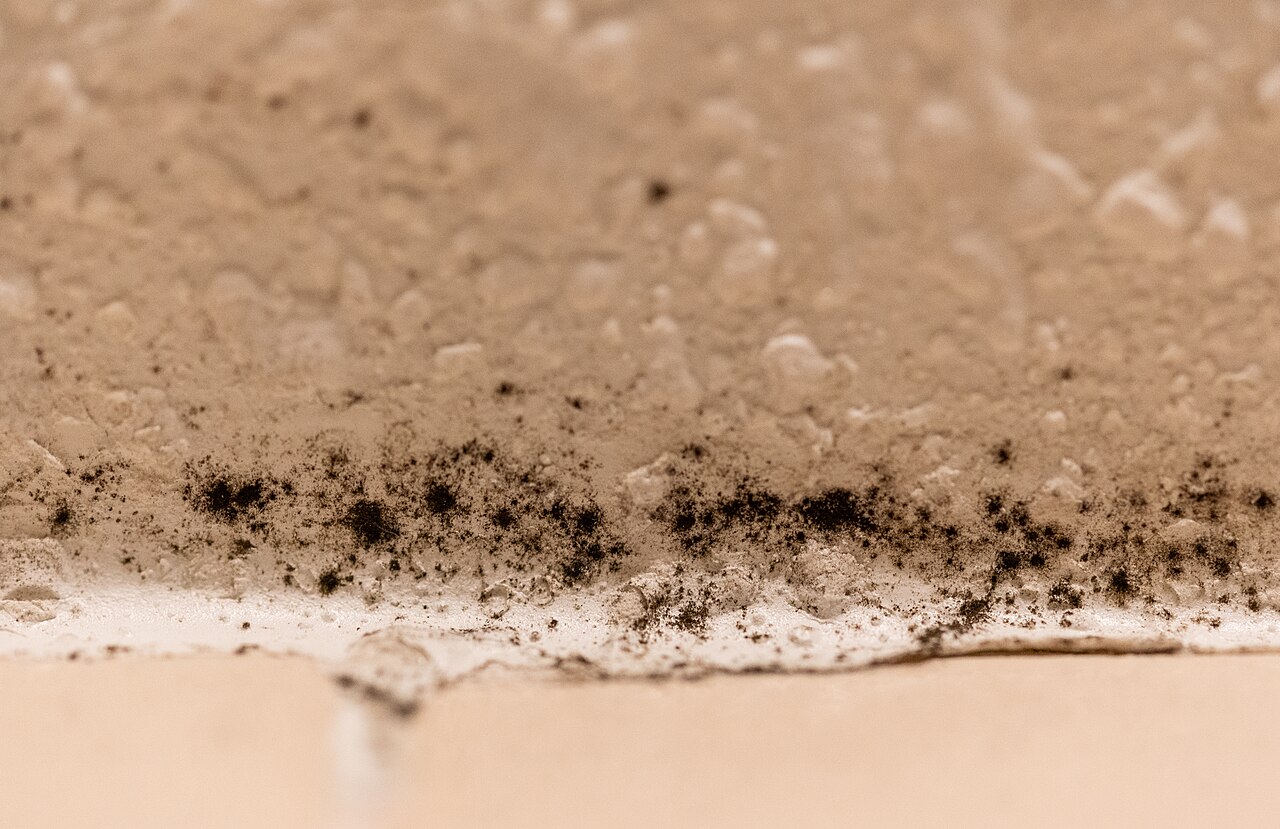
Mold removal safety equipment
Removal disturbs settled spores and mycotoxins, so without the right kit you take a concentrated dose of exactly what you are trying to remove. The specifications below follow EPA and NIOSH guidance.
Respirator. N95 filtering facepiece as a minimum under 10 sq ft. Half-face respirator with P100 cartridges for 10 to 100 sq ft. Surgical masks are not tested for fine particulate retention and leak at the face seal. Fit counts as much as filter rating, since a properly fitted N95 outperforms a badly fitted P100.
Eye protection. Non-vented chemical splash goggles. Safety glasses leave open side gaps that airborne spores travel through. If you wear prescription glasses, the goggles need to fit over them.
Gloves. Nitrile, neoprene or natural rubber with a 12-inch cuff covering the wrist. Latex surgical gloves tear too easily on construction surfaces, and household vinyl is inadequate.
Clothing. Long sleeves and trousers that go straight into the wash afterwards, or get bagged before you re-enter living space. Above 10 sq ft, disposable Tyvek coveralls stop you carrying spores through the house. Remove them inside out before leaving the work area.
HEPA vacuum. True HEPA rated 99.97% at 0.3 microns. Standard shop and household vacuums exhaust through the bag, redistributing fine particles including spores and mycotoxins. Drywall demolition and surface cleaning both need one.
So let's get into the actual process for remediation now...
Fix the moisture source
Removing mold while the water source is still active buys a few weeks at most.
Before taking out any material, a pin-type moisture meter maps how far the damage actually reaches. Probe drywall, framing and subfloor in the visible area and in the areas next to it. Readings above 16% moisture content in wood support active growth, and above 28% support structural rot.
Indoor relative humidity is measurable with an inexpensive digital hygrometer. In bathrooms, basements and humid climates, a dehumidifier is often part of the remediation rather than an optional extra.
Containment before removal
Disturbing growth releases spores, and without containment they settle throughout the building.
Under 10 sq ft on isolated hard surfaces, basic containment does the job: close the room, seal the vents, and run a HEPA air purifier in the work area. Between 10 and 100 sq ft, full negative pressure containment applies:
- 01Turn off HVAC to the work area and seal all supply and return registers with 6-mil poly sheeting and tape
- 02Seal doorways with 6-mil poly, leaving a flap entry point
- 03Place a HEPA air scrubber exhausting outside through a window, which draws air into the work area rather than letting contaminated air escape
- 04Set up a decontamination zone just outside the entry for PPE removal
- 05Bag demolished material in the work area rather than carrying it through living space
Removing black mold from hard surfaces
Glazed tile, glass, metal, sealed stone, hard plastic and painted concrete can be cleaned rather than replaced, since growth sits in surface biofilm without penetrating the material.
- 01Lightly mist the area with water before touching it, which suppresses the spore release that happens on first contact
- 02HEPA vacuum to lift loose surface spores before applying anything wet
- 03Scrub with a stiff-bristled brush using an EPA-registered fungicidal cleaner or 3% hydrogen peroxide
- 04Wipe clean with fresh disposable cloths, since reusing a cloth reapplies spores
- 05HEPA vacuum the surface and surrounding area again
- 06Dry completely with fans or a dehumidifier, because residual moisture is the most common reason growth returns within weeks
Bleach is the wrong tool on anything porous. The EPA does not recommend sodium hypochlorite for those materials, and the reason is structural. A typical bleach solution is 95 to 97% water by volume. On grout, drywall, wood or concrete block the water penetrates while the hypochlorite does not follow at the same rate. You end up adding moisture to an already wet substrate while killing only surface cells. The hyphae inside the material can survive. Bleach works on hard non-porous surfaces where penetration is not a factor. Mixing it with any ammonia-based cleaner produces chloramine gas, which is acutely toxic at low concentrations.
Black mold removal products that work
Hardware shops stock four or five products aimed at household mold, and they do different jobs. Some strip the stain, some kill the mold itself, and a couple leave something behind that slows regrowth. Picking by job saves buying all of them.
RMR-86 is the fast-acting stain remover most commonly reached for on grout and painted surfaces. It removes the black discolouration in minutes without scrubbing, though it is a stain treatment rather than a preventive.
RMR-141 is the EPA-registered disinfectant from the same range, suited to the killing step rather than the cosmetic one. Using 86 for appearance and 141 for the biology is the usual pairing.
Concrobium Mold Control works differently, drying to a film that crushes spores mechanically and leaves a residue that resists regrowth. It is unscented and contains no bleach or ammonia, which suits occupied rooms.
Mold Armor covers a range from bathroom sprays to exterior siding products. Check which one you are buying, since the formulations differ considerably.
3% hydrogen peroxide from a pharmacy is the unbranded option, effective on non-porous surfaces in 10 to 15 minutes, breaking down into water and oxygen with no residue.
Natural options hold up better than their reputation suggests, on the right surface. Undiluted white vinegar at 5% acetic acid, left in place a full hour, clears surface growth from grout and tile. Borax leaves a residue that keeps discouraging regrowth after you finish. Tea tree oil is the strongest antifungal of the household group, though it is unsafe around cats. None of them reach hyphae inside porous material, so the cut-out rule applies to them exactly as it does to the branded products. Our guide to natural black mold removal covers concentrations, contact times and the combinations that are dangerous to mix.
Our comparison of seven black mold removal sprays sets out each one's active ingredient, EPA registration and contact time, and which surfaces its label permits.
Drywall: cut out and replace
Drywall with growth on it cannot be cleaned. The paper facing is cellulose and the hyphae penetrate it fully during colonisation, so surface cleaning removes visible spores while leaving the mycelial network intact, and regrowth can start within days.
- 01Score with a utility knife and break along the line, avoiding a circular saw or jigsaw, which aerosolise fine dust and spores through the room
- 02Cut out 12 to 18 inches beyond the visible boundary on all sides, stopping at studs or joists to give a clean nailing surface
- 03Double-bag removed material in 6-mil poly and seal before carrying it anywhere
- 04Inspect the framing behind the removed section, studs, plates and blocking
- 05Light surface mold on framing: scrub with a stiff brush, apply an EPA-registered encapsulant, dry fully before closing
- 06Heavy growth on framing: sand or plane to bare wood then encapsulate, and replace any member showing rot
- 07Replace with paperless drywall such as DensArmor or ToughRock, since fiberglass mat facing removes the cellulose food source
- 08Confirm framing moisture is below 14% before installing, or growth can recur inside the wall
- 09Prime with mold-resistant primer before painting
Moisture-resistant greenboard uses treated paper, which is still cellulose and still food if it stays wet long enough. Paperless products are the appropriate choice anywhere that has flooded or is likely to again.
Shower and bathroom remediation
Most shower mold, the black along grout and caulk lines, is Cladosporium or Aspergillus in surface biofilm rather than Stachybotrys. Surface growth on intact tile cleans off. Stachybotrys behind tiles on a failed substrate means the tile comes off. For a fuller breakdown of what each spot means, see bathroom mold vs mildew.
Grout and tile. No cleaner dissolves biofilm on its own, so a stiff grout brush does the first pass. Follow with an antifungal cleaner containing quaternary ammonium compounds or hydrogen peroxide.
Silicone caulk. Replace rather than clean. Mold colonises inside the silicone matrix, not only on its face, so surface cleaning takes off the visible layer and leaves the rest. Strip with a plastic removal tool, clean the substrate, dry it completely, and replace with a mold-resistant silicone containing a biocidal additive, usually zinc pyrithione.
Behind the tiles. Hollow-sounding tiles, cracked grout, loose tiles or any flex under pressure indicate waterproofing failure. Cement board substrate can be dried and treated if structurally sound. Greenboard must be replaced, since it is moisture-resistant in its paper treatment rather than waterproof and has been superseded by cement board in wet areas under current codes.
Exhaust fan. A fan venting into attic space creates a second moisture problem upstairs. Hold a tissue near the exterior vent while it runs to confirm it exhausts outside. Codes require turning over room air eight times an hour, and most 50 to 80 CFM consumer fans fall short in larger bathrooms. Required CFM is room volume in cubic feet divided by 7.5.
Kitchen remediation
The under-sink cabinet is where kitchen mold does structural damage. Trace the water before removing anything. Check supply line connections at the shutoff valve and faucet tubes, since failure rates climb after 10 to 15 years of service. Braided stainless lines still develop fissures at the ferrule. Run the disposal and watch the drain hose connection, then check the P-trap slip joints. Particle board cabinet flooring that has absorbed moisture swells and cannot be dried for reuse, so it gets replaced with solid wood or sealed plywood.
Two smaller sources repay a quarterly look. The refrigerator condensate drain pan sits warm and permanently damp behind the kick plate, and the dishwasher door liner behind the lower gasket holds water that standard cycles never reach. Both clean with 3% hydrogen peroxide.
Where else to check
Bathrooms and kitchens account for the growth people actually find. The three below produce contamination that stays hidden until it is well established, which is what turns a weekend job into a five-figure one.
Walls with water intrusion. Exterior walls taking moisture from roof leaks, failed flashing or cold-climate condensation grow mold on the back face of the drywall, invisible until the wall is opened. The musty smell usually arrives before anything visible does.
Basements and crawl spaces. Concrete block typically hosts Cladosporium or Penicillium. Wood framing in a crawl space supports Stachybotrys if it stays wet. Crawl space contamination matters more than its location suggests, since air movement through floor penetrations pulls spores into the living space above.
HVAC evaporator coil and drain pan. The coil runs humid by design. A blocked condensate drain leaves standing water in the pan, and growth follows. A contaminated system distributes spores every time the fan runs, which makes this professional work in every case.
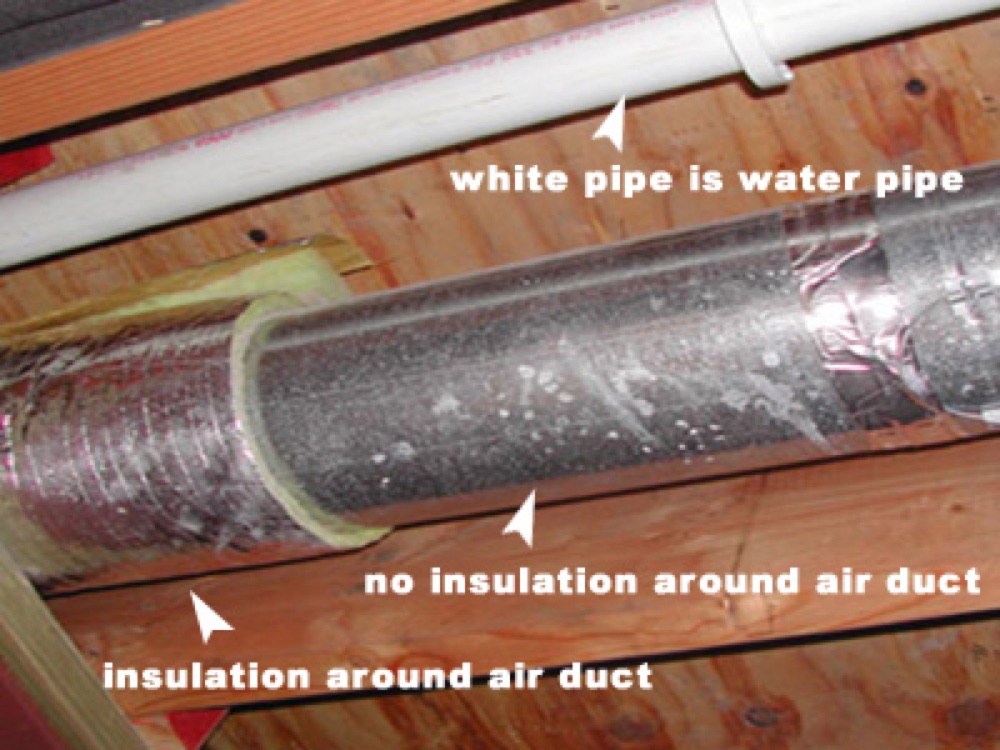
Black mold effects on humans
How much harm black mold does depends on how much of it there is, how long you have been breathing it, and who you are. A patch on a shower seal that you clean this weekend is a cleaning job. Growth behind a wall that has been there a year, in a house with a child who wheezes, is a health problem.
Mendell and colleagues reviewed 33 epidemiological studies in 2011 and found consistent associations between damp housing and respiratory outcomes, including asthma onset in both children and adults. Mudarri and Fisk estimated in 2007 that around 21% of current US asthma cases, roughly 4.6 million people, trace back to household dampness and mold, at an annual healthcare cost near $3.5 billion.
Mold reaches you three ways, and the route explains the symptom.
The simplest is the spores themselves, which are allergens. Breathing them brings sneezing, a blocked or runny nose, itchy watering eyes, and a rash in some people, and for anyone with asthma they can set off an attack. Standard allergy testing picks this up, because the mechanism is the same as hay fever.
Then there are the mycotoxins. These ride on spores and on the fine fragments a colony sheds. In a water-damaged building they arrive alongside bacteria and the musty gases the growth gives off, so what you breathe is a mixture rather than one toxin. Recurring sinus infections, a cough with no infection behind it, headaches, chest tightness, and a tiredness that sleep does not touch are the usual results of weeks of that. No allergy test will come back positive, which is why people in this situation are often told nothing is wrong.
The third affects a smaller group. In roughly a quarter of people, whose genetics leave them unable to clear these toxins efficiently, the inflammation keeps running after the exposure ends. That is chronic inflammatory response syndrome, and it is why two people can share the same moldy house and only one of them gets ill.
Children, older adults, pregnant women and anyone with asthma, COPD or a weakened immune system react at lower exposures and recover more slowly. In a healthy adult a mold problem usually produces allergy and irritation. In an infant sleeping in a damp room, or a patient on chemotherapy, the same growth can produce serious respiratory illness.
If you have been living with growth for months rather than days, our guide to how dangerous black mold exposure actually is covers what long exposure does. Screening for that third route takes about fifteen minutes. The free VCS test measures the visual contrast deficit associated with biotoxin exposure, alongside the symptom questionnaire. Where the question is what a person has absorbed rather than what is growing in the building, a mycotoxin urine test measures what the body is clearing, though a raised ochratoxin A reading is as likely to come from coffee as from a wall. Our reference on mold toxicity symptoms lists what to watch for.
The screening runs in your browser and takes about fifteen minutes from calibration to result.
Start the test nowHiring a black mold remediation company
Professional black mold remediation runs roughly $500 to $6,000 depending on scale and material, against $50 to $150 for DIY supplies. Jobs involving HVAC decontamination or multiple rooms sit at the upper end and beyond.
Three things separate a competent contractor from an expensive one:
IICRC S520 certification. This is the North American standard governing assessment, containment, procedure, documentation and clearance. It is a specific credential rather than a generic "mold certified" badge, and asking for it directly is reasonable.
Industrial HEPA equipment. Commercial air scrubbers move far higher CFM than consumer purifiers and hold continuous negative pressure across multi-day projects. Contaminated ductwork needs vacuum extraction with HEPA-contained equipment at supply and return registers, which consumer duct cleaning sprays do not accomplish.
Independent clearance. The remediator performs the work and an independent industrial hygienist confirms the result. A company that tests its own work has an obvious conflict of interest, and any contractor who resists this arrangement is telling you something.
EPA size thresholds: DIY or professional
The EPA's Mold Remediation in Schools and Commercial Buildings (EPA 402-K-01-001) sets three remediation levels by affected area. These assume the moisture source has been found and corrected, since ongoing water intrusion negates any remediation regardless of scale.
| Mold area | Approach | Containment required |
|---|---|---|
| Under 10 sq ft | DIY with appropriate PPE | Basic: seal room from rest of home |
| 10 to 100 sq ft | Professional procedures recommended, DIY only with full containment | Full: negative air pressure, 6-mil poly |
| Over 100 sq ft | Professional remediation | Full professional containment |
| HVAC contamination | Professional regardless of area | System isolation |
Some situations call for a professional whatever the size:
- ·An occupant has respiratory disease, is immunocompromised, or has symptoms consistent with mold-related illness
- ·The moisture source has not been identified or corrected
- ·Water damage followed sewage or floodwater
- ·Mold is in HVAC air handling equipment, ductwork or coils
- ·Hidden contamination is suspected and the full extent is unknown
HVAC contamination is about distribution rather than extent. A contaminated wall exposes the room it sits in, while a contaminated air handler delivers to every room the ducts serve, which is why where growth starts in a duct system decides urgency more than the size of the visible patch does.
Post-remediation testing and clearance
Visual inspection alone does not confirm success. A cleaned area may pass a look while airborne counts stay elevated or mycotoxins persist in settled dust.
Spore trap air sampling collects airborne spores over a measured volume, analysed under microscopy. Clearance means indoor counts at or below the outdoor reference sample, with no Stachybotrys indoors. Counts fluctuate through the day and dormant dry mold releases few spores, so false negatives happen.
ERMI and HERTSMI-2 dust sampling analyse settled dust by mold-specific quantitative PCR. ERMI covers 36 species, HERTSMI-2 the 5 most associated with CIRS. Dust is more sensitive than air for historical contamination, since spore DNA persists for months after visible growth has gone, and the scores give a quantitative before-and-after comparison.
Long-term black mold prevention
Prevention is moisture control. Spores are present regardless, so the variable is whether conditions let them colonise.
Hold relative humidity at 30 to 50%. Measure with a digital hygrometer rather than by how the air feels, since human perception of humidity is unreliable. Above 60% sustained, growth becomes possible with no water source at all.
Respond to leaks within 24 to 48 hours. That is the EPA’s drying window for water-damaged materials, and an emergency plumber costs a fraction of a remediation project.
Exhaust bathrooms outside. Run fans during showers and for 15 to 20 minutes after, and confirm the duct reaches the exterior rather than the attic.
Check the annual maintenance points. Roof flashings at valleys, penetrations and chimney saddle. Window and door sill flashings. Gutter drainage discharging away from the foundation. HVAC condensate line flushed annually. Supply line connections under sinks and at appliances.
Avoid carpet below grade. Carpet over a concrete slab holds slab condensation against a cellulosic food source. Ceramic tile or luxury vinyl plank on sealed concrete suits those spaces better.
Maintain attic ventilation. In cold climates, interior air diffusing through the ceiling condenses on cold roof sheathing. The standard ratio is 1 sq ft of net free ventilation per 150 sq ft of attic floor, balanced between soffit intake and ridge exhaust.
Frequently asked questions
Can I paint over black mold?
No. Encapsulant paints stop spores aerosolising without killing active growth or halting it beneath the coating, and paint applied over active mold can peel within months. Colonised material comes out or gets treated with a registered biocide, dried completely, then primed with mold-resistant primer before any topcoat.
How do you remove black mold yourself?
On hard surfaces, mist it first so spores stay put, then HEPA vacuum. Scrub with an EPA-registered fungicide or 3% hydrogen peroxide, wipe with disposable cloths, and dry completely. On drywall, ceiling tile, insulation or carpet, cut the material out 12 to 18 inches past the visible edge instead of cleaning it. Fix the water source before either, and stay under 10 square feet.
Is it safe to clean black mold yourself?
Under 10 square feet on hard surfaces, yes, with an N95, non-vented goggles, gloves and the room sealed off. The risk sits less in the mold itself than in the volume of spores released while disturbing it, which is why containment matters more than the cleaner you pick. Anyone with asthma, a weakened immune system, or who is pregnant is better off leaving the disturbing part to someone else.
Does homeowners insurance cover black mold removal?
Usually only where the mold followed a sudden covered water event, such as a burst pipe, and was reported promptly. Damage traced to long-term leaks, poor maintenance or humidity is generally excluded, and many policies cap mold coverage at $5,000 to $10,000 even when it applies. Photograph everything and file on the water damage rather than the mold.
How long does black mold remediation take?
A small DIY job on non-porous surfaces under 10 sq ft takes a few hours. A professional project involving drywall removal, framing treatment and replacement typically runs 1 to 5 days. Larger projects with HVAC involvement can take 1 to 2 weeks, plus drying and clearance time before reoccupation.
How much does black mold removal cost?
Roughly $500 to $6,000 professionally, depending on area, material and whether ductwork is involved. DIY supplies for a small job run $50 to $150. Anything requiring structural replacement or HVAC decontamination sits above that range.
What does black mold smell like?
Growing colonies produce microbial volatile organic compounds. Stachybotrys gives a musty, earthy odour often described as wet soil or rotting wood, with geosmin and 1-octen-3-ol among the compounds responsible. No smell does not mean no mold, since dormant colonies produce little.
Can black mold come back after remediation?
Yes, if the moisture source was not corrected. Remediation removes colonised material and surface contamination rather than sterilising a building, and new spores settle continuously. With the water fixed, a properly remediated space should not recur.
Do I need a mold test before starting?
Not for visible growth. Testing earns its cost in three situations: confirming hidden extent before opening walls, independent post-remediation clearance, and cases where symptoms suggest contamination but nothing visible has been found.
Is it safe to stay in the house during remediation?
For small isolated jobs on hard surfaces with the area sealed, yes. For professional projects with active demolition or HEPA scrubbers running, occupants leave the work area and are often advised to leave the building. Large multi-room projects generally call for temporary relocation.
Sources
- ·U.S. Environmental Protection Agency (2012). Mold Remediation in Schools and Commercial Buildings. EPA 402-K-01-001.
- ·IICRC (2015). S520 Standard and Reference Guide for Professional Mold Remediation.
- ·World Health Organization (2009). WHO Guidelines for Indoor Air Quality: Dampness and Mould. Copenhagen: WHO Regional Office for Europe.
- ·Mendell MJ, Mirer AG, Cheung K, Tong M, Douwes J (2011). Respiratory and allergic health effects of dampness, mold, and dampness-related agents. Environmental Health Perspectives 119(6):748-756. PMID 21669584.
- ·Mudarri DH, Fisk WJ (2007). Public health and economic impact of dampness and mold. Indoor Air 17(3):226-235. PMID 17542835.
This guide is educational and does not constitute professional remediation advice. Growth over 100 sq ft, HVAC contamination, or occupant health effects require a certified professional.