We reviewed Best Moisture Meter for Walls, Wood and Firewood: Pin and Pinless
Quick answer
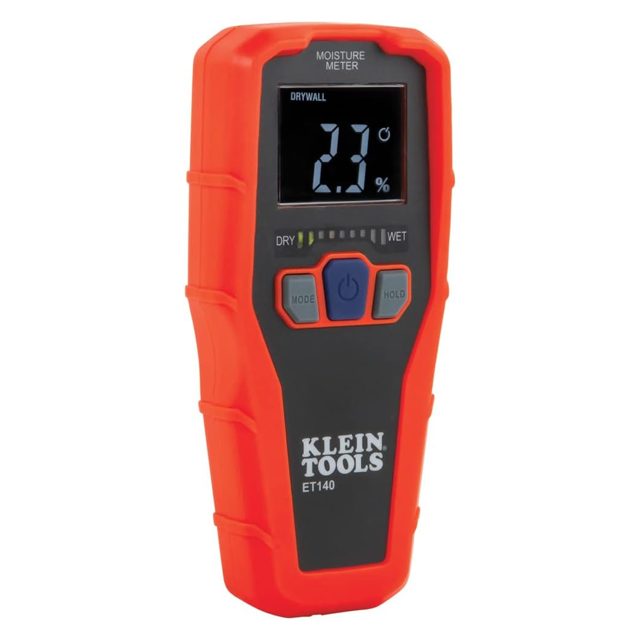
For checking walls, ceilings and floors in a home, the Klein Tools ET140 pinless meter is the best moisture meter. It scans ¾ of an inch deep without holes and shows a relative reading you compare against a dry patch of the same wall.
On drywall that reading is relative, so a patch reading two to three times the dry stretch is wet. The General Tools MMD4E pin meter confirms the wet spots before a wall is opened and checks firewood, which is seasoned below 20%.
Published October 26, 202618 min readEvidence-based
Water gets into a house in ways that take months to show. A slow leak under a sink, a failed shower pan, a roof flashing that lets in a cup a day, a basement wall that wicks from the ground. Each wets the materials long before a stain appears.
By the time the paint bubbles or the smell arrives, the drywall, the framing behind it or the subfloor has been wet for weeks. That is the window in which mold establishes itself. A moisture meter finds the water while the wall still looks fine, and it tells you how far the wet patch extends and whether drying is working.
You may have a stain you can’t explain, a musty smell in one room, or a floor that feels soft in one spot. Or a stack of firewood that hisses in the stove. Or you may have a hygrometer reading that’s fine and a wall that still feels damp.
But which moisture meter gives a reading you can act on, and what number means the wall is wet?
Note: Mold and mould are the same word, spelled two ways. This article uses the American spelling.
Moisture meter or hygrometer: which one your problem needs
A moisture meter measures water inside a material: a wall, a floor, a joist, a log. A hygrometer measures water in the air. The two get confused because both are sold as "humidity" tools, and the wrong one answers a question you didn’t ask.
Air problems: a hygrometer
A clammy room, streaming windows, a wardrobe that smells, bedding that doesn’t dry.
Material problems: a moisture meter
A ceiling stain, a soft patch of floor, a cold damp spot on a wall, a leak you can’t see.
A room that feels clammy, windows that stream, a wardrobe that smells and bedding that doesn’t dry are air problems. A hygrometer on the shelf tells you whether the room sits above 60%.
A ceiling stain, a soft patch of floor, a wall that’s cold and damp in one place, a leak you suspect but can’t see. These are material problems. Only a moisture meter shows whether the material is wet now.
The two often work together. A damp bedroom at 65% will wet the cold wall behind the wardrobe. A moisture meter on that wall shows whether condensation has soaked the drywall or only misted the paint. A dry room at 42% with a wet wall means a leak, not the air.
How pin and pinless meters work, and what each can’t see
A pin meter pushes two steel pins into the material and measures electrical resistance between them. Wet wood conducts; dry wood doesn’t. The reading is converted to a moisture content percentage calibrated for wood, and it describes the material between the pin tips and nowhere else. Standard pins reach about ⅜ of an inch; long insulated pins on a hammer probe read two inches into a joist or a sill plate.
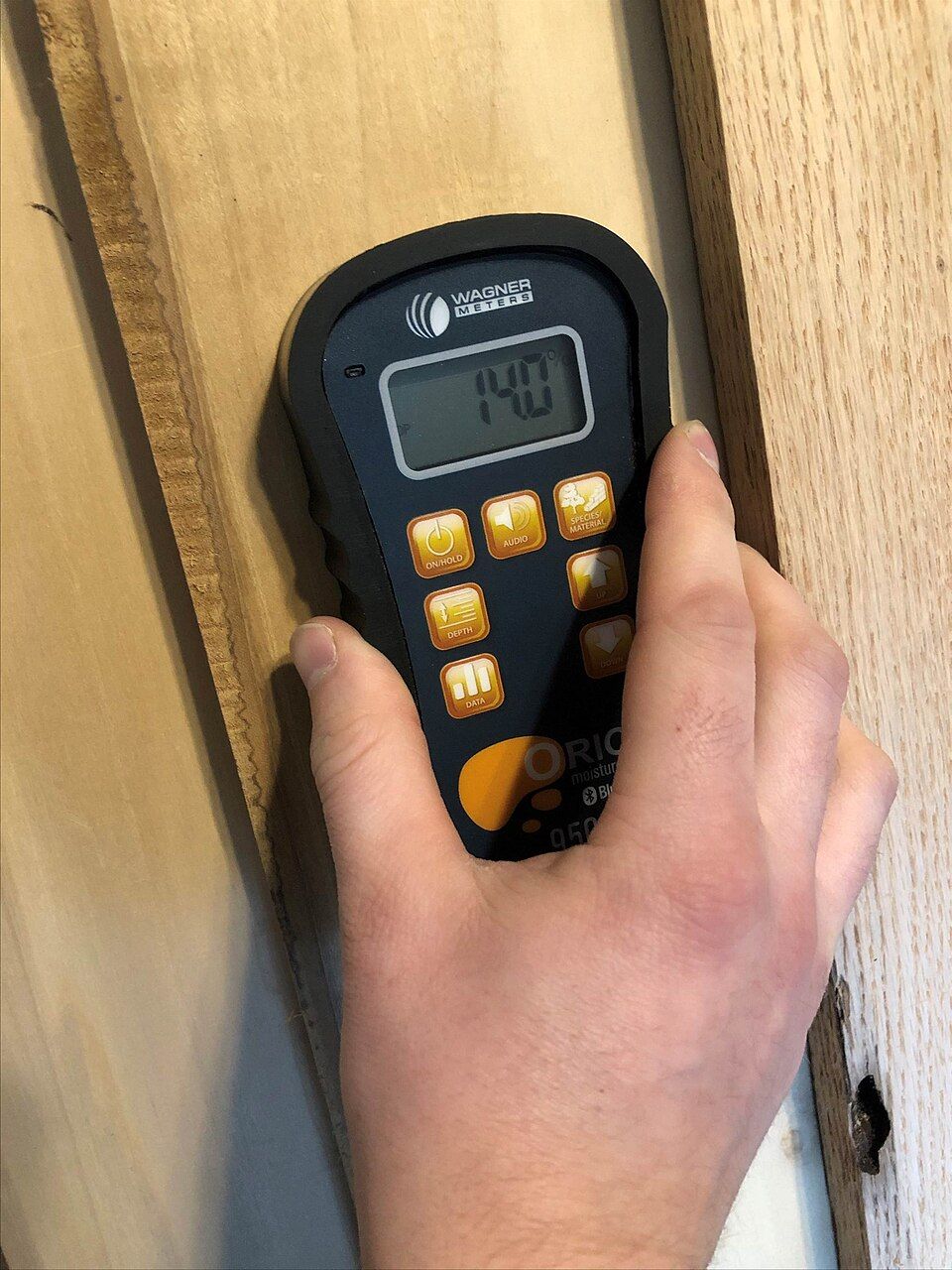
A pinless meter holds a flat sensor plate against the surface and sends an electromagnetic field a fixed depth into the material. That depth is usually ¾ of an inch, and up to 1½ inches on professional units. Water changes how the material responds to the field, and the meter reports the average for the whole block it scanned. It leaves no holes and covers a wall in minutes.
How deep each type reads
Standard pins⅜ in
Consumer pinless¾ in
Professional pinlessup to 1½ in
Insulated hammer-probe pins2 in
A pinless meter reads through the surface without holes. It averages everything within its scan depth into one number. Photo by Hrco, Wikimedia Commons, CC BY-SA 4.0.
Each type has a blind spot. A pinless meter can’t separate a wet surface from a dry core, or a dry surface from wet framing behind the drywall. Everything in its ¾ inch gets averaged into one number, and anything dense or metallic reads as wet.
A pin meter sees only the two points it touches, so a wet patch between two dry probe spots goes unnoticed. It also leaves two small holes in every finished surface it tests.
What the reading means: wood, drywall, subfloor, concrete, firewood
Moisture meters are calibrated for wood, and the percentage they show is wood moisture content. Every other material is read on a relative scale.
Wood moisture content
6–12%
Indoor wood
12–16%
Crawl space, garage
16–20%
Elevated: find the source
Over 20%
Decay fungi and mold
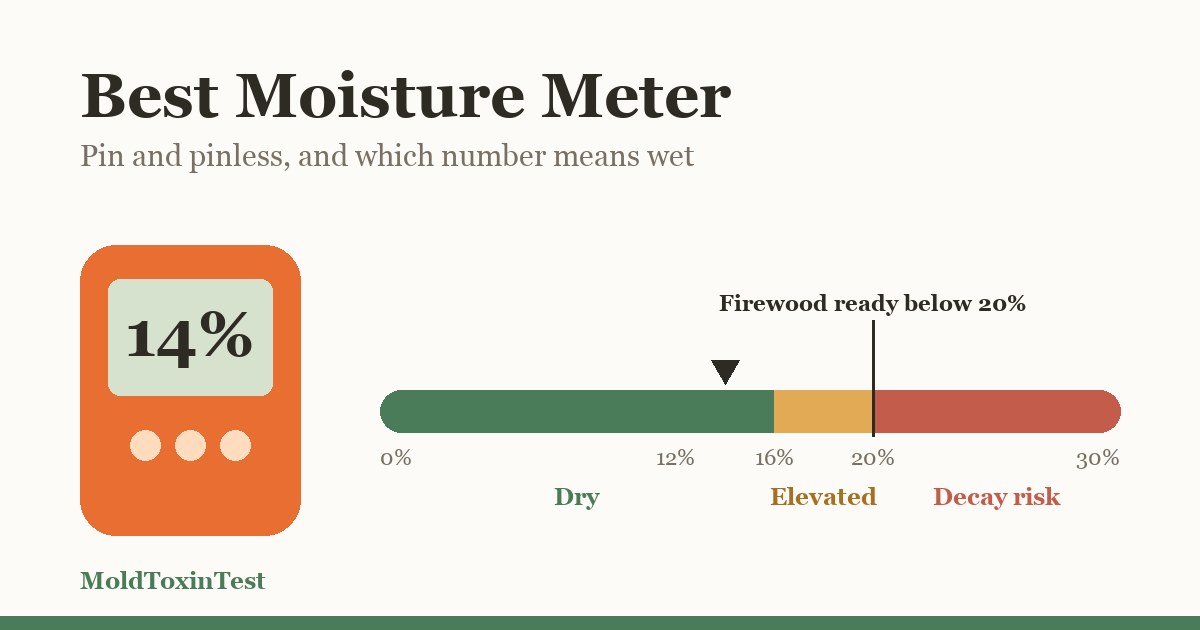
Framing, joists and structural wood. Wood indoors settles at 6 to 12% depending on the season and the climate. Framing in a crawl space or an unheated garage sits at 12 to 16% and is fine there. Readings of 16 to 20% are elevated and mean there is a source to find.
Above 20%, the Forest Products Laboratory’s minimum for decay fungi, wood stays wet enough for rot and surface mold. The higher it reads, the faster both move.
Drywall and plaster. Gypsum doesn’t hold water the way wood does, so a meter’s drywall or "reference" scale is a relative number, not a percentage. The meaning comes from comparison: a dry stretch of the same wall reads one figure, and a patch reading two to three times that is wet. On a pin meter’s wood scale, dry drywall usually reads in the low teens or below, and anything approaching 20% wood-equivalent is wet.
Subfloor and flooring. Plywood and OSB subfloors behave like wood: 12% is dry, 16% is suspicious, 20% is wet. Hardwood flooring and the subfloor beneath it need to be within 2 to 4 points of each other before installation. Otherwise the floor cups and gaps as they equalize. A flooring installer’s meter has species settings for this.
Concrete and masonry. A pinless meter on concrete gives a relative reading only, useful for comparing a damp patch of slab to a dry one and for tracking drying. Concrete that needs a flooring decision takes a proper slab test rather than a handheld meter.
Firewood. Under 20% on a freshly split face, with the pins pushed into the grain, is seasoned wood that burns clean. The EPA’s Burn Wise program used the same figure. Wood at 25 to 30% smokes, deposits creosote in the chimney, and gives off less heat.
Firewood stacked under cover to season. A pin reading under 20% on a freshly split face means it is ready to burn. Photo by Rajani Gairshail, Wikimedia Commons, CC BY-SA 4.0.
The baseline method for walls
Every wall reading starts with a baseline. A pinless meter held against a stretch of the same wall, well away from the suspect area, gives the number that "dry" means there today. Three readings across the dry area, averaged, are better than one.
A wall scanned every six inches
Baseline about 10. Cells at two to three times that are wet, and the edge of the wet area points toward the source.
10
10
11
10
11
12
10
11
10
12
14
18
11
10
12
16
24
29
10
11
13
21
30
32
Baseline Edge of the wet area Wet: two to three times baseline
The suspect area then gets scanned in a grid, every six inches or so, with each reading noted or marked lightly in pencil. A patch reading two to three times the baseline is wet. A patch reading a few points above baseline, in a line, often traces a pipe or a stud rather than water.
The edge of the wet area is the useful part. It shows how far the water has spread, and following the edge leads to the source. Up to a window sill, across to a bathroom wall, down to a baseboard where a floor has been mopped once too often. Marking the edge also gives a line to measure drying against, since a wall that is drying reads lower at the edge each day.
A pin meter confirms the wettest spots. Two small holes at the base of a wall that’s about to be opened anyway cost nothing. The pin reading settles whether the pinless number was water or something dense in the wall.
False readings: metal, temperature, species and surface water
A pinless meter reads metal as wet.
Metal studsNail plates over pipesFoil-backed insulationMetallized vapor barriersDucts and pipesDrywall screwsA mopped or wiped surfaceMorning condensationCold or hot woodDense hardwoods
Metal studs, nail plates over pipes, foil-backed insulation, a metallized vapor barrier, a duct or a pipe within the scan depth, even drywall screws. All push the reading up. A reading that jumps in a vertical line every 16 inches is studs or screws. One that jumps along a horizontal band at waist height is often a pipe run.
Metal studs sit every 16 inches behind finished drywall, and a pinless meter reads each one as a wet stripe. Photo by P199, Wikimedia Commons, public domain.
The density of a stud alone, with no metal, raises a pinless reading a few points.
Surface water fools both types. A wall that has been wiped, a floor that has been mopped, or condensation from a cold night reads wet for an hour and dries. Wiping the surface, waiting, and reading again separates a film of water from a soaked material.
Pin meters drift with temperature. The calibration assumes wood around 70°F; cold wood reads low and hot wood reads high, by roughly a point for every 10°F away from that. In an unheated garage in January, a pin reading of 17% may be 19% in truth.
Dense hardwoods also read differently from the softwood the meter assumes, and meters with a species setting correct for it. The cheap ones don’t, which is fine for drywall and framing and a problem for a walnut tabletop.
Painted and sealed surfaces are read through by a pinless meter and not by pins, which only read the paint layer unless pushed through it.
Using a moisture meter to find the source of a stain or smell
A stain or a musty smell in one room is a question of where the water is coming from. A moisture meter answers it faster than opening walls.
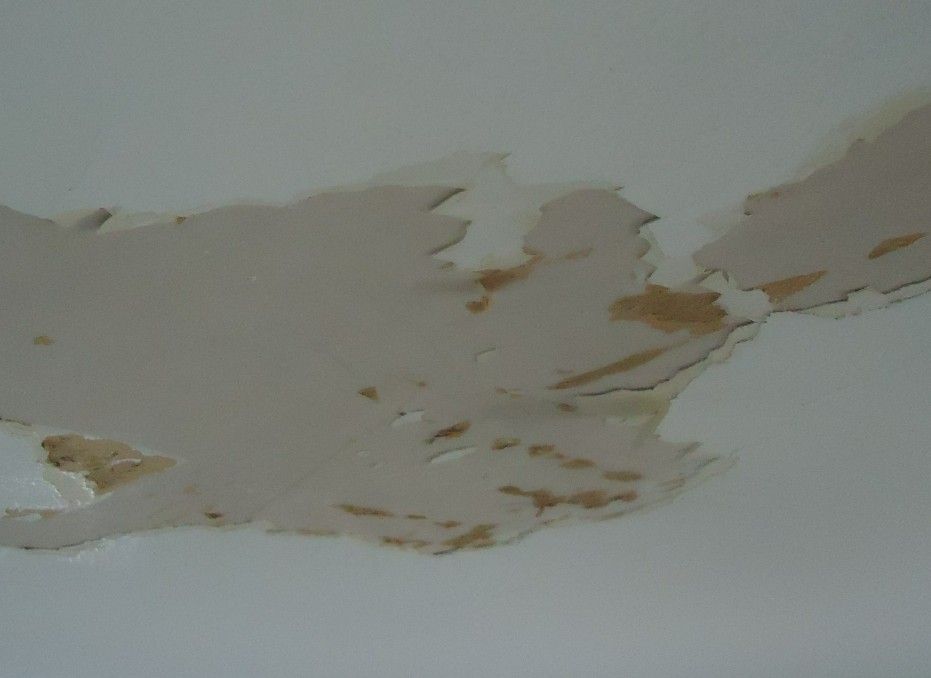
A ceiling stain like this is the end of the story. Scanning outward from it maps how far the water has spread and which way it came. Photo by Tomwsulcer, Wikimedia Commons, CC0.
The scan starts at the stain and works outward in every direction until the readings fall to baseline, which gives the shape of the wet area.
Widens upward
From above: a roof, a window, an upstairs bathroom.
Widens downward and along the baseboard
From the floor: a slab, a mopping habit, a leaking appliance.
A wet column beside a bathroom wall
A shower pan, a tile grout failure or a supply line.
The shape points at the source. A wet area that widens upward comes from above: a roof, a window, an upstairs bathroom. One that widens downward and along the baseboard comes from the floor: a slab, a mopping habit, a leaking appliance. A wet column beside a bathroom wall is usually a shower pan, a tile grout failure or a supply line.
The underside of the floor above, the back of the wall in the next room, and the ceiling of the room below get scanned too. Water travels along framing and shows up far from where it entered.
For a smell with no stain, the scan covers the cold spots first. Exterior wall corners, behind furniture against outside walls, under windows, the bottom foot of any basement wall, and under sinks. A wet reading there, in a room where the hygrometer reads under 50%, means a leak or a cold bridge rather than the air. The dew point calculator shows whether the room’s humidity and the wall’s temperature make condensation the likely cause.
A moisture meter doesn’t detect mold. It finds the water mold needs. Whether a dark mark in a wet area is growth is a question for the mold detector. A patch that has been wet for more than a couple of days has usually started growing something.
How we chose
Each meter here is sold for building materials rather than soil, and reads wood as a percentage and other materials on a stated relative scale. Each has enough buyers to show how it behaves after the first week. We looked for a hold function, a backlight, auto power-off, spare pins where pins apply, a stated scan depth where they don’t, and a case.
We haven’t tested these against a laboratory oven-dry sample. The notes draw on the makers’ specifications, inspection-industry guidance on pin and pinless behavior, and a read-through of buyer reviews on each listing. Ratings and review counts are from the live Amazon listings in October 2026.
Protimeter and Extech make the meters inspectors carry; the Protimeter SurveyMaster and the Extech MO290 are excellent and priced for people who use them daily. They’re named here for anyone buying for work.
The 6 best moisture meters
1. Klein Tools ET140 pinless
Best for walls
Type
Pinless
Depth
¾ in
Scales
Drywall, wood, masonry
Rating
4.5 (6,000+)
The ET140 is the pinless meter for walls, ceilings and floors in a home. It scans ¾ of an inch deep, shows a relative reading on a nine-LED bar and a numeric display, and has settings for drywall, wood and masonry. It fits a pocket and runs on a 9-volt battery.
Buyers describe tracing a damp patch beside a bathroom wall to its source. One who had used a pin meter for years bought it to stop leaving holes and calls it accurate for the money. Several note that it isn’t a certified instrument and that readings over metal studs run high, which is true of every pinless meter. Rated 4.5 stars from more than 6,000 buyers.
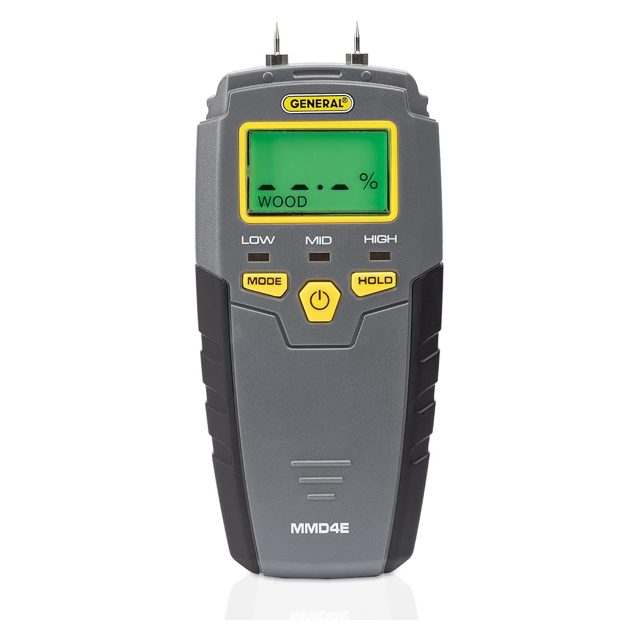
The MMD4E is the pin meter to keep in the drawer. It reads wood from 5 to 50% and drywall and masonry on a relative scale. It has a hold button, a backlight and auto power-off, and comes with a protective cap and spare pins. It’s the meter that confirms a pinless reading before a wall is opened and the one that checks firewood.
Owner reports go back to 2010, when a buyer caught a flooring installer about to lay hardwood over a wet subfloor. Recent buyers call it quick and easy, and some note that the pins bend in dense hardwood if pushed at an angle. Rated 4.5 stars from more than 15,000 buyers.
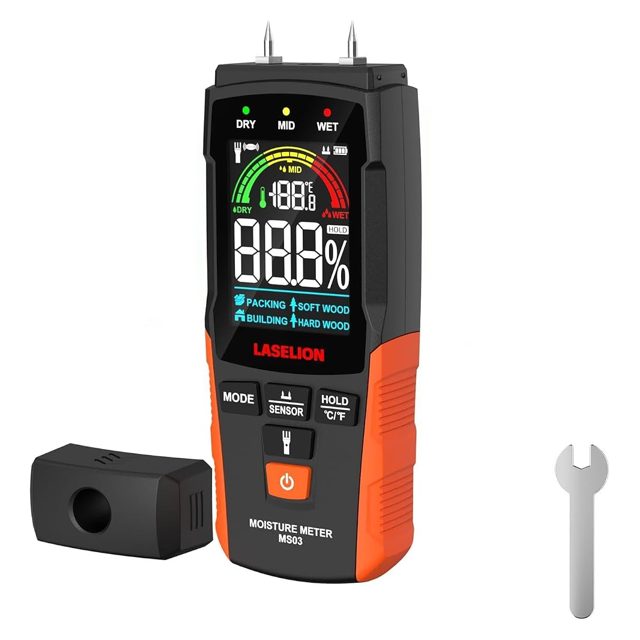
The MS03 puts both modes in one budget body: a pinless sensor on the back for scanning and a pair of pins on top for confirming. It has a hold function, a flashlight and auto power-off, and it reads wood, drywall, plaster and concrete.
It’s the pick for someone who wants one meter for an occasional check and would rather not buy two. The review base is small and the sensor plate is smaller than the Klein’s, so the pinless readings are more sensitive to how flat it sits. Rated 4.5 stars from more than 500 buyers.
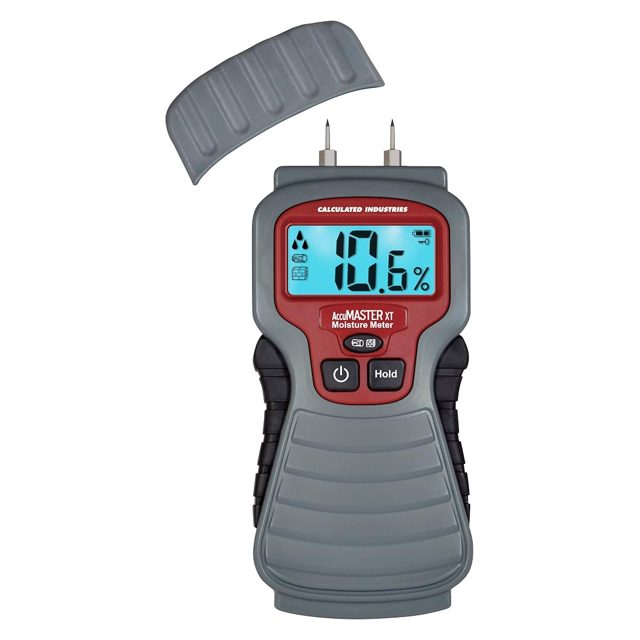
The AccuMASTER XT is the firewood meter. Sharp pins, a backlit display, and a readout that labels wood as low (5 to 11%), medium (12 to 15%) or high (16 to 50%). The stack gets sorted without remembering thresholds. It reads walls and ceilings on the same pin scale.
It’s sturdier than the MMD4E and a little more expensive, and the pins are replaceable. Rated 4.5 stars from more than 800 buyers.
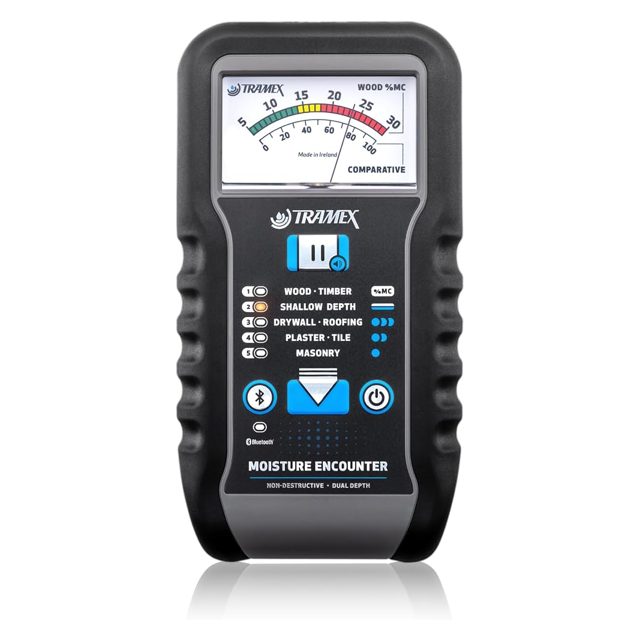
The Moisture Encounter is the pinless meter home inspectors and restoration crews carry. It reads at two depths so surface moisture and core moisture can be compared. It has separate scales for wood, drywall and roofing or plaster, a large analog-style display, and an audible alarm above a threshold you set.
It costs several times the Klein, and the gain is in the dual depth and the consistency of the readings across a large wall. It’s the buy for a landlord, a flipper or anyone inspecting more than one property. Rated 4.5 stars from more than 120 buyers.
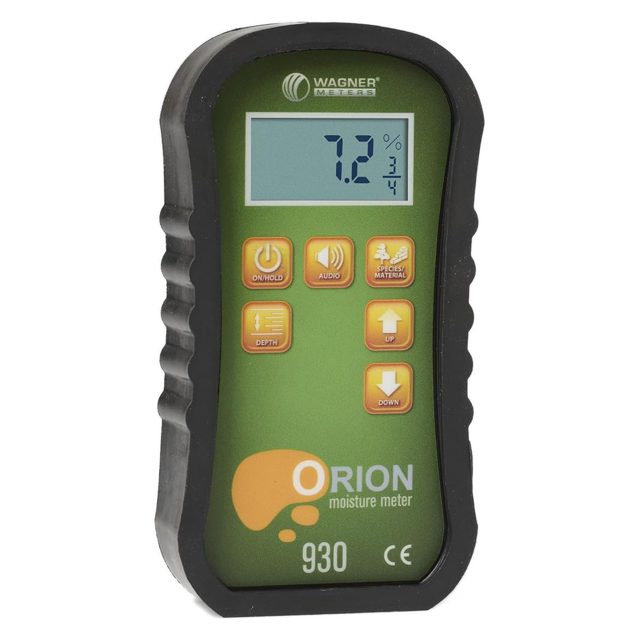
The Orion 930 is a wood meter, and the one for a workshop or a flooring job. It reads at two depths and has species settings for the density correction a pin meter can’t make. It ships with a calibration block so it can be checked on site. The reading is wood moisture content to a tenth of a percent, the resolution a tabletop at 7% and lumber at 9 require.
It isn’t for walls. For firewood it’s overkill, and for drywall it has no scale. Rated 4.6 stars from a small group of buyers.
As an Amazon Associate we earn from qualifying purchases, at no extra cost to you.
Which moisture meter for which job
A stain, a smell or a suspected leak at home. The Klein ET140 to scan and map, the General MMD4E to confirm. Together they cost less than a plumber’s call-out.
One meter for occasional checks. The LASELION MS03.
Firewood. The AccuMASTER XT or the MMD4E, on a freshly split face, aiming for under 20%.
Woodworking or installing a hardwood floor. The Wagner Orion 930, with the species set, reading both the boards and the subfloor.
A landlord, an inspector or a house you’re buying. The Tramex ME5, with the MMD4E in the bag for confirmation.
A basement or crawl space. Either pinless meter on the bottom foot of the walls and the sill plate, and the MMD4E’s pins in the joists. A pin reading above 20% in a joist is the number that gets a contractor called.
Soil and plant moisture meters
The probes sold for houseplants and gardens share the search term and nothing else. They measure the conductivity of soil between two metal prongs and show a dial from dry to wet. The result reflects the soil’s salts and the depth of the probe as much as the water. They’re useful for deciding when to water a fern.
On a wall or a log they read nothing meaningful, and a building moisture meter pushed into a plant pot reads nothing meaningful either. Anyone searching for a soil meter needs a garden guide, not this one.
After the reading: drying, mold and the next step
A wet reading is the start of two jobs: stopping the water and drying the material. Drying is measured with the same meter, against the same baseline, every day or two. Drywall and framing that return to within a few points of baseline within a week, with air moving and the source fixed, usually come through without replacement. Material that stays wet past that, or that was wet for days before anyone noticed, has usually started to grow mold inside it.
Where the wet area has already grown something, removing mold from walls covers the cleanup for drywall and paint, and mold in basement covers the below-grade version. Drywall that reads wet through its full thickness, with growth on the back, is usually replaced rather than cleaned.
The best moisture meter for a home is the one that gets used before the wall is opened. A pinless scan, a pin confirmation and a baseline turn a stain into a map, and the map points at the source.
The screening runs in your browser and takes about fifteen minutes from calibration to result.
The Klein Tools ET140 pinless for scanning walls, ceilings and floors without holes, paired with the General Tools MMD4E pin meter to confirm wet spots and check firewood. Together they cover almost every household check.
Pin or pinless moisture meter: which is better?
Pinless for finding and mapping moisture across a surface without damage; pin for confirming a reading at a point, reading deeper into framing, and testing firewood. Pinless meters read metal and dense material as wet, and pin meters miss anything between the two probe points, so the two together are the reliable setup.
What moisture reading is bad for drywall?
Drywall readings are relative, so the bad number is anything two to three times the reading on a dry stretch of the same wall. On a pin meter’s wood scale, dry drywall reads in the low teens or under, and a reading approaching 20% means the board is wet.
What moisture content is too high for wood?
Indoor wood sits at 6 to 12%, framing in unheated spaces at 12 to 16%. Readings of 16 to 20% call for finding the source. Above 20%, the Forest Products Laboratory’s threshold for decay fungi, wood is wet enough for rot and mold to take hold.
What moisture content should firewood be?
Under 20%, measured on a freshly split face with the pins in the grain. The EPA’s Burn Wise guidance uses the same figure. Wetter wood smokes, gives less heat and coats the chimney with creosote.
Do moisture meters detect mold?
No. They detect the water that mold needs. A patch that has been wet for more than a couple of days usually means growth has started. A dark mark in a wet area can be checked with the mold detector.
Why does my moisture meter read high on a dry wall?
Metal within the scan depth: studs, nail plates, foil-backed insulation, pipes, ducts or screws all read as moisture on a pinless meter. A reading that jumps every 16 inches is studs. Confirming with pins, which only read the material they touch, settles it.
How accurate are cheap moisture meters?
Within 2 to 3 points on wood near room temperature, which is enough for the 16% and 20% decisions. They lose accuracy on cold or hot wood, on dense hardwoods without a species setting, and on anything other than wood, where the reading is relative anyway. The baseline method counts for more than the meter’s spec.
Moisture meter or hygrometer for a damp room?
A hygrometer first, since a clammy room, streaming windows and a musty smell are air problems and a hygrometer shows whether the room is over 60%. A moisture meter then shows whether that air has soaked the cold walls, or whether a dry room has a wet wall from a leak.
Can a moisture meter read through paint or tile?
A pinless meter reads through paint, wallpaper and thin coatings to its scan depth. Tile and stone block or distort the field on most consumer units, so bathrooms are read from the back of the wall or from the ceiling below. Pins read only what they touch, so paint has to be pierced.
How deep does a pinless moisture meter read?
A fixed depth set by the design, ¾ of an inch on the Klein ET140 and most consumer meters, up to 1½ inches on dual-depth professional units. Everything within that block is averaged, so a pinless meter can’t tell a wet surface from a wet core.
Can I use a soil moisture meter on walls?
No. Soil probes measure conductivity between two prongs in soil and are calibrated for nothing else. A building moisture meter reads wood, drywall and masonry; a soil meter reads potting mix.