Understanding White Mold: Is it really dangerous?
Most people meet white mold with a cloth already in hand. On a windowsill it reads as dust, at the back of a wardrobe as lint, on basement concrete as something spilled and dried. The question of what it actually is tends to arrive a week later, when the patch is back in the same place.
White mold can be confusing because it does not seem as intimidating as other mold variants. Aspergillus, Penicillium, Cladosporium, Trichoderma and Mucor all produce white colonies. A patch that is pale today can be green or black inside a fortnight, once it starts releasing spores. You are looking at a stage in the life of common household growth.
Painted plaster and sealed wood give growth up easily. Carpet backing, bare timber, and the paper face of plasterboard hold onto it, because those materials are food as well as habitat. Basement and crawl space masonry adds a further complication, since a white bloom on concrete or brick is frequently a mineral deposit rather than anything living.
Note: Mold and mould are the same thing, spelled differently on either side of the Atlantic, so white mould and white mold describe identical growth. This article uses the American spelling throughout.
How to identify white mold
Three appearances account for most of what turns up in homes, and the texture narrows down what you are dealing with faster than anything else.
Cotton-wool tufts standing proud of the surface, the look people describe as white fuzzy mold or fluffy white mold, generally point to Mucor or to early growth of several genera on damp organic material. Flat, powdery films, most common on timber, are typically young Penicillium or Cladosporium. Fine threads webbing across a surface are mycelium, the feeding network itself, which becomes visible when conditions stay damp for long stretches. Flat growth is also what many people mean by white mildew, though in household use mildew and mold describe the same organisms at different depths rather than two separate things.
Texture tells you how established the colony is and what it is feeding on, which matters more for treatment than knowing the exact species.
For a second opinion on a pale patch, the free mold detector weighs a photo against efflorescence, dust and the other common lookalikes.
Fungal pigment comes mostly from spores, so a colony that has not begun producing them looks white or cream whatever species it belongs to, and the same patch can turn olive, grey, or black within a fortnight. Several species stay pale for life, including many Mucor colonies, Trichoderma before it greens, and Aspergillus niger, which spreads as a white mat long before its black spore heads develop. Catching growth while it is still white means catching it early.
Three things shape what you do next: the material underneath, how far the patch has spread, and who is breathing nearby.
Is white mold dangerous?
White mold carries the same risk profile as mold of any other shade, because the organisms overlap completely.
Healthy adults typically experience allergic and respiratory effects: blocked or running nose, sneezing, coughing, sore throat, watering or itchy eyes, and skin irritation in some cases. Symptoms usually build with time spent in the affected room and fade after leaving.
Several genera that commonly appear white can generate mycotoxins in the right circumstances, Aspergillus and Penicillium among them. Aspergillus fumigatus goes further and can establish a genuine lung infection, aspergillosis, in people with compromised immunity or existing lung disease.
Three variables set the seriousness of any given patch, and colour is not among them. Size comes first, with roughly 10 square feet marking the EPA's threshold for professional involvement. Depth comes second, meaning whether growth sits on a finish or has worked into drywall, timber, or textile. Occupancy comes third, since infants, older adults, asthmatics, and immunocompromised people react at lower doses and recover more slowly.
Symptoms that lift during a few days away and return within a day of getting home are pointing at the property rather than at an infection. The symptoms associated with mold toxicity set out the wider pattern, and the free visual contrast sensitivity screen measures a neurological marker of biotoxin exposure in roughly fifteen minutes.
White mold or efflorescence on concrete and masonry
On concrete, brick, block, and mortar, a white powdery bloom is often not biological. Efflorescence forms when water travels through masonry, dissolves mineral salts on the way, and evaporates at the surface, stranding those salts as a crystalline crust. The result reads convincingly as white mold on concrete or cement.
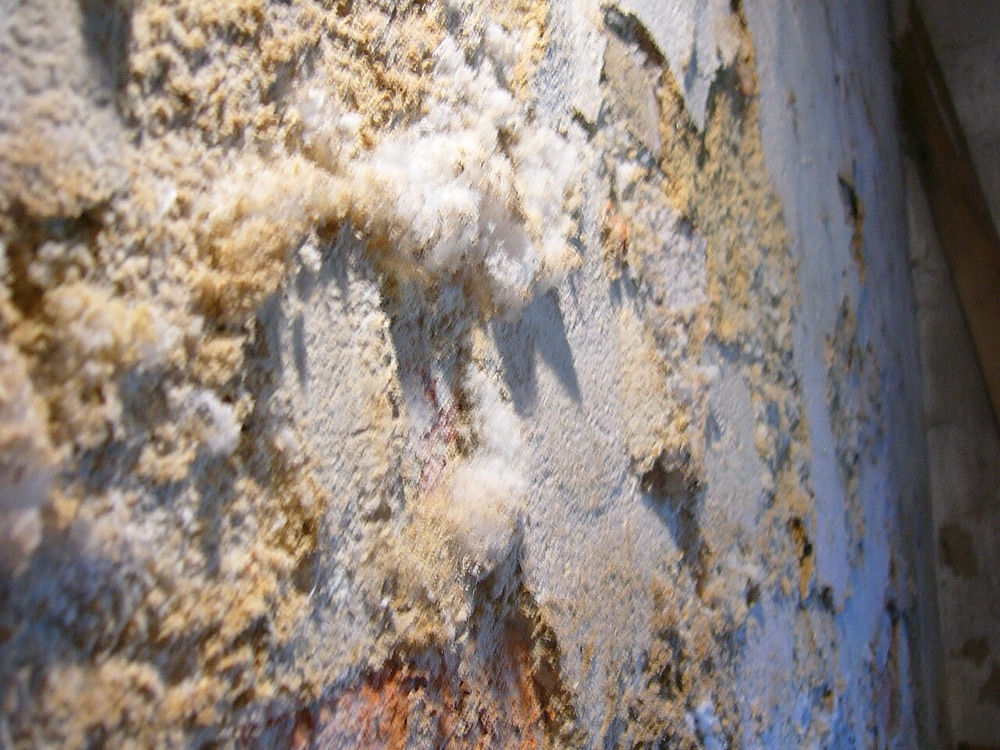
Efflorescence dissolves into the surface and vanishes. Fungal growth stays put, and water frequently beads on it.
Salt crushes to a gritty powder with the feel of chalk. A colony smears instead, and has a slightly greasy or fibrous quality.
Active growth smells earthy and musty. Mineral deposit smells of nothing at all.
Efflorescence needs salts, so it only forms on masonry, concrete, brick, and mortar. Anything white on timber, drywall paper, paint, or fabric is not efflorescence.
Efflorescence causes no harm by itself, though it does confirm that water is tracking through the wall, and that same moisture route is what feeds fungal growth nearby. Finding it means there is a water path worth following even when nothing is growing yet.
White mold on wood
Timber is porous and organic, which makes it both shelter and food. Pale growth turns up most often on framing, floor joists, subfloor decking, roof sheathing, unfinished furniture, and the underside of wooden bed frames pressed against cool exterior walls.
Sealed or painted timber usually carries the problem on top of the finish, where cleaning reaches it. Bare wood behaves differently, since hyphae push into the grain and a surface wipe leaves that network alive to return.
Pressing the timber firmly with a screwdriver tip or a fingernail tells you more than looking at it does. Wood that resists is structurally sound and worth cleaning. Wood that yields, feels spongy, or crumbles has passed into rot, and rotted timber is replaced rather than cleaned. Our guide to mold and mildew on wood works through that press test in full.
Powdery white mold on wood in a loft or crawl space usually signals a ventilation fault rather than a leak, because those voids hold humid air against cold timber for months at a time. That difference redirects the whole repair, from chasing a water source to moving air.
White mold on walls
Interior walls grow pale colonies on painted plaster, wallpaper, and the paper facing of plasterboard. Fluffy white mold on interior walls gathers where surfaces run coldest: behind furniture backed against outside walls, in the junction of two external walls, around window reveals, and along skirting in rooms where air sits still.
Sound painted plaster and painted plasterboard generally clean up, because the paint film holds growth on the surface. Wallpaper is less recoverable, as the paste feeds colonies that then spread behind the paper beyond reach. Plasterboard whose paper facing has been penetrated, shown by staining that survives cleaning or a facing that has gone soft, needs that section cut away and replaced.
The working method for painted surfaces appears in our guide to removing mold from walls, and the question of whether you are looking at surface growth or something rooted is handled in black mold vs mildew.
White mold in basements, crawl spaces, and attics
These three spaces generate more reports of white mold in a house than everywhere else combined, for one shared reason. Each traps humid air against cold surfaces, and nobody inspects them often.
Basements pair below-grade cold walls with moisture migrating through concrete and very little air exchange. Pale growth on overhead joists, cardboard storage boxes, and stored furniture is routine, and possessions are often colonised well before the structure is.
Crawl spaces floored with bare earth vent ground moisture into a sealed cavity continuously. White mold under a house on joists and subfloor decking is close to expected wherever no vapour barrier has been laid, and air rising through floor penetrations carries spores into the rooms above.
Lofts and attics grow it on rafters and roof sheathing, generally because warm moist air escaping upward from the house condenses on cold timber. Bathroom extractor fans discharging into the loft instead of through the roof are a frequent single cause, and finding one usually accounts for everything else.
All three respond to the same order of work, which is worth following even when the growth is what draws your attention first. Reducing the moisture entering the space comes before improving ventilation, and both come before cleaning, since cleaning a space that is still damp leaves the conditions that grew it in place. The dew point calculator shows whether the air in a cold basement is already condensing on the surfaces around it, and the dehumidifier guide covers the capacity these spaces actually need. Our basement mold guide works through the same problem below grade.
White mold on carpet, fabric, and clothes
Textiles hold water far longer than hard surfaces, and pale growth on fabric usually traces to a specific event: washing left sitting in the machine, a wardrobe against a cold external wall, storage in a loft or basement, or an item packed away before it dried through. A mattress on a solid base grows it on the underside for the same reason.
Washable items are generally recoverable, and the approach is roughly the same whatever the fabric. Brushing the loose material off outdoors keeps spores out of the house, after which the hottest cycle the fabric tolerates, with an oxygen bleach additive, does the work. Drying them completely afterwards matters as much as the wash, and sunlight helps where it is available. Anything that still smells afterwards is holding residue deep in the fibres and benefits from a soak in oxygen bleach before a second wash.
Leather, suede, and tailored pieces respond badly to home treatment and are better sent to a specialist cleaner. Items showing rot, or growth running through the weave rather than resting on it, are rarely worth the effort of saving.
Carpet is a case of its own, built from three layers, and growth in the backing or underlay behaves nothing like growth in the pile. White mold on carpet is frequently a young colony that has not yet darkened, and whether it can be saved turns on how long the carpet stayed wet, which our guide to mold in carpet works through in detail.
White mold on houseplant soil
The white fuzz appearing on potting compost is almost always a saprophytic fungus, meaning it consumes decaying organic matter in the soil rather than living tissue. It poses little threat to a healthy plant and none to the people in the room. Unlike white growth on walls or timber, it points to how the plant is being watered rather than to a moisture problem in the building.
It shows up when watering outpaces what the plant uses, when a pot drains poorly, when air barely moves in the room, or when light levels sit low. Those same conditions eventually put roots under strain, so the fuzz functions as feedback about care.
Since the growth lives on the surface layer rather than in the root zone, dealing with it is mostly a matter of removing that layer and changing the conditions that produced it. Scraping away the top inch or two of compost along with the visible growth, then topping up with fresh material, clears what is there. Letting the soil dry further between waterings, moving the plant somewhere brighter with better circulation, and clearing fallen leaves off the surface addresses why it appeared. A light scatter of cinnamon has mild antifungal properties and is widely used to discourage a repeat.
Growth that keeps returning after a soil change generally means the pot is not draining properly or the plant is being watered on a schedule instead of by need.
White powdery mildew on plant leaves
The white coating that forms on plant foliage is a different organism entirely from anything else in this article. Powdery mildew belongs to the order Erysiphales, and unlike the household molds above, these fungi are obligate parasites that can only live on living plant tissue. They cannot colonise your walls, and household mold cannot colonise your peonies.
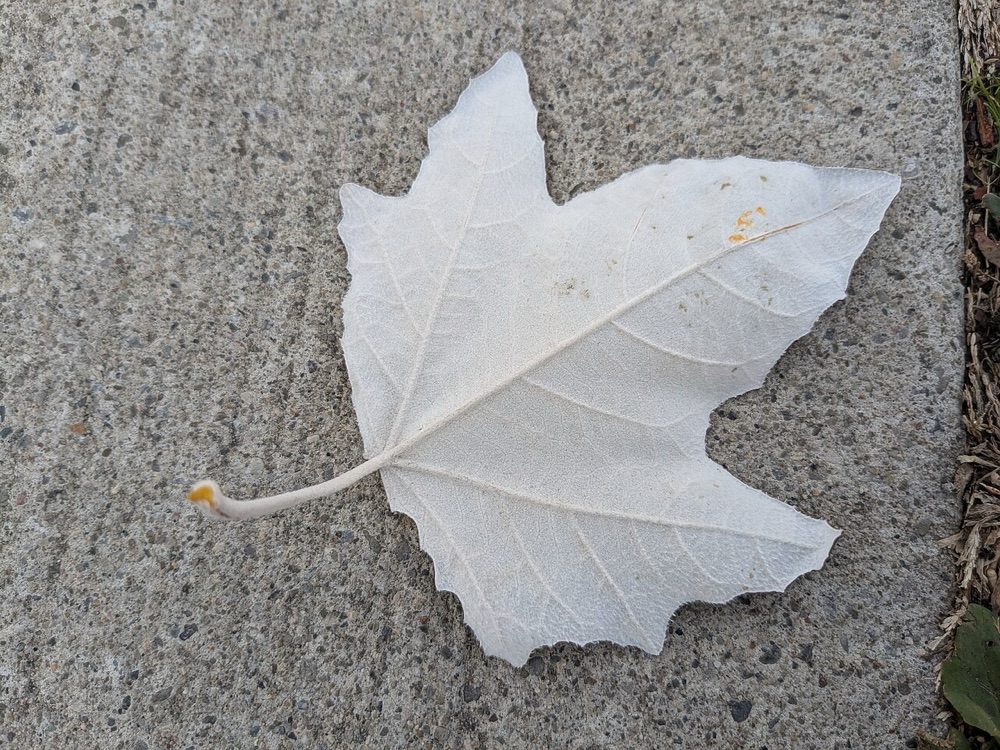
It presents as a dusty white or greyish film, typically starting on upper leaf surfaces and spreading to stems and buds. Squash, cucumbers, roses, peonies, phlox, lilacs, and grapes are frequent hosts, and the species are largely host-specific, so an outbreak on one plant does not automatically threaten a different genus beside it.
Powdery mildew thrives with warm dry days and humid nights, which is close to the opposite of what most fungi need. It does not require standing water on the leaf to germinate, so it spreads through dry summers that keep other plant diseases dormant.
Control works on two fronts, removing what is infected and making the plant a less comfortable host. Affected leaves are best binned rather than composted, and thinning crowded growth or spacing plants further apart opens up the airflow that discourages it. Potassium bicarbonate sprays work well and are the most reliable home option, neem oil offers both treatment and prevention, and sulfur-based fungicides are effective when applied before temperatures climb too high. Watering at soil level rather than over the foliage, and doing it in the morning, keeps night-time leaf humidity down.
Powdery mildew presents no direct health risk to people, which sets it apart from the indoor growth covered elsewhere here.
White mold on bread and food
Fuzzy white growth on bread is typically Rhizopus stolonifer, commonly called black bread mold, which begins white and darkens as its spore heads mature. Penicillium and Mucor species appear on food just as readily, and all three can be white at first sight.
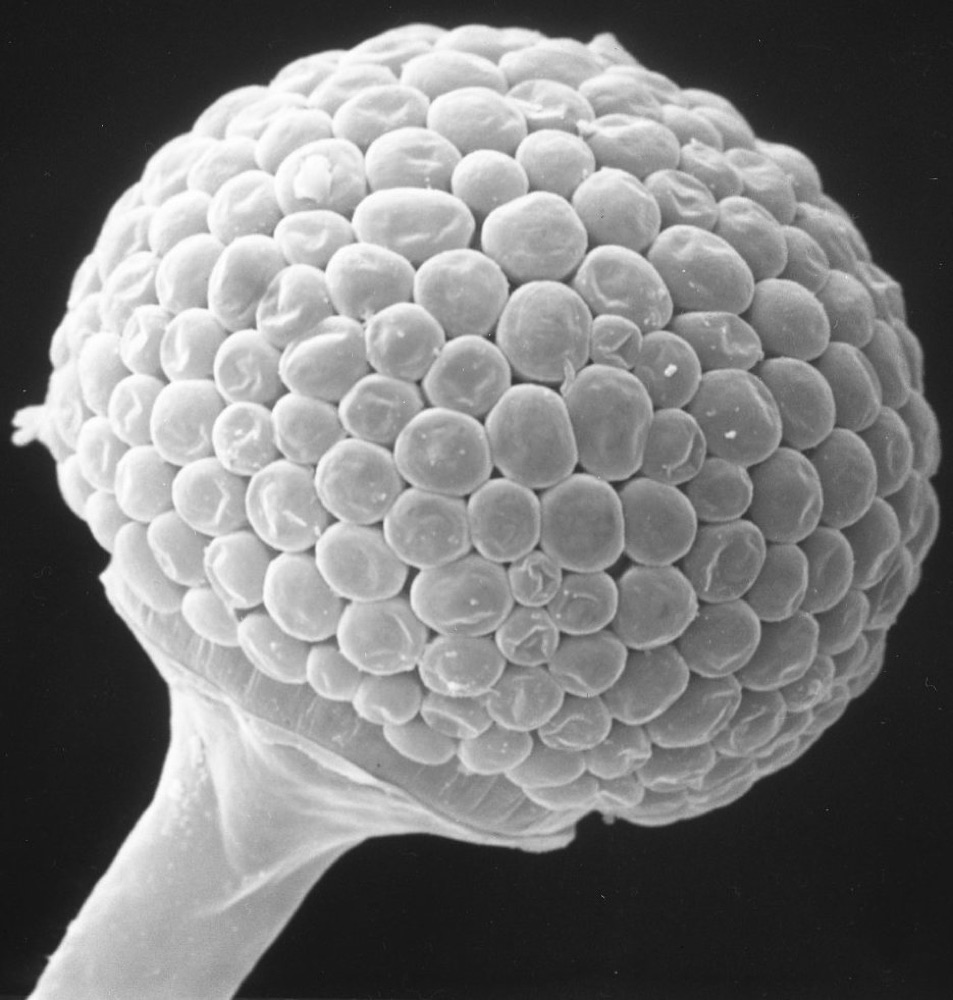
Food safety guidance on this is stricter than most people expect, and the reasoning matters. Soft, moist foods should be discarded whole rather than trimmed, because their high water content lets hyphae and any associated toxins spread well beyond the visible patch. That covers bread, soft fruit, soft cheese, yoghurt, jam, cooked leftovers, and peanut butter.
Dense, low-moisture foods can be salvaged by cutting at least an inch around and beneath the affected area with a clean knife, which applies to hard cheeses, firm carrots, and cured meats such as salami. The mold cultures deliberately grown in blue cheese and on brie rinds are a separate matter entirely and pose no issue.
Mycotoxins produced by some species are heat-stable, so cooking or toasting does not neutralise them.
Recurring mold on food stored in one particular spot is usually telling you the humidity in that cupboard or room is higher than it should be, which links the kitchen bin back to the wider damp question.
White water mold in pools and hot tubs
White water mold is neither a household mold nor, strictly speaking, a fungus. It is a biofilm formed largely by Saprolegnia species and Chytridiomycota, organisms classed among the protists that behave like fungi without belonging to them. Pool owners encounter it as white or off-white sheets drifting in the water or clinging to surfaces, most often described as looking like wet tissue paper, shredded kitchen roll, or cotton wool, with a slick gelatinous feel between the fingers.
The biofilm matrix is built from cellulose, glucans, and chitin, which shields the organisms inside from normal sanitiser levels, so a pool holding correct chlorine can still develop it. Pink slime, the Serratia marcescens bacterium, frequently accompanies it, since both exploit the same neglected corners.
Order matters more here than with most cleaning jobs, because the biofilm and the filter can each undo the other. Cleaning or backwashing the filter comes first, since spores shelter inside it and an untreated filter reseeds the pool the moment you restart circulation. Then break the biofilm up mechanically with a brush, net, and vacuum, since chemicals struggle to penetrate an intact matrix. Only then shock the water, at a substantially higher chlorine concentration than routine treatment and held for an extended period rather than a single dose. Brush again as the shock works, and keep circulation running throughout.
Prevention comes down to circulation and attention: run the pump long enough each day, brush the surfaces that never get touched, keep sanitiser levels steady rather than letting them swing, and clean the filter on schedule.
How to remove white mold
Removal on household surfaces follows the same order regardless of what the growth turns out to be, since the sequence is built around the moisture rather than the species. Plant soil, foliage, food, and pool water each behave differently and are covered in their own sections above.
Growth returns wherever water keeps arriving, whether from a leak, condensation on cold surfaces, ground moisture, or air held above 60 percent humidity. This step determines whether the rest of the work lasts.
An N95 respirator, gloves, and eye protection. Disturbing a colony puts spores into the air, and overhead work in a loft or crawl space delivers them straight into your breathing zone.
Shut interior doors, open exterior windows, and cover anything nearby you would rather spores did not settle on.
where the surface permits, then empty it outdoors into a sealed bag. Ordinary vacuums blow fine spores straight back into the room.
On porous materials and stubborn patches, undiluted white vinegar left in contact for an hour outperforms bleach, whose active ingredient stays on the surface while its water content soaks into what lies beneath. Three percent hydrogen peroxide serves as a colour-safe alternative.
once it is clean and dry, then seal it. Keep the respirator on and a vacuum running, because dry sanding throws fine dust into the air.
with fans or a dehumidifier for a full 24 hours afterwards. Growth resumes on a surface left damp.
where growth has entered plasterboard, insulation, carpet underlay, or ceiling tile, since cleaning the face of those materials leaves the colony inside them.
When white mold needs a professional
Most white mold a homeowner finds is within reach of a cloth and an afternoon. A few situations are not, and they tend to share one feature: the growth is somewhere you cannot fully see or reach. It is worth bringing someone in when the affected area passes roughly 10 square feet, when growth sits inside wall cavities, ductwork, or insulation, when timber has softened or structure is involved, when it reappears within weeks despite the moisture being corrected, or when a member of the household has asthma, reduced immunity, or an existing respiratory condition.
Crawl spaces and lofts justify outside help earlier than living areas do, because working in a cramped, poorly ventilated void while disturbing established growth is a substantially higher-exposure job than wiping down a bathroom wall. Our black mold remediation guide covers what containment and professional removal involve at that scale.
Preventing white mold
Generally speaking, white mold growth can be reduced by controlling two things: how much moisture is in the air, and how freely that air moves. Everything below follows from those two.
On the humidity side, a range of 30 to 50 percent relative humidity keeps most species from establishing, and a dehumidifier through the damp months with a cheap hygrometer to read the actual figure is usually enough to hold it there. On the airflow side, the spaces that trap still air tend to be the ones that grow things first, which means basements, lofts, wardrobes, and any room kept shut for long stretches are worth opening up. Leaving a gap behind furniture standing against exterior walls helps for the same reason.
A few structural checks are worth making once rather than repeatedly. A vapour barrier over bare earth in a crawl space cuts off ground moisture at the source. Bathroom and kitchen extractors sometimes discharge into a roof void rather than outdoors, which quietly feeds the loft above. Leaks repaired in the week they appear, and anything wet dried inside 24 to 48 hours, stay ahead of the window in which colonies establish.
A dry building does not produce white mold, and keeping that humidity figure steady prevents far more of it than anything applied after the fact. A recurring musty smell with nothing visible behind it is worth following up, and our guide to tracking a musty smell to its source gives the search order room by room.
If a building has been damp for a season and you have had congestion, fatigue or brain fog that eases when you are away from home, the Visual Contrast Sensitivity test measures a neurological effect of biotoxin exposure. Free, in your browser, about 15 minutes.
Frequently asked questions
Is white mold dangerous?
It carries the same risks as mold in any other colour, because the same species produce it. Effects are usually allergic and respiratory, and several genera appearing white are capable of producing mycotoxins. How seriously to take it depends on the size of the patch, whether it has penetrated the material, and whether anyone in the home is very young, elderly, asthmatic, or immunocompromised.
How can I tell white mold from efflorescence?
Spray the area with water. Efflorescence dissolves and disappears; mold does not. Efflorescence also crushes into gritty powder, gives off no smell, and forms only on masonry, concrete, or brick. Mold smears when rubbed, carries a musty odour, and grows on organic materials as well as stone.
Why is some mold white and other mold black?
Colour comes largely from spores, so a colony that has not begun sporulating usually looks white or cream. The identical species can present white while young and green, grey, or black once mature, and a few remain pale for life.
Can I remove white mold myself?
Patches under roughly 10 square feet on hard or sealed surfaces are reasonable to tackle with an N95, gloves, eye protection, and either detergent and water or undiluted vinegar left to dwell. Growth inside walls, insulation, ductwork, or spread across larger areas belongs with a remediation professional.
Is white mold on houseplant soil harmful?
Usually not. It is normally a saprophytic fungus living on decaying matter in the compost rather than on the plant or on you. Scrape off the top inch or two of soil, water less often, and improve the light and airflow around the pot.
What kills white mold?
Undiluted white vinegar held against the surface for an hour handles most household species, and detergent with water suffices for light growth on hard materials. Three percent hydrogen peroxide covers situations where vinegar is unsuitable. Bleach underperforms on porous surfaces because the water in it soaks inward while the active ingredient remains on top.
Does white mold turn into black mold?
A pale colony commonly darkens as it matures and produces spores, so the same patch can look black weeks later. That is a change in appearance, not a change of organism, and it does not mean the growth became Stachybotrys chartarum, which is a specific species requiring sustained saturation.
Is white mold on wood a structural problem?
Not inherently. Press the timber firmly: wood that stays hard is sound and can be cleaned and sealed, while wood that feels soft or spongy has started to rot and needs replacing. Growth on loft or crawl space timber generally indicates a ventilation fault rather than a leak.
Is powdery mildew on plants the same as white mold in a house?
No. Powdery mildew comes from the order Erysiphales, fungi that can only survive on living plant tissue. It cannot spread to your walls, household mold cannot infect your plants, and powdery mildew poses no direct health risk to people.
Can I cut the mold off bread and eat the rest?
No. Bread is soft and moist, which lets the fungal network and any toxins extend well past the visible patch, so the loaf should be discarded. Hard, dry foods such as firm cheese, carrots, and salami can be salvaged by cutting an inch around and below the affected area.
Test Yourself Against Mold Toxicity
The Visual Contrast Sensitivity test measures a neurological effect of biotoxin exposure that most people cannot notice on their own. Free, online, and under 15 minutes.