Complete Guide for Natural Black Mold Removal
Artificial harmful chemicals are not the only option for removing black mold from water damaged ceilings and bathrooms. Natural substances like vinegar, tea tree oil, hydrogen peroxide and alcohol can be highly effective when used correctly.
Undiluted white vinegar left on a surface for a full hour will clear black mold from tile, grout, sealant and paint. But the half vinegar, half water mix you see everywhere drops the acid below the strength that does the job.
This guide covers the natural route only. Where growth has gone past what a household cleaner reaches, our black mold remediation guide covers the containment, cutting out and professional side of the work.
Note: Mold and mould are the same word, spelled two ways. This article uses the American spelling.
What black mold is
Mold is a fungus, and the dark patch on your wall is the part you can see of something larger. Beneath it runs a network of fine threads called hyphae, which form the mycelium and push into the material, digesting it for food. The surface bloom is mostly the reproductive layer, producing spores.
Black mold usually means one of two quite different things. In everyday use it covers any dark growth. What turns up in bathrooms is usually Cladosporium or a general dark mildew sitting on the surface. Used strictly, it means Stachybotrys chartarum, which is a slimy, very dark green-black growth that needs a surface kept near saturation for a week or two before it establishes.
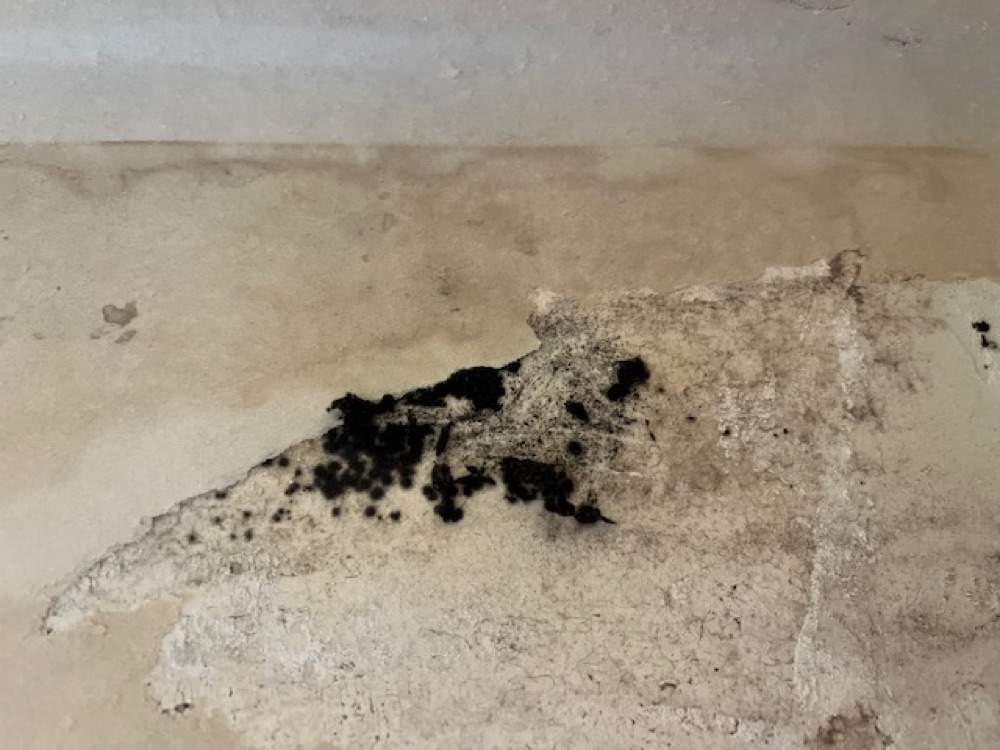
Stachybotrys carries a thicker, heavily melanised cell wall. The pigment that makes it look black also helps it resist acid, so it responds less readily to vinegar than Aspergillus or Penicillium do. Its presence also tells you the water has been running long enough to reach material behind the surface. If you are unsure which you have, telling black mold from mildew takes about a minute with a damp cloth.
Spores themselves are ordinary. They drift in through windows, settle everywhere, and no house has ever been free of them. Moisture is what wakes them up, which is why drying the surface afterwards counts for as much as the cleaning.
Where black mold grows
Black mold needs moisture, though it does not always come from a leak. Humidity, condensation on a cold wall, or air that never moves will do it just as well. The shape of the growth usually gives away which one you are dealing with.
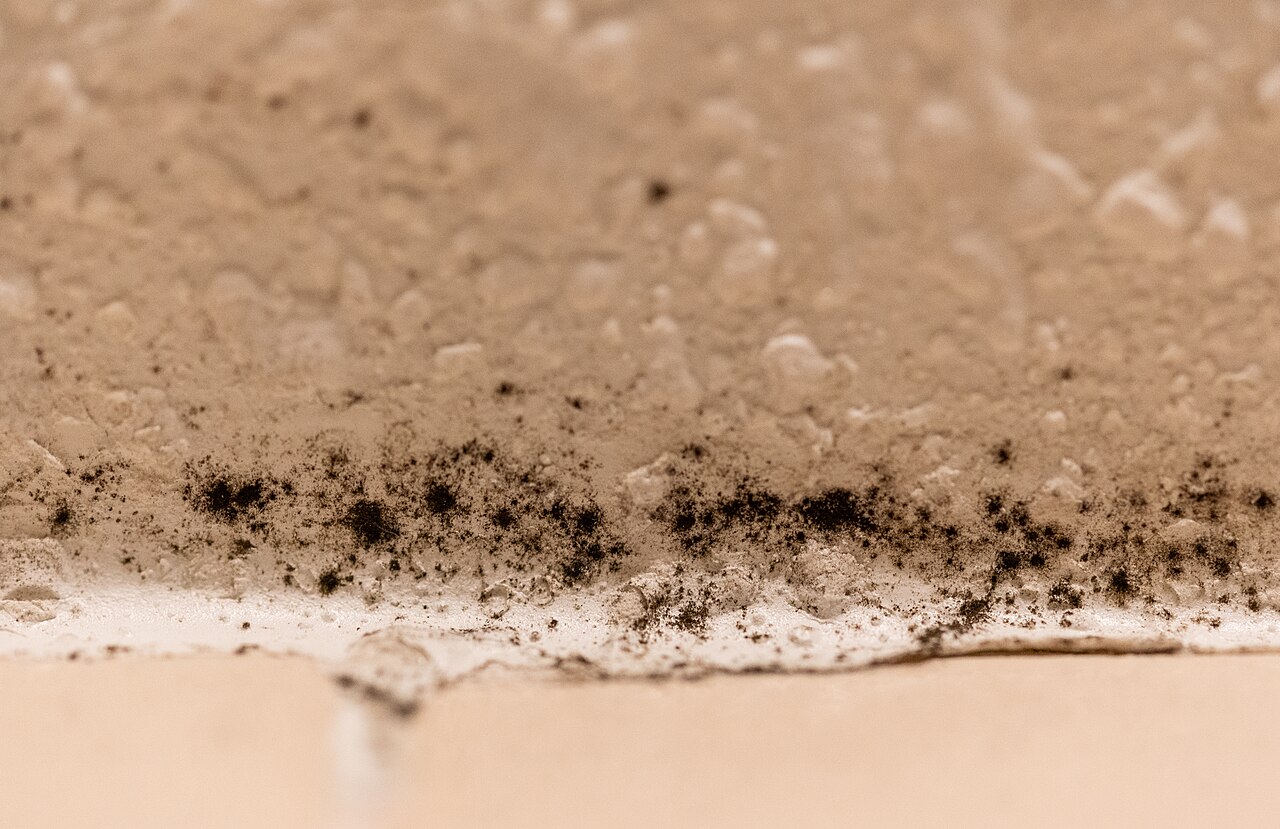
It is usually best to start with bathroom grout, then the silicone sealant around baths or shower trays, then the ceiling above the shower. Window reveals collect condensation overnight. Other common spots are behind furniture pushed flat against an outside wall, under kitchen sinks, and inside the door gasket of a front-loading washing machine. Basements and crawl spaces stay cool and damp year round. In lofts, the place to look is wherever a bathroom fan vents into the roof space instead of outside.

A persistent musty smell with nothing visible usually means growth somewhere you have not looked yet.
What you need
Everything here comes from a supermarket or hardware shop.
- White vinegar, 5% acidity, at least a litre
- Two spray bottles, one for vinegar and one for the follow-up
- 3% hydrogen peroxide from a pharmacy
- Baking soda
- Borax, if you want residual protection afterwards
- A stiff brush for grout and a soft cloth for painted surfaces
- An old toothbrush for corners and sealant
- Disposable cloths or paper towels
- Heavy-duty bin bags
- N95 respirator, non-porous gloves, and goggles rather than glasses
A box fan and a correctly sized dehumidifier both help at the drying stage, and a vacuum with a true HEPA filter is useful if you happen to own one.
Protecting yourself and the rest of the house
Scrubbing a colony sends spores into the air, and the heating or air conditioning system will carry them into rooms that were clean before you started. Four steps prevent that.
Closing the door and pushing a towel against the gap underneath makes a real difference. Central heating or air conditioning is best switched off, with plastic taped over any vents in the room.
An exterior window with a box fan in it blowing outward puts the room under slight negative pressure, so air leaves the building instead of drifting into the hallway.
Misting the surface with plain water before touching it keeps spores from going airborne. Dry brushing or dry sanding mold is the one thing to avoid outright.
The N95, gloves and goggles are easier to put on before starting than partway through.
Steps to remove mold naturally
Mold colonises damp material within 24 to 48 hours, so cleaning a surface that keeps getting wet buys you a couple of days. Tracing the leak, improving the ventilation or bringing the humidity down comes first.
Spray the area lightly with water and let it settle for a few minutes. If you own a HEPA vacuum, which captures 99.97% of particles at 0.3 microns, vacuum the area now. An ordinary household vacuum passes spores through the bag and out the exhaust, so without HEPA it is better to skip this.
Neat 5% white vinegar goes into a spray bottle. The growth wants soaking along with about 12 inches beyond its visible edge, since hyphae reach further than the colour does. Standard white vinegar sits at the concentration with good evidence behind it, and cutting it to 2.5% with water takes it into the range where it falls away sharply.
Acetic acid needs time to cross the fungal cell wall, then acidify what is inside. Spraying and wiping straight away achieves almost nothing, and skipping the hour is the usual reason a patch comes back. An hour is the minimum, and longer does no harm.
Once the vinegar is wiped away, 3% hydrogen peroxide left for 10 to 15 minutes handles what the acid missed and lightens staining. The two work well in sequence with a wipe between, though never mixed in one bottle.
A teaspoon of baking soda in two cups of water in a spray bottle, or a thicker paste for grout, gives you a gentle abrasive that lifts residue without scratching. A stiff brush suits grout and masonry, a soft cloth suits paint. Working steadily rather than vigorously lets the residue lift off instead of scattering.
Dead mold still triggers allergies, so a surface that has been sprayed but never wiped can keep causing symptoms. Disposable cloths are easiest here, going straight into a bag that can be double-bagged and carried out through the window or nearest exterior door.
Keep the fans, dehumidifier and window open. Anything still damp after the work will be growing again within weeks. Wood wants to read under 16% on a moisture meter.
One cup of borax in a gallon of warm water, applied and left without rinsing, raises the surface pH and discourages regrowth. Borax carries on inhibiting growth after you finish, and it does not off-gas the way bleach does.
Growth on wood behaves differently from growth on paint, and our guide to mold and mildew on wood covers where the grain lets hyphae run deeper than a spray reaches. The vinegar smell fades on its own within a few hours, faster with a window open.
The natural mold cleaners compared
Concentrations are what you buy off a shelf. Contact times are minimums before wiping.
| Cleaner | Use at | Contact time | Best on | Notes |
|---|---|---|---|---|
| White vinegar | Undiluted, 5% | 60 minutes | Grout, tile, glass, plastic, painted surfaces | Best supported household option. Do not dilute |
| Hydrogen peroxide | Undiluted, 3% | 10 to 15 minutes | Non-porous surfaces, light grout, some fabrics | Breaks down to water and oxygen. Test for bleaching first |
| Borax | 1 cup per gallon warm water | Leave on, no rinse | Tile, painted masonry, non-porous | Keeps inhibiting growth after you finish |
| Tea tree oil | 1 tsp per cup water | 60 minutes, no rinse | Small non-porous areas, sealant, washing machine seals | Strongest antifungal of the group. Keep away from cats. See our tea tree oil guide |
| Baking soda | 1 tsp per 2 cups water, or as paste | While scrubbing | Any washable surface | Abrasive and deodoriser rather than fungicide |
| Isopropyl alcohol | 70%, undiluted | Evaporates fast | Around electronics, quick spot jobs | No residual effect, evaporates before deep action |
| Grapefruit seed extract | 10 drops per cup water | 10 to 15 minutes | Non-porous | Popular but poorly evidenced. Commercial extracts are often adulterated |
For a whole-room job, vinegar first, baking soda to scrub, borax to finish. That sequence handles black mold naturally on almost any hard surface. Tea tree oil is the upgrade for spots that keep coming back in a pet-free home.
Surfaces vinegar can damage
Vinegar is a mild acid, so a few surfaces react badly to it.
It corrodes aluminium and cast iron, so those are best left to something else. Natural stone including marble, granite, travertine and limestone will etch, leaving a dull patch that does not polish out. Waxed or oiled wood loses its finish. Grout that has not been sealed can soften with repeated acid exposure, so use it there but not weekly.
On those surfaces, 3% hydrogen peroxide makes a straightforward substitute, or a baking soda paste where the growth is light enough to lift mechanically.
Testing a hidden corner first takes a minute and saves a worktop.
Combinations to avoid
Hydrogen peroxide and vinegar should not share a bottle either. Combined they form peracetic acid, which is corrosive to skin, eyes and airways. Using them one after another on the same surface, with a wipe in between, is fine and works well.
Vinegar and baking soda together simply cancel out. An acid and a base neutralise each other, the fizzing is carbon dioxide, and what remains is close to salt water. Both are useful here, just at different stages.
What cleans up and what has to come out
Hyphae grow down into whatever the mold is feeding on, while a liquid cleaner only ever reaches the surface.
| Material | Type | Can you clean it? |
|---|---|---|
| Glazed tile, glass, metal, hard plastic, sealed stone | Non-porous | Yes |
| Sealed grout, painted wood, finished worktops | Semi-porous | Usually, with scrubbing and patience |
| Unsealed grout, bare wood, brick, concrete | Semi-porous | Often, though expect to repeat it |
| Drywall, ceiling tile, insulation, carpet and underlay, upholstery, cardboard | Porous | No. These come out rather than get cleaned |
Drywall is the common exception people ask about. The paper facing is cellulose, mold eats cellulose, and by the time a colony is visible the hyphae have gone through the facing into the gypsum core. Cutting it out 12 inches beyond the visible edge is the standard remediation contractors work to, and our guide to removing mold from walls covers the procedure.
When to stop and call someone
A few situations call for a professional rather than a spray bottle.
Growth inside a wall cavity, under flooring, above a ceiling or anywhere in the heating and cooling system is beyond what surface cleaning reaches. So is anything that followed sewage or floodwater.
Where someone in the household is immunocompromised, asthmatic, pregnant, or an infant, the balance tips toward having someone else do the disturbing part.
Symptoms that ease when someone leaves the house and return when they come back point at the building rather than at the wall you are cleaning. The symptoms associated with mold exposure cluster in recognisable ways, and our free VCS test screens for the visual contrast deficit linked to biotoxin exposure in about fifteen minutes.
Where exposure has already gone on long enough to affect someone, clearing the wall is the first half of the job. Our mold detox protocol covers what follows, in the order that makes it work.
The screening runs in your browser and takes about fifteen minutes from calibration to result.
Start the test nowKeeping it from coming back
Cleaning buys you time. Controlling the moisture is what makes it last.
Indoor relative humidity sits best between 30 and 50%. A cheap hygrometer tells you where you are, and a dehumidifier closes the gap in rooms that run damp. Sustained above 60%, growth becomes possible with no leak at all.
The bathroom extractor fan does most good running through every shower and for twenty minutes afterwards, assuming it vents outside rather than into the loft.
A spray bottle of vinegar kept in the bathroom, misted over the shower walls and screen after use, stops the film that feeds regrowth. Adding vinegar to the mopping water does the same on floors.
A gap behind furniture on external walls lets air move, and wardrobes on those walls benefit from having their doors left open now and then.
Leaks are best dealt with the day they turn up, given that 24 to 48 hour window before anything starts.
Checking the same spots four weeks later tells you whether it held. Regrowth inside a month means water is still arriving, and no amount of further cleaning will settle it until that is dealt with. For an actual measurement, a HERTSMI-2 dust panel runs roughly $150 to $200, and our test interpreter will read the result for you. Sample no sooner than four to six weeks after cleaning, since testing earlier returns a falsely clean answer.
Common questions
Does vinegar kill black mold?
On hard surfaces, yes. Undiluted 5% white vinegar left for an hour has solid evidence behind it against Aspergillus, Penicillium and Cladosporium, which covers most household growth. Stachybotrys chartarum, the true black mold, resists acid better thanks to its melanised cell wall, and its presence usually means water has already reached material behind the surface.
Should you dilute vinegar to clean mold?
No. Standard white vinegar is 5% acetic acid, which is the concentration the evidence supports. A half-and-half mix takes you to 2.5%, where effectiveness drops off steeply, so neat is the way to go.
How long do you leave vinegar on mold?
At least 60 minutes, and longer is fine. The acid needs that time to cross the fungal cell wall, so spraying and wiping immediately achieves very little.
Is vinegar or bleach better for mold?
On porous materials, vinegar. Household bleach is 95 to 97% water, so on absorbent surfaces the water soaks in while the chlorine stays on top. The EPA does not recommend bleach for porous materials. On non-porous surfaces both work, and vinegar spares you the fumes. Never combine the two.
Does baking soda kill mold?
Only weakly. Its real value is as a gentle abrasive that lifts residue without scratching, plus it deodorises well. Use it for the scrubbing stage and let vinegar or peroxide do the killing.
Can you mix vinegar and baking soda for mold?
There is no benefit, because an acid and a base neutralise each other and leave you with something close to salt water. Vinegar first for the hour, then baking soda separately as the scrub, works better than combining them.
Does hydrogen peroxide kill black mold?
Yes. Household 3% hydrogen peroxide is an effective antifungal oxidiser and works in 10 to 15 minutes on non-porous surfaces. It breaks down into water and oxygen, leaving no residue. A hidden spot is worth testing first, since it lightens some fabrics and finishes.
Do essential oils remove mold?
Tea tree oil has the strongest evidence of the group. It works well on small non-porous areas at a teaspoon per cup of water, left an hour without rinsing. Clove and eucalyptus have antifungal activity too. Grapefruit seed extract is best skipped, since commercial preparations are frequently adulterated with synthetic preservatives.
Is it safe to remove black mold yourself?
Under 10 square feet, on hard surfaces, with the room contained and an N95 on, generally yes. Above that, inside wall cavities or ductwork, or where someone in the house is immunocompromised, asthmatic, pregnant or an infant, hand it over.
Will cleaning the mold stop my symptoms?
Removing the source is the first step. Dead mold still triggers allergic reactions, which is why the surface has to be physically wiped rather than only sprayed, and why the bagging step matters. Where symptoms have been running for months, assess the exposure separately from the wall.