We Tried 9 Air Purifier for Mold: Here is What We Think
An air purifier for mold works because mold spores are large. The EPA puts most of them between 2 and 10 microns, and a True HEPA filter captures 99.97 percent of particles down to 0.3 microns, so any properly rated unit removes spores from the air passing through it. However, air purifiers differ in other traits. For example, some move far more air than others, some carry enough activated carbon to deal with the musty gases mold releases while others carry almost none, some add ozone to your room while claiming to help, and the replacement filters cost very different amounts over the years you will actually run them.
One point sits underneath every recommendation below. A purifier cleans air. It does not touch the colony producing the spores, so a unit running beside a damp wall is treating a symptom on a schedule. We chose the units here for you if you are fixing the moisture and want the air clean while you do, or if you live with a problem you cannot fully remove, such as a rented flat or a slab basement.
Note: Mold and mould are the same thing, spelled differently on either side of the Atlantic, so an air purifier for mould and an air purifier for mold are the same purchase. This article uses the American spelling throughout.
What an air purifier for mold can and cannot do
Three things come off mold and into your air, and a purifier handles each differently.
Spores are the reproductive particles, and at 2 to 10 microns they are among the easiest things a HEPA filter ever meets. Pollen runs 10 to 100 microns, fine dust below 2.5, and the 0.3 micron rating point that HEPA is tested at sits well below anything a fungus releases. Every unit in this article captures spores, and the differences between them on that count are about volume of air processed, not capture rate.
Fragments make up the second category, and they are the less discussed one. Colonies shed broken hyphae and cell wall pieces, some smaller than a micron, and these carry allergens and toxins on their surfaces. HEPA captures the large majority of them, with the finest fraction passing more readily, which is one reason a high-quality filter with a tighter rating matters more than marketing about spore removal suggests.
Microbial volatile organic compounds, or MVOCs, are the third. They are gases, produced as the colony feeds, and they are what you smell as musty. No particle filter touches a gas. Removing MVOCs requires adsorption onto activated carbon, and the amount of carbon in a unit decides how much it can hold before the filter is saturated and the smell returns. A thin carbon-coated mesh, which is what most mid-priced units ship with, saturates in weeks. Several pounds of granular carbon last months.
No purifier removes the source. Spores are released continuously from active growth, so a purifier running in a room with a colony is in a permanent race it cannot win outright, though it can hold airborne counts down substantially while the moisture problem gets fixed. Our guide to removing mold from walls and the black mold remediation guide cover that side of the job.
What matters when choosing an air purifier for mold
Whether the box says air purifier, air cleaner, or air filter for mold, the filter inside is what you are buying, and the phrase True HEPA matters because the alternatives are engineered to sound similar. "HEPA-type," "HEPA-like," and "99 percent HEPA" filters are not tested to the standard and can let through many times the particles a true filter does. H13 is the medical-grade classification, capturing 99.95 percent at the most penetrating particle size, and it is now common enough in consumer units that there is little reason to accept less.
Ask how much carbon the unit contains. Manufacturers who carry a meaningful amount, from roughly a pound upward to fifteen, say so, because it is a selling point. Manufacturers who do not describe the carbon layer with adjectives instead. For a room that smells musty, carbon weight is the specification that decides whether the smell goes. The same rule picks an air purifier for off-gassing from new furniture and paint.
Clean Air Delivery Rate, measured in cubic feet per minute, is the honest number for how much air a unit actually cleans. The working rule is a CADR of at least two-thirds of the room's square footage, so a 300 square foot room needs a CADR of 200 or more, which delivers roughly four to five air changes per hour. Buying a unit rated for a smaller space than you have means it runs flat out, loudly, and still falls behind.
Ionizers, plasma modes, and some UV systems produce ozone, a lung irritant that the EPA advises against generating indoors. Look for CARB certification, which limits ozone output, or UL 867 compliance, and treat any unit that markets ozone as a feature as disqualified. Several units below include an ionizer that can be switched off; leaving it off costs nothing.
A cheap purifier with expensive filters costs more over time than a dearer unit with cheap ones. Replacement HEPA filters run from around $20 to over $200 depending on the unit, on schedules from six months to five years, and that arithmetic often reorders the rankings.
UV-C lamps inside a purifier expose passing air for a fraction of a second, far too short to reliably inactivate spores, and photocatalytic oxidation and bipolar ionization have not displaced HEPA for particle removal in any independent testing. They are additions to a filter, not substitutes for one, and they inflate price more than performance.
The 9 best air purifiers for mold
There are many brands in the market, and most of them advertise mold removal in some form. We tested these nine specifically for mold, looking at the filter grade, the weight of activated carbon, the airflow against room size, ozone output, and the running cost of filters over five years. We also noticed that not all air purifiers are suitable for a mold problem, since several popular models rely on UV or ionization that adds little, and some carry a carbon layer too thin to touch a musty smell. Here are the nine we would put in a room with mold, in order of how well they handle it. Prices move, so we give each unit a band rather than a figure, and the links go to Amazon listings.
1. IQAir HealthPro Plus
$900 and up

The IQAir HealthPro Plus is the unit the mold-illness community keeps returning to, and the reasons hold up. Its HyperHEPA filter is tested to 0.003 microns, two orders of magnitude finer than the HEPA standard, which matters for the sub-micron fragment fraction more than for spores themselves.
It carries about five pounds of activated carbon and alumina in a separate gas-phase cartridge, and the fan moves enough air for spaces up to roughly 1,100 square feet. IQAir does not publish a CADR, which is a mark against transparency rather than performance.
The price sits around $900 and up, the unit is large and heavy, and the filter set is expensive, though the main HEPA is rated for up to four years. Buy it for a serious, ongoing exposure situation or chemical sensitivity, not for a bathroom that gets musty in winter.
Check price on Amazon2. Austin Air HealthMate Plus
$700 to $900

The Austin Air HealthMate Plus is the second unit we recommend for mold exposure. IQAir leads on particle filtration, and Austin Air leads on carbon. The HealthMate Plus packs roughly fifteen pounds of activated carbon and zeolite, more than any other consumer unit, around a medical-grade HEPA core, which makes it the strongest choice when the problem is MVOCs, musty odour, and chemical sensitivity as much as spores.
It is a steel box with a fan and no electronics to fail, filters last up to five years, and the unit is made in the United States. Weaknesses are honest ones: it is heavy, plain, louder on high than modern units, and priced around $700 to $900. No CADR is published.
For someone living with a damp building they cannot leave, this is the unit that handles the smell.
Check price on Amazon3. Coway Airmega AP-1512HH Mighty
$200 to $270
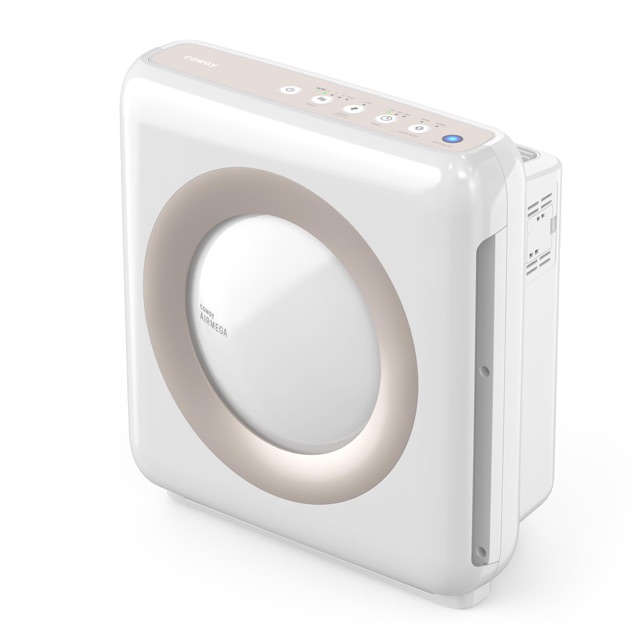
The Coway Airmega AP-1512HH Mighty is the best value in the field for a bedroom or living room up to about 360 square feet. It has True HEPA, a real carbon filter rather than a coated mesh, a CADR around 246 for smoke, quiet operation on low, and an auto mode driven by a particle sensor that actually works. It includes a switchable ionizer.
Replacement filters are inexpensive and available everywhere. The Mighty and its updated Mighty2 sibling appear on independent test rankings year after year, and at roughly $200 to $270 nothing else combines the performance and running cost this well.
Its limit is carbon quantity, so for a strongly musty room pair it with source removal rather than expecting it to clear the smell alone.
Check price on Amazon4. Winix 5500-2
Under $200
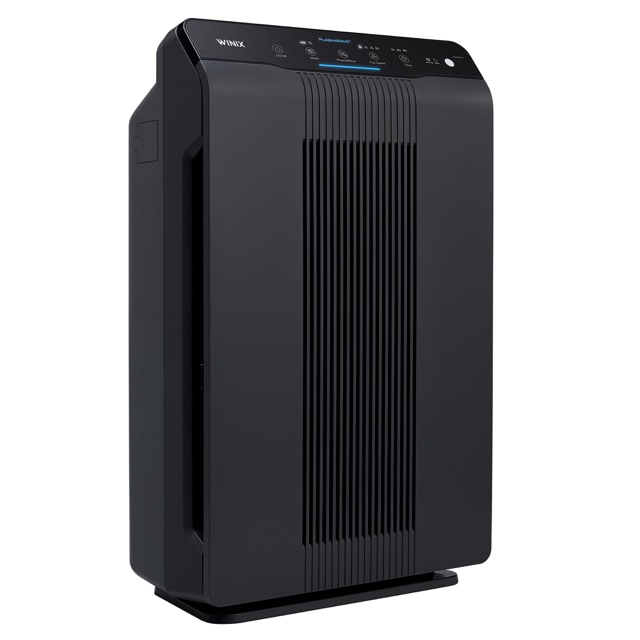
The Winix 5500-2 is our budget pick, and it does not behave like one. It has True HEPA, about 500 grams of granular activated carbon, which is a genuine amount at this price and more than most competitors under $300 carry, and a CADR around 232 for rooms to roughly 360 square feet.
Its PlasmaWave ionization mode is switchable, and filters are cheap. It is slightly louder than the Coway on high and the design is dated, but for under $200 it delivers verified HEPA performance with real carbon, which is exactly the combination mold calls for.
Check price on Amazon5. Levoit Core 600S
$250 to $300
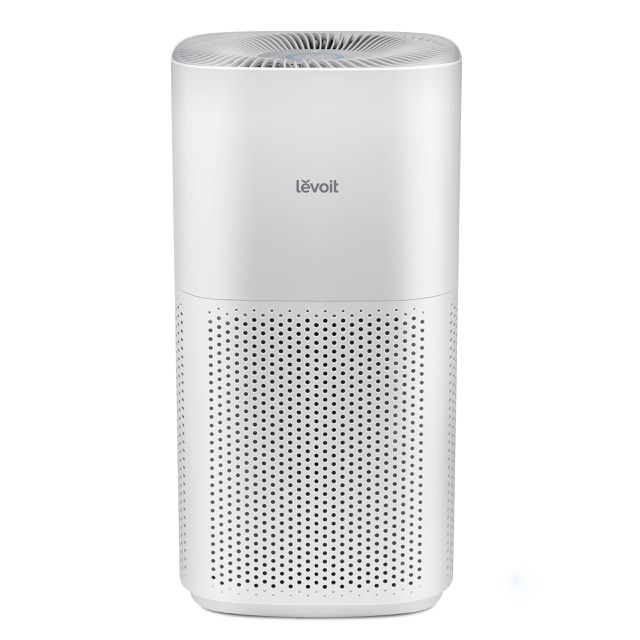
The Levoit Core 600S is the large-room option at a mid-range price. A CADR of about 391 handles open-plan spaces and basements up to roughly 600 square feet at a proper air-change rate, with an H13 True HEPA filter and a carbon layer, app control, and a particle sensor. It is quiet for its throughput.
The carbon quantity is moderate, so it is a spore-and-dust workhorse rather than an odour specialist, and Levoit sells a heavier "toxin absorber" filter variant worth choosing for a musty room. It is priced around $250 to $300, with reasonable filter costs.
Check price on Amazon6. Blueair Blue Pure 211+
Around $300
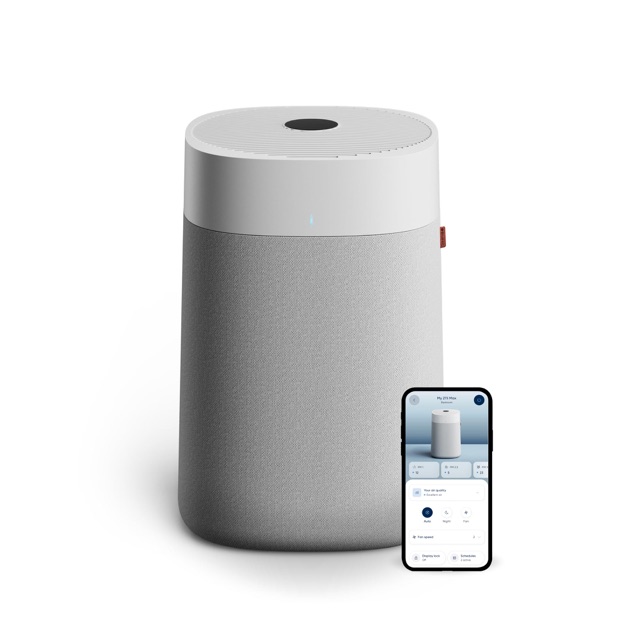
The Blueair Blue Pure 211+ is a high-CADR unit, around 350, that clears a large room fast and quietly, which is why it regularly appears among Consumer Reports' recommended purifiers. Blueair's filtration combines mechanical filtration with electrostatic charging to hit HEPA-equivalent capture at lower fan resistance, and the unit is simple to the point of having one button.
The carbon layer is thin, so this is a spore and particle machine first and a musty-smell machine a distant second. It costs around $300, with filters about every six months at moderate cost.
Check price on Amazon7. Alen BreatheSmart 75i
$700 to $800
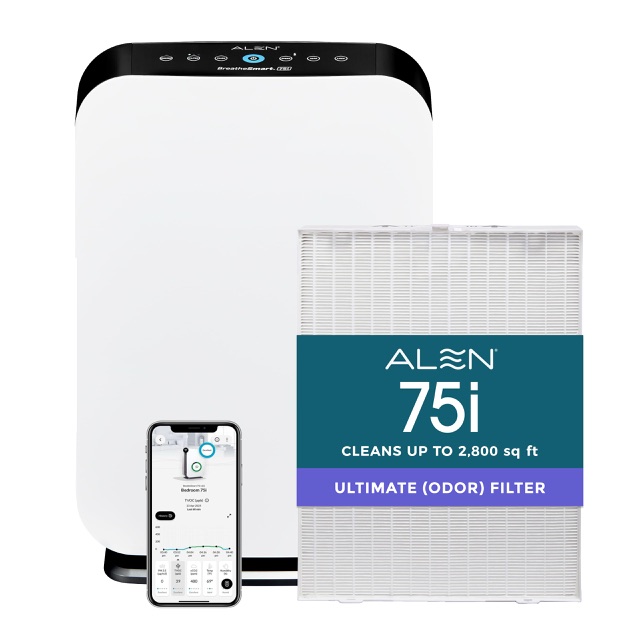
The Alen BreatheSmart 75i is built for very large spaces, up to about 1,300 square feet, with a CADR around 347 and H13 HEPA. Alen's advantage for mold is filter choice: the unit accepts a "Fresh" filter variant loaded with several pounds of activated carbon, which turns a large-room particle purifier into a credible odour and MVOC unit.
It is quiet, well built, and carries a lifetime warranty. Price is the obstacle, at roughly $700 to $800 plus filters around $100 each, but for an open-plan lower floor with a damp history it is the most capable single unit short of the IQAir.
Check price on Amazon8. Honeywell HPA300
Around $250
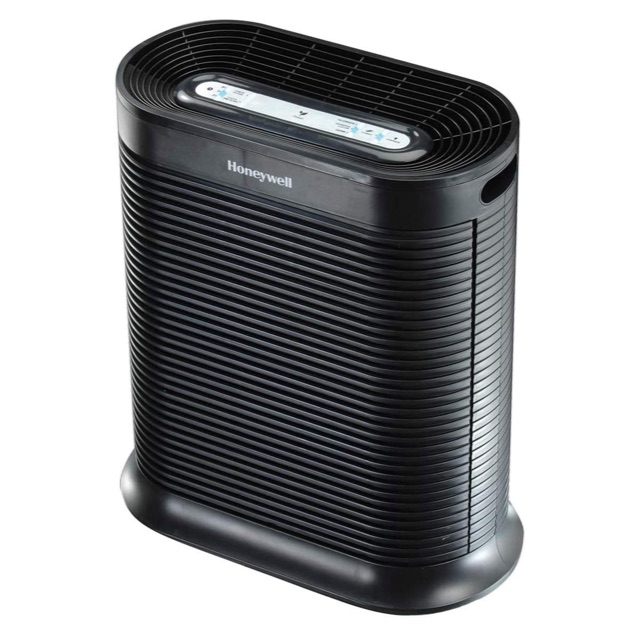
The Honeywell HPA300 is a long-running favourite in independent testing, with a CADR around 300 for rooms to about 465 square feet and true HEPA filtration. Its carbon pre-filter is a thin sheet, so odour handling is limited, and it runs louder than newer designs on the higher settings.
Filters are widely available and cheap, and the unit costs around $250. Choose it for reliable spore removal in a large bedroom or living room where the smell is not the main complaint.
Check price on Amazon9. Levoit Core 300
Around $100
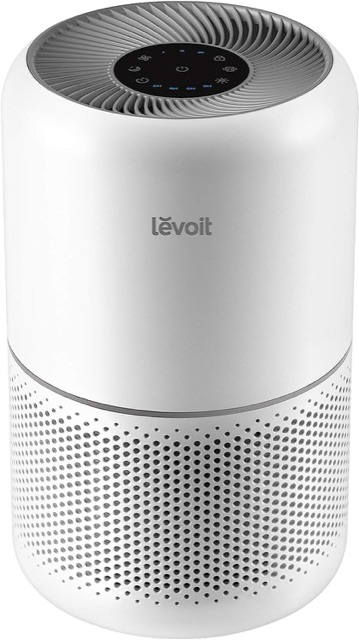
The Levoit Core 300 is the small-room budget unit, for a bedroom, office, or bathroom up to about 220 square feet, with true HEPA and a CADR around 141. It is compact, quiet, and costs around $100, with filters near $20.
The carbon layer is minimal, so it captures spores well and does little for odour. It earns its place as the purifier for a single problem room, a child's bedroom on a damp exterior wall, or a small rented flat where one unit near the bed is the realistic budget.
Check price on AmazonAir purifier for musty smell
Musty smell due to mold is also a common problem in the house. Sometimes in basements, kitchens and bathrooms you can encounter it for months without ever finding a visible patch, because the colony sits behind a panel, under a floor or inside a wall cavity. The smell itself comes from the gases the colony releases as it feeds, so a HEPA filter does nothing for it, and the specification that clears it is the weight of activated carbon in the unit. The units that actually clear a musty room, the Austin Air HealthMate Plus, the IQAir HealthPro Plus, and the Alen 75i with its carbon-heavy filter, carry pounds of granular carbon rather than grams. The Winix 5500-2 is the budget exception, with enough carbon to make a real difference in a single room.
Even the heaviest carbon has a ceiling. MVOCs are produced continuously by active growth, so a purifier clearing the smell in a room where the colony survives is a maintenance cost, not a fix. If the smell keeps returning, our guide to what a musty smell in a house is telling you covers tracing it to the growth producing it.
Black mold, mycotoxins, and purifiers
If you are looking for a black mold air purifier, you are probably worried about mycotoxins, the toxic compounds some species produce, rather than spores. The honest picture is mixed. Mycotoxins do not float freely; they travel on spores and on the fine fragments colonies shed, so a HEPA filter that captures those particles captures the toxins riding on them. The sub-micron fragment fraction is where capture is least complete, which is where tighter filtration such as IQAir's HyperHEPA earns its cost. Carbon adsorbs some mycotoxins in the gas phase, though evidence on how much is thin and manufacturers claiming to “remove mycotoxins” are extrapolating.
The species behind the black mold reputation, Stachybotrys chartarum, produces heavy, sticky spores that do not aerosolise as readily as lighter species, so airborne counts near a Stachybotrys colony are often lower than the appearance suggests, and the exposure concentrates in disturbance, meaning cleaning, demolition, or airflow across the growth. A purifier earns its place during and after remediation of a Stachybotrys patch, when disturbance sends the most material airborne. Our guide to how dangerous black mold exposure actually is covers where the real risk sits.
Placement, runtime, and filters
Run the purifier continuously. Spore counts climb back within hours of a purifier switching off, so a unit on a timer is a unit resetting itself. Auto mode on a sensor-equipped unit handles the fan speed, and the machine should never be fully off in the room with the problem.
Put the purifier in the room where you spend the most hours, which almost always means the bedroom, and position it with clear space on all sides rather than in a corner or behind furniture, since intake and exhaust both need airflow. One unit per problem room outperforms one large unit trying to serve a floor through doorways.
Change filters on the manufacturer's schedule, sooner in a room with active growth, because a HEPA filter loaded with spores keeps working but a carbon filter that has saturated simply stops. Handle used filters as contaminated: bag them at the unit, and do not tap them out indoors.
When a purifier is the wrong tool
A purifier is the right purchase alongside source removal, or in a space you cannot fully fix. It is the wrong purchase as a substitute for either. If a room's humidity sits above 50 percent, a dehumidifier does more for mold than any purifier, since growth stops without moisture and no amount of filtering stops growth. If there is visible mold, removal comes first and the purifier runs during it. If the source is inside the HVAC system, a room purifier is fighting a distribution network, and our guide to mold in air vents covers why the coil and the ducts need attention before the room does.
If you are buying because of how you or someone in the house has been feeling, the purifier decision and the health question are separate. The symptoms associated with mold toxicity are worth reviewing, and the free visual contrast sensitivity screen measures a neurological marker of biotoxin exposure in about fifteen minutes, which tells you whether the exposure has been affecting you rather than only the air.
Frequently asked questions
Does an air purifier help with mold?
Yes, for the airborne part of the problem. A True HEPA filter captures mold spores, which at 2 to 10 microns are well within its range, and activated carbon adsorbs the musty gases active growth releases. A purifier does not remove the colony producing the spores, so it works as a companion to fixing the moisture source rather than a replacement for it.
What is the best air purifier for mold?
For most rooms, the Coway Airmega AP-1512HH Mighty or the Winix 5500-2 deliver true HEPA and real carbon at a reasonable price. For serious or ongoing exposure, the IQAir HealthPro Plus leads on filtration and the Austin Air HealthMate Plus leads on carbon for odour and MVOCs. Large open spaces are best served by the Levoit Core 600S or Alen BreatheSmart 75i.
Do HEPA filters remove mold spores?
Yes. HEPA captures 99.97 percent of particles at 0.3 microns, and mold spores are far larger, so capture is effectively complete for spores passing through the filter. The finer cell fragments colonies shed are captured less completely, which is where higher-grade H13 and beyond filtration matters.
Will an air purifier get rid of a musty smell?
Only one with enough activated carbon, measured in pounds rather than a coated mesh, and only while the colony producing the smell is being removed. Units with heavy carbon such as the Austin Air HealthMate Plus clear the odour; units with a thin carbon layer freshen the room briefly and then saturate.
Are air purifiers with UV or ionizers better for mold?
No. UV exposure inside a purifier lasts a fraction of a second, too brief to reliably inactivate spores, and ionizers and plasma modes can produce ozone, a lung irritant. HEPA plus carbon does the work; UV and ionization add price and, in some units, ozone. Switch ionizers off and look for CARB certification.
How big an air purifier do I need for mold?
Match CADR to the room. A CADR of at least two-thirds of the room's square footage delivers roughly four to five air changes per hour, so a 300 square foot room needs a CADR of 200 or more. Undersized units run loud and still fall behind.
Can an air purifier remove mycotoxins?
Partly. Mycotoxins ride on spores and fragments, so HEPA captures the particles carrying them, with the finest fragments captured least completely. Carbon adsorbs some in the gas phase, though evidence is limited. No purifier removes mycotoxins from the surfaces they settle on, which is why source removal matters more than air treatment.
Some of the links in this article are Amazon affiliate links. That means we may earn a small commission if you use them to purchase a product. It costs you nothing extra, it does not change the content, and it supports our research and development. As an Amazon Associate, we earn from qualifying purchases.
Test Yourself Against Mold Toxicity
The Visual Contrast Sensitivity test measures a neurological effect of biotoxin exposure that most people cannot notice on their own. Free, online, and under 15 minutes.