Top 7 Black Mold Removal Sprays: What Each One Actually Kills
Quick answer
RMR-141 is the strongest all-round black mold killer for a household. It is an EPA-registered fungicide that works on hard and porous surfaces, provided it stays wet for 10 minutes.
RMR-86 clears the black stain left behind in seconds, though it is a bleach stain remover rather than a registered mold killer. For bleach-free work on wood, painted walls and fabric, Concrobium Mold Control dries into a film that keeps working after you put the bottle down.
Published September 25, 202614 min readChecked against labels and EPA records
Black mold settles wherever water lingers: shower grout, window frames, bathroom ceilings, basement walls. It stains what it grows on and can leave the room smelling musty. It releases spores that can trigger coughing, sneezing and asthma in the people living there.
On tile, grout, concrete and painted walls, the mold stays close to the surface, where a black mold removal spray can reach it. Some formulas also leave a film that keeps new growth away for weeks. Drywall and insulation that mold has grown through usually come out during black mold remediation, because no liquid reaches the growth inside.
You may have sprayed a bathroom ceiling already, watched the black fade in seconds, and found it back within a month.
But are mold removal sprays any good, or do they only hide the stain? Some bleach the pigment and leave the colony alive. Others kill it, and a few also leave a film that slows regrowth. The active ingredient on the back label tells you which kind you are holding.
Note: Mold and mould are the same word, spelled two ways. This article uses the American spelling.
What a black mold removal spray can and cannot do
The black in black mold comes from melanin, a dark pigment built into the cell walls of species like Stachybotrys and Cladosporium. Bleach oxidises that pigment within seconds, which is why a stained grout line turns white almost as the spray lands.
Killing the organism
Killing the organism takes more: the spray has to reach the cells, stay wet for the full contact time on its label, and carry an active ingredient registered to kill fungi.
Mold growing on tile, glass, sealed stone or hard plastic sits in a thin surface film, so a liquid covers all of it.
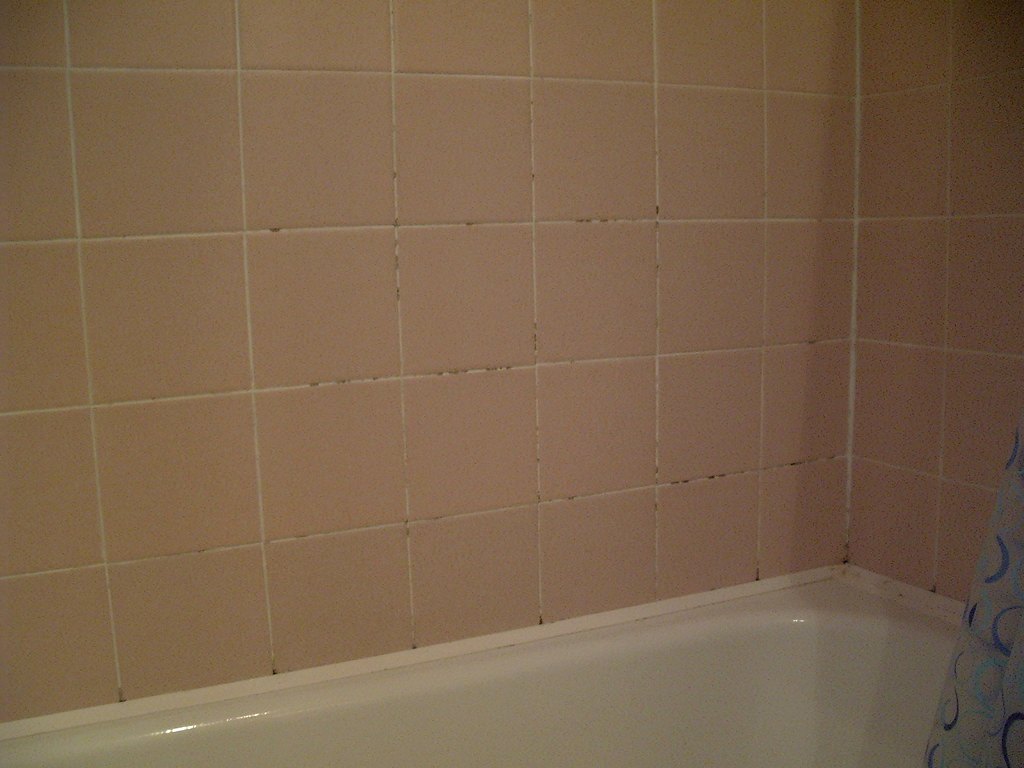
Black growth along the grout lines above a bathtub. Photo by sermoa, Flickr, CC BY-SA 2.0.
On bare wood, unsealed grout and painted plaster, the feeding threads grow a little way into the material. A spray reaches them only as far as it soaks, so those surfaces need the full contact time on the label.
How we chose these sprays
Each spray here was selected from its label, safety data sheet and EPA registration record rather than from a laboratory trial. We checked the active ingredient and, where published, its concentration.
We also checked what each product is registered as.
Fungicide
A fungicide kills mold.
Mildewstat
A mildewstat only inhibits it.
Stain remover
A stain remover makes no kill claim at all.
We recorded the contact time each label requires for mold, the surfaces the label permits, and whether the formula leaves a residue. Buyer ratings come from the live Amazon listings as of September 2026.
Products whose active ingredient we could not confirm from a label or data sheet were left out, including several popular sprays sold for mold.
How to choose a black mold removal spray
The active ingredient.
Sodium hypochlorite is bleach. It works fastest on stains and kills what it contacts on hard surfaces. Its water soaks into porous materials while the chlorine stays near the surface, so it cleans the face of a board without reaching what grows inside.
Quaternary ammonium compounds, usually shortened to quats, kill by breaking down the cell membrane. They act more slowly than bleach, tolerate wood and paint far better, and leave a thin film that keeps working after the surface dries.
Thymol comes from thyme oil. It carries a registered kill claim at very low concentration and has almost no odour, which suits occupied homes.
Alkaline salts, the chemistry behind Concrobium, dry into a crystalline film on the surface. The manufacturer describes that film as crushing the mold and resisting regrowth.
Hydrogen peroxide at 3% is the unbranded option, used alongside vinegar, borax and tea tree oil for natural black mold removal.
EPA registration.
An EPA Reg. No. on the back label means the kill claims on the front were reviewed before sale. A product without one can promise to remove stains or odours, but it cannot legally claim to kill mold.
"Fungicide" in the registration means the product kills. "Mildewstat" means it stops growth without necessarily killing what is already there.
Contact time.
Every registered spray states how long the surface must stay visibly wet. For mold that is usually 10 minutes. Wiping at two minutes gives you a clean-looking surface over living growth.
Surfaces.
Bleach whitens fabric, etches some stone and corrodes metal fittings over time. Quats, thymol and alkaline salts are gentler on wood and paint, and the label lists what each one permits.
Residue.
Bleach leaves nothing behind once it breaks down. Quats and Concrobium leave a film that slows regrowth, which suits rooms that will stay damp-prone.
Fumes and who lives there.
Bleach sprays in a small bathroom produce chlorine fumes strong enough to sting the eyes. Where anyone in the house has asthma or is already reacting to the mold, the low-odour registered options avoid adding a second irritant to the first.
Mixing
Bleach combined with ammonia produces chloramine gas. Bleach combined with vinegar or any acidic cleaner releases chlorine gas. Using one product, wiping, then applying another with a rinse in between keeps that from happening.
The 7 best black mold removal sprays
Registered fungicides kill the colony on hard and porous surfaces. Bleach sprays clear stains fastest on tile and grout, and the gentler formulas suit bedrooms, sensitive households and large areas.
Ratings are taken from the Amazon listings in September 2026. Links go to those listings.
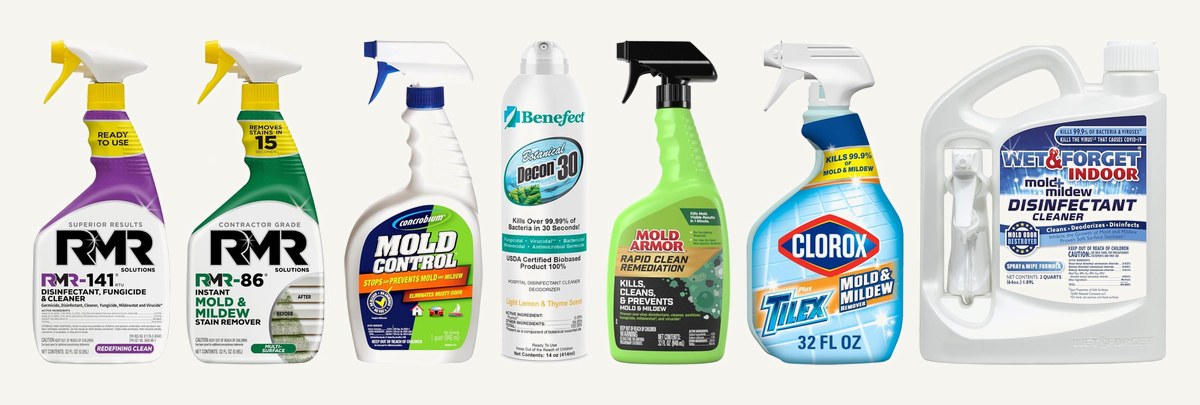
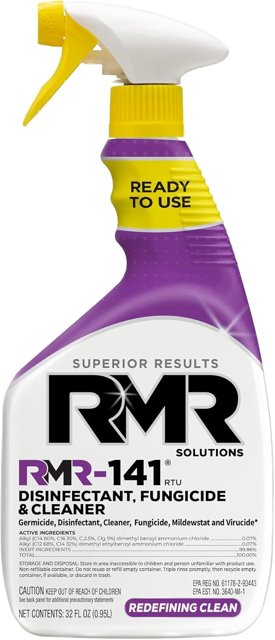
RMR-141 is the black mold removal spray we would reach for first in almost any room. Its active ingredient is a quat, n-alkyl dimethyl benzyl ammonium chloride, and it is EPA-registered as a fungicide, mildewstat, virucide and disinfectant.
The label covers porous and non-porous surfaces, so it works on wood, drywall faces, subfloor and concrete as well as tile. On porous materials the surface has to stay wet for a full 10 minutes, and removing it earlier leaves mold alive.
It contains no bleach, has a mild scent, and leaves a residual film once dry. Stains are its weakness: it kills the colony and often leaves the dark mark behind, which is where RMR-86 comes in.
Rated 4.4 stars from more than 18,000 buyers, 32 oz bottle.
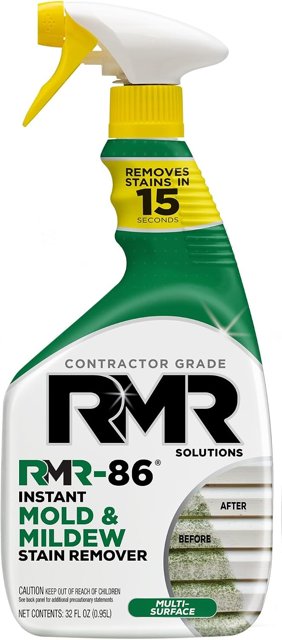
With more than 67,000 ratings at 4.4 stars, RMR-86 is the most-reviewed mold product on Amazon. Black staining on grout, caulk, siding and concrete fades within seconds of spraying, with no scrubbing.
Its active ingredient is sodium hypochlorite. It will kill surface growth it touches, since that is what bleach does, but it is sold as a stain remover and carries no registered mold-kill claim. It also leaves nothing behind to slow regrowth.
The fumes are strong enough to need ventilation, a respirator and goggles. It also bleaches coloured fabric, carpet and some wood finishes on contact.
RMR sells it as the partner to RMR-141. The pairing runs in that order: kill with 141, then clear what stays visible with 86.
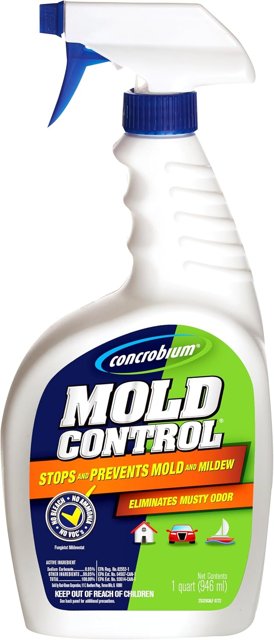
Concrobium is the one spray here you leave on rather than wipe off. It is EPA-registered (Reg. No. 82552-1) with sodium carbonate as the listed active ingredient, blended with sodium bicarbonate and trisodium phosphate.
As it dries, the salts form a thin film over the surface, which the manufacturer says crushes the mold and resists regrowth.
It has no bleach, no ammonia and no odour, and the listing describes it as VOC-free. That makes it the choice for bedrooms, closets, fabric, and anyone who reacts to chemical smells.
It does not remove staining, so a surface treated with Concrobium alone can stay dark. Rated 4.1 stars from more than 2,500 buyers, 32 oz spray.
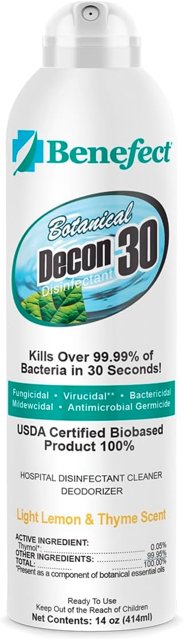
Benefect Decon 30 carries a registered kill claim with a plant-derived active ingredient. Thymol from thyme oil makes up 0.05% of the formula, and it is EPA-registered (Reg. No. 84683-3-74771) as a disinfectant and fungicide.
Remediation contractors use it in occupied buildings because it leaves no synthetic residue, needs no rinse, and is approved for food-contact surfaces. The smell is light lemon and thyme rather than chlorine.
The 30 in the name refers to its 30-second claim against bacteria. Mold needs longer, and the fungicide section of the directions sets the time to use.
It costs more per ounce than anything else on this list, and the 14 oz spray suits spot work while the gallon suits framing after a leak. Rated 4.6 stars from more than 3,800 buyers.
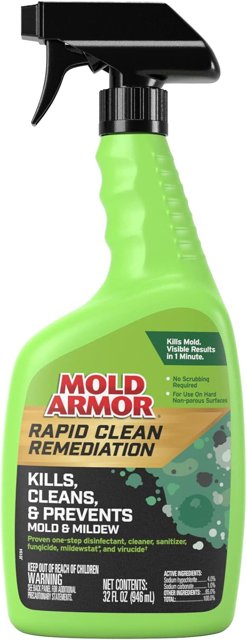
Mold Armor Rapid Clean Remediation combines a kill and a clean in one bleach-based step. Its active ingredients are sodium hypochlorite and sodium carbonate, and it is EPA-registered (Reg. No. 4091-23).
Unlike RMR-86, it carries registered claims as a fungicide, mildewstat and disinfectant, so it covers both jobs on hard surfaces. The label limits it to hard, non-porous materials: tile, grout, glass, fiberglass, vinyl and sealed stone.
Fumes and fabric damage follow the same rules as any bleach spray. Rated 4.6 stars, though from a smaller sample of around 280 buyers.
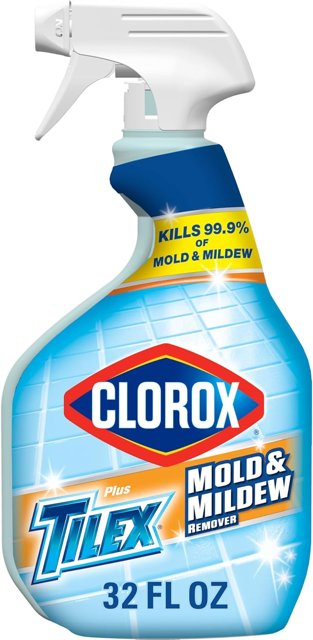
Tilex is the budget pick for bathroom growth, and the one found in most supermarkets. The formula is 2.4% sodium hypochlorite, and the label claims it kills 99.9% of mold and mildew on hard surfaces.
It suits glazed and unglazed ceramic tile, grout, vinyl, fiberglass and plastic shower surrounds. It does not belong on wood, drywall, fabric or metal fixtures.
For weekly shower maintenance it does the job at a fraction of the price of the specialist sprays. Rated 4.8 stars from more than 1,700 buyers, 32 oz spray.
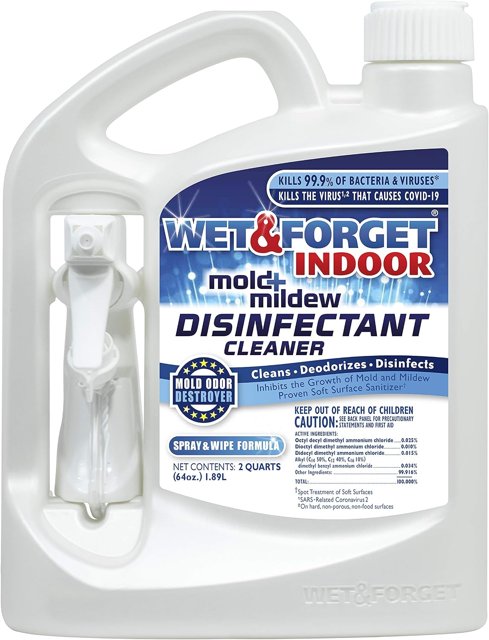
7. Wet & Forget Indoor Mold and Mildew Disinfectant Cleaner
Best for large areas
Active
Four quats
Contact
10 min
Scrubbing
None
Rating
4.1 · 2,700+
Wet & Forget Indoor is for large areas and for anyone who cannot scrub. It uses a blend of four quats, including octyl decyl dimethyl ammonium chloride and alkyl dimethyl benzyl ammonium chloride, with no bleach.
The surface needs to stay wet for 10 minutes, after which you wipe it dry or let it air dry, with no scrubbing or rinsing. Black staining fades gradually over weeks rather than seconds.
The manufacturer says heavy, long-established stains can take six months to a year to clear, with repeat treatment every seven days. That makes it a maintenance product for basements, bathrooms and closets that grow something every year, rather than a same-day fix.
Rated 4.1 stars from more than 2,700 buyers, 64 oz bottle.
Bleach sprays suit glazed tile, grout and other hard surfaces.
Everything else
Quats, thymol and alkaline salts handle wood, paint, masonry and fabric.
Shower grout and tile
Any of the three bleach sprays suits glazed tile and grout. Tilex handles weekly upkeep cheaply, Mold Armor Rapid Clean adds a registered kill, and RMR-86 deals with staining that will not shift. A grey or white powdery patch on the same tiles is often mildew rather than mold, and it wipes off with far less effort.
Silicone caulk
Mold grows inside silicone as well as on it. Bleach lightens the surface, but growth that has spread through the bead generally means cutting the caulk out and replacing it with a mold-resistant silicone.
Painted walls and ceilings
RMR-141 or Concrobium suit paint better than bleach, which can lift or streak it, so a hidden test patch comes first. Bubbling or peeling paint means water has reached the wall itself, and removing mold from walls starts with finding that source.
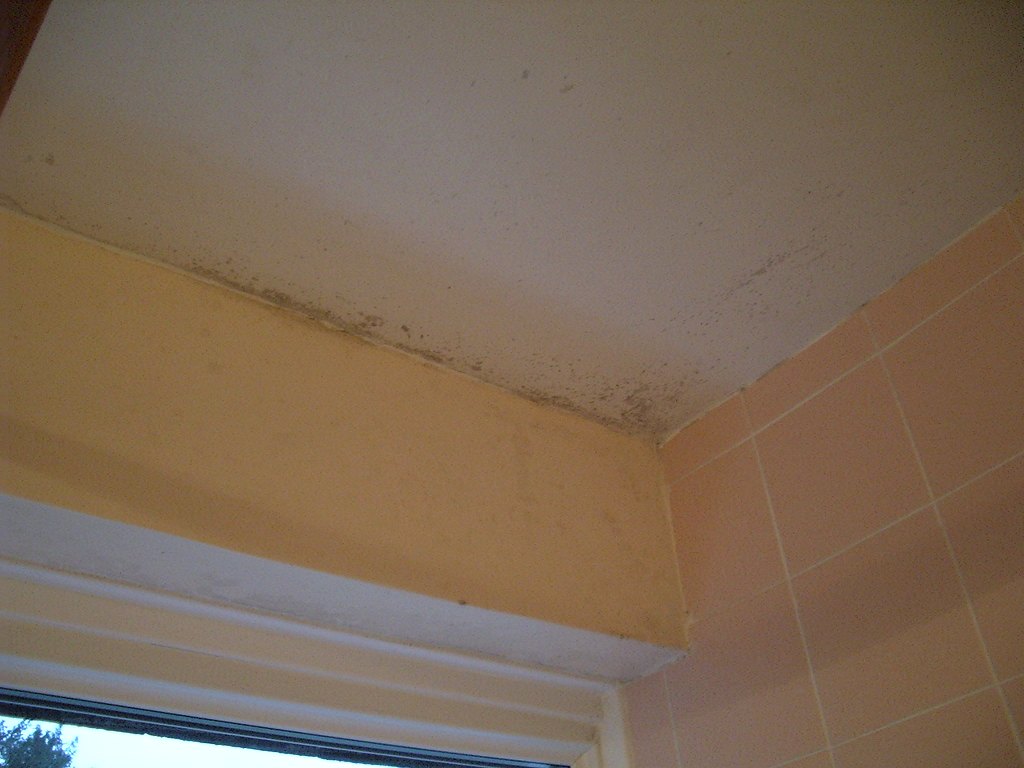
A ceiling that keeps growing it despite cleaning usually points to condensation or a slow leak, the two usual causes of mold on a bathroom ceiling.
Mold spreading across a bathroom ceiling above a window, where condensation collects. Photo by sermoa, Flickr, CC BY-SA 2.0.
Wood trim, studs and subfloor
RMR-141, Benefect and Concrobium all permit bare wood on the label. A coat of Concrobium over dried timber adds a film that slows regrowth, and bleach is best kept off wood since it discolours the grain.
Basement concrete and block
RMR-141 and Concrobium both suit masonry. White powder on the wall may be efflorescence, a mineral salt often mistaken for mold in a basement.
Fabric, upholstery and carpet
Concrobium's label permits fabric, and it will not bleach it. Soaked carpet and underlay rarely recover with a spray, since mold in carpet grows down into the backing.
After a leak
Water damage brings bacteria along with mold, so a registered disinfectant such as RMR-141 or Benefect suits the cleanup better than a stain remover.
How to use a black mold removal spray
Where a label's directions differ from these steps, the label comes first.
1Fix the water first. Growth returns on any surface that stays damp, whichever spray you use.
2Test a hidden patch. Paint, wood, stone and fabric can all react to a spray, and a small test spot shows it before the whole wall does.
3Open a window and cover up. Gloves, goggles and a mask protect you from the spray and from spores you disturb.
4Spray until the surface is visibly wet. Cover the growth and about 12 inches beyond its edge, since the colony usually extends past what you can see.
5Hold the contact time. Keep the surface wet for the full time on the label, usually 10 minutes for mold. Respray any patch that starts drying early.
6Wipe and bag. Wipe with disposable cloths and bag them straight away. Concrobium is the exception, since it is left to dry.
7Clear the stain last. If a dark mark remains after a registered killer, a bleach stain remover can follow once the first product is wiped and rinsed.
8Dry the area completely. A fan, open window or dehumidifier finishes the job. A surface still damp tomorrow can start growing again within weeks.
When black mold comes back after spraying
Growth that returns to the same spot within weeks points to moisture rather than a weak spray. A failed seal, condensation on a cold wall or humidity sitting above 60% will regrow whatever the spray killed. The EPA calls moisture control the key to mold control for that reason.
A musty smell in the house with nothing visible usually means growth a spray cannot reach. It may sit behind a wall, under flooring or inside the HVAC system. Mold around the cooling coil or in ductwork spreads each time the fan runs, and the source is rarely the air vent you can see.
The screening runs in your browser and takes about fifteen minutes from calibration to result.
RMR-141 suits the widest range of situations. It is an EPA-registered fungicide that works on porous and hard surfaces with a 10-minute contact time. For stains, RMR-86 works fastest. For a bleach-free option that keeps working after it dries, Concrobium Mold Control.
Does RMR-86 kill black mold?
It kills surface growth it contacts, since its active ingredient is sodium hypochlorite. It is sold as a stain remover, though, and carries no registered mold-kill claim or residual protection. RMR pairs it with RMR-141, which does carry that registration.
What is the difference between RMR-86 and RMR-141?
RMR-86 is a bleach stain remover that clears black marks in seconds. RMR-141 is a quat-based, EPA-registered fungicide and disinfectant that kills mold on porous and hard surfaces and leaves a residual film.
Is Concrobium better than bleach for mold?
On porous surfaces, fabric and anywhere near people who react to fumes, yes. It is EPA-registered, odourless and leaves a film that resists regrowth. Bleach clears stains faster on hard surfaces, which Concrobium does not attempt.
What spray kills black mold on drywall?
RMR-141 and Concrobium suit light surface growth on painted drywall better than bleach. Both permit porous surfaces, and both leave a film that slows regrowth. Growth that has spread into the paper facing sits beyond a spray’s reach.
How long should mold spray sit before wiping?
As long as the label states, which for most registered mold killers is 10 minutes of visible wetness. Bleach stain removers work in seconds on the pigment, but that speed applies to the colour rather than the kill.
Can you use mold spray on wood?
Quat-based and alkaline sprays suit wood. RMR-141, Concrobium and Benefect all permit it on the label. Bleach sprays can discolour wood and do not reach growth inside the grain.
Are mold sprays safe around pets and children?
Keeping pets and children out of the room until the surface is dry applies to all of them. Benefect and Concrobium are the lowest-odour registered options. Bleach sprays produce fumes that need ventilation and a closed door.
Does mold spray stop mold coming back?
Quat sprays and Concrobium leave a film that slows regrowth for a while. None of them outlast a moisture problem, so holding humidity between 30 and 50% is what keeps a treated surface clean.
Some of the links in this article are Amazon affiliate links. That means we may earn a small commission if you use them to purchase a product. It costs you nothing extra, it does not change the content, and it supports our research and development. As an Amazon Associate, we earn from qualifying purchases.