Best Non-Toxic Mattress: 5 Certified Organic Picks and the Protector to Pair With Them

Quick answer

In our research, the best non-toxic mattress for most people is the Avocado Green Mattress: GOTS-certified as a finished product, with organic latex, wool and cotton and no polyurethane foam, glue or fiberglass. For an all-latex bed at a lower price, the Sleep On Latex Pure Green carries the same two organic certifications and is made in Chicago.

Happsy is the best organic mattress in a box, and My Green Mattress Kiwi suits couples and children. Across the owner threads we read on Reddit, the recurring complaint about organic mattresses is firmness rather than chemicals, so each pick below says how firm it runs.

For allergies, a zippered cotton encasement with a weave under 10 microns blocks dust mite allergen, and an organic cotton waterproof protector keeps sweat and spills out of the mattress.

Published October 3, 202615 min readEvidence-based

We spend close to a third of our life lying on a mattress, breathing the air a few inches above it. A bed built from organic latex, wool and cotton gives that air nothing to carry.

Most mattresses sold today are built the other way. Polyurethane foam, chemical fire barriers and glue are cheap and fast to manufacture, and they keep releasing chemicals long after the plastic wrap comes off.

You may have unrolled a new bed-in-a-box, opened the windows against the smell, and still had a headache for a week from toxic materials.

But what is a non-toxic mattress, and how do you tell a certified one from a brand that just calls itself natural?

Waking with headaches or blocked sinuses even after changing the bed? Take the free mold toxin exposure test.15 minutes

What makes a mattress toxic

A conventional mattress is mostly polyurethane foam, made from petroleum-derived chemicals. Memory foam is polyurethane with extra additives. Both release volatile organic compounds (VOCs), the smell that fills a bedroom when a new foam mattress expands. An air purifier for off-gassing thins that smell, but the foam keeps producing it.

Foam burns fast, so it needs a fire barrier. For years that meant chemical flame retardants such as PBDEs, which were later linked to hormone disruption and have been phased out in the US. The chemistry changed, but the idea stayed: a foam core wrapped in something that stops it burning.

Adhesives hold the layers together, and some release formaldehyde. Synthetic latex is made from styrene. "Soy foam" and "bio-foam" are mostly polyurethane with a small plant-based share.

An older mattress isn’t automatically safer. Foam breaks down with age, and the flame retardants and fragments inside it end up in household dust.

How a non-toxic mattress passes the fire test

Every mattress sold in the US has to pass an open-flame test set out in federal regulation 16 CFR 1633. A burner is held against the mattress, and the fire it produces must stay below set heat limits for 30 minutes.

The regulation sets the result, not the method, so the same test can be passed with fiberglass, with chemical treatments, or with wool.

A 2023 survey of US manufacturers for California’s Bureau of Household Goods shows what the industry mostly chooses. Silica-embedded rayon fibre sat inside about 58% of mattresses, fiberglass in about 8.6%, and wool in under 1%.

Fire barriers inside US mattresses, 2023 survey
Silica-embedded rayonabout 58%
Fiberglassabout 8.6%
Woolunder 1%

Organic mattresses use the wool route. A thick layer of wool, sometimes combined with organic cotton or a plant-based fibre called PLA, chars rather than burns and holds the flame back on its own. The mattress passes the same test with nothing sprayed on and nothing woven from glass.

Certifications that mean something, and ones that don’t

Certifications exist because "natural", "green" and "eco" can be printed on any label without proof.

GOTS
Finished mattress
Global Organic Textile Standard

A GOTS-certified mattress is at least 95% certified organic fibre, and the whole product and the factory are inspected. Polyurethane foam, formaldehyde, heavy metals and chemical flame retardants are prohibited, even in the remaining 5%. This is the strongest certification a finished mattress can hold.

GOLS
Latex layers
Global Organic Latex Standard

At least 95% certified organic latex, with limits on what the rest can be. GOLS is the mark to look for on the latex layers.

GREENGUARD Gold
Emissions
Emissions test

An emissions test. The finished mattress is placed in a chamber and its VOC emissions, including formaldehyde, must stay under strict limits. It says the mattress emits little, not that the materials are organic.

OEKO-TEX Standard 100
Textiles
Harmful-substance test

A harmful-substance test on textiles, with Class I the strictest grade. Useful alongside GOTS, weak on its own.

MADE SAFE · EWG Verified
Ingredients
Ingredient screens

Ingredient screens that check every component against lists of chemicals of concern.

CertiPUR-US
Foam only
Foam standard

A standard for polyurethane foam, developed by the foam industry. It bans PBDEs, formaldehyde and certain other chemicals from the foam, and it limits VOC emissions. It confirms the foam meets a minimum standard, not that the mattress is free of foam.

The name on a certificate decides what it covers. A GOLS certificate written to a latex supplier in Sri Lanka applies to the latex when it left that factory, not to the mattress you receive. The brands below hold their certifications in their own names, and GOTS keeps a public database where any certificate can be checked.

The materials inside a non-toxic mattress

Certified organic mattresses are built from latex, wool and cotton, usually over steel coils.

Layer 1Organic cotton

The cover and quilting. Breathable, soft, and free of the finishing chemicals used on conventional cotton.

Layer 2Organic wool

Wool is the fire barrier, and it also pulls moisture away from your body and releases it into the air. Dust mites and mold both need damp, and wool keeps the sleeping surface drier than any synthetic layer.

Layer 3Organic latex

Natural latex is tapped from rubber trees and foamed into a dense, springy block. It supports without the sinking feel of memory foam, lasts longer, and sleeps cooler because its open cell structure lets air through. Dunlop latex is denser and firmer and can be GOLS-certified; Talalay is softer and lighter.

Layer 4Steel coils

Pocketed coils give a hybrid its bounce and airflow. They aren’t organic, but they’re inert, and the air moving between them keeps the base of the mattress dry.

Together, these materials resist mold far better than foam. Polyurethane holds sweat and humidity against a solid base, and white mold on the underside of a foam mattress on a platform bed is the usual result. Latex and wool breathe, and a coil base lets moisture out from below.

How we chose these mattresses

Each mattress here holds GOTS or GOLS certification issued in the brand’s own name, with no polyurethane foam, chemical flame retardants, fiberglass or adhesives. We checked the fire barrier each one uses and the emissions certification it carries.

We then looked at construction (all-latex or hybrid), firmness options, trial period, warranty and price band.

We haven’t slept on each of these mattresses ourselves. For comfort and durability we read owner threads on r/Mattress, r/nontoxic and r/moderatelygranolamoms. We also used two independent read-throughs of Reddit, each covering more than 120 owner posts, for Avocado and Sleep On Latex. We looked for the complaints that repeat: firmness surprises, smell, sagging, and how each company handles returns and warranty claims.

Buyer ratings come from the live Amazon listings as of October 2026. Where a brand sells only through its own site, we say so.

The 5 best non-toxic mattresses

Avocado and Naturepedic set the standard for organic certification. Sleep On Latex brings the price down for an all-latex bed, and Happsy does the same for a hybrid in a box. My Green Mattress adds firmness choice and a kids’ range.

1. Avocado Green Mattress

Best overall
Certified
GOTS · GOLS
Build
Latex hybrid
Firmness
Firm, medium, plush
Trial
1 year

The Avocado Green is the best non-toxic mattress for most sleepers because of how far its certification goes. The whole mattress is GOTS-certified as a finished product, the latex is GOLS-certified, and it also carries GREENGUARD Gold, MADE SAFE, EWG Verified and OEKO-TEX Class I.

Inside are 2 to 3 inches of organic Dunlop latex, depending on the firmness, over up to 1,379 pocketed coils in seven zones. Organic wool and an organic cotton cover wrap the whole thing. The wool is the fire barrier. There is no polyurethane, no PLA bioplastic, no glue and no fiberglass.

The firm version suits back and stomach sleepers, the medium has an extra inch of latex, and the plush adds a pillow top for side sleepers. Avocado offers a one-year trial and a 25-year warranty.

Owners on Reddit praise how cool it sleeps and the absence of any chemical smell. The complaints cluster on firmness for lighter side sleepers, on the price, and on warranty claims and returns, which several owners describe as slow and demanding. The trial allows one return, so the firmness choice up front carries more weight here than with other brands.

Avocado sells its mattresses direct rather than through Amazon, and the price sits at the higher end of this list.

2. Sleep On Latex Pure Green Organic Latex Mattress

Best all-latex value
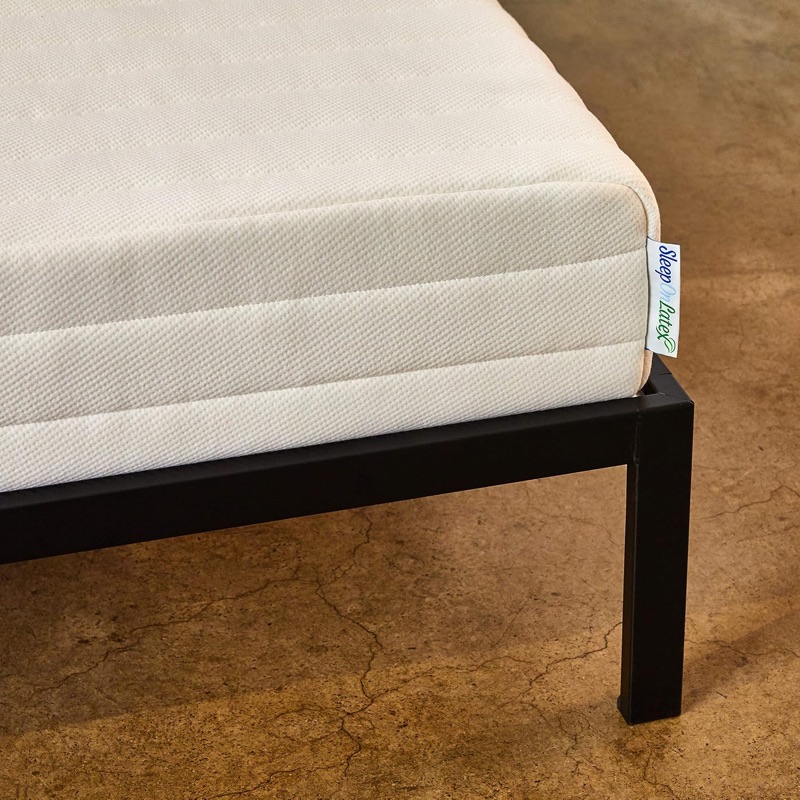
Corner of the Sleep On Latex Pure Green organic latex mattress on a black metal frame
Certified
GOLS · GOTS cover
Build
8″ all-latex
Firmness
Medium, firm
Rating
4.4 / 4.6

The Pure Green is the best-value all-latex organic mattress on Amazon. It’s 8 inches of GOLS-certified organic latex, in two layers, under a quilted cover of GOTS-certified organic cotton and wool. The company designs, sews and assembles it in its Chicago factory, and the latex is also Fair for Life certified.

With no coils, it has the steady, buoyant feel of solid latex and very little motion transfer. It comes in medium and firm, and the firm version is one of the few organic mattresses built for stomach sleepers.

The trade-off is weight and bounce: an all-latex queen is heavy to move, and some people miss the spring of coils.

Owner threads agree on one point: both firmnesses run firmer than their labels. A good share of owners end up adding a soft latex topper for side sleeping. Customer service and the free doorstep pickup on returns draw no complaints at all. A few owners report the latex softening after four or five years, while one reports nine years with no change.

The medium is rated 4.4 stars from more than 630 buyers, and the firm 4.6 stars from more than 590.

3. Happsy Organic Hybrid Mattress

Best in a box
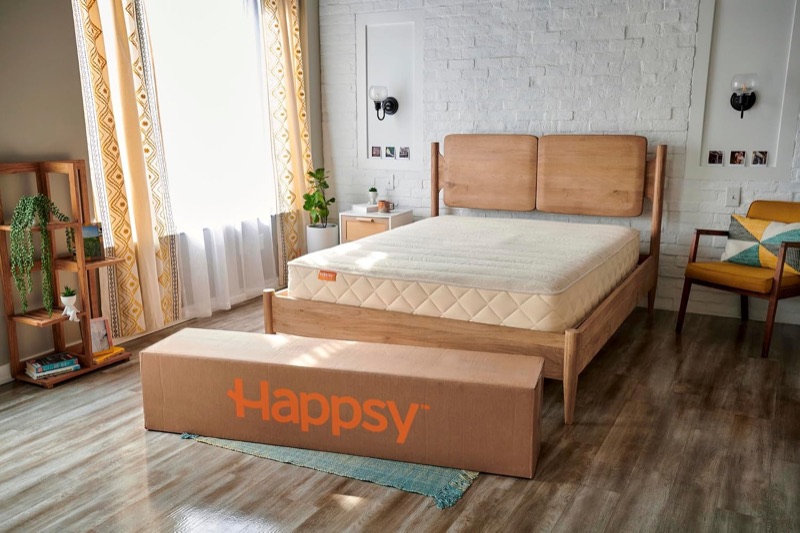
Happsy organic hybrid mattress on a wooden bed frame with its shipping box in front
Certified
GOTS · GOLS
Build
10″ hybrid
Firmness
Medium-firm
Rating
4.2 (110+)

Happsy is made by Naturepedic as its lower-priced, ship-in-a-box brand, and it keeps the same certified organic factory. The mattress is GOTS-certified, the latex is GOLS-certified, and it carries GREENGUARD certification for emissions.

It’s a 10-inch hybrid: organic latex over encased steel coils, with organic cotton, organic wool and a sugarcane-based PLA batting. The coils are held in place without glue.

The feel is medium-firm, and Happsy offers a 120-night trial and a 20-year warranty. It’s the easiest organic mattress to get up a narrow staircase.

Owners describe it as softer than the other beds here, which suits side sleepers. A few report a slight dip in the middle after several months. Rotating it as Happsy advises is the usual fix.

Rated 4.2 stars from more than 110 buyers.

4. Naturepedic Chorus Organic Mattress

Cool-sleeping hybrid
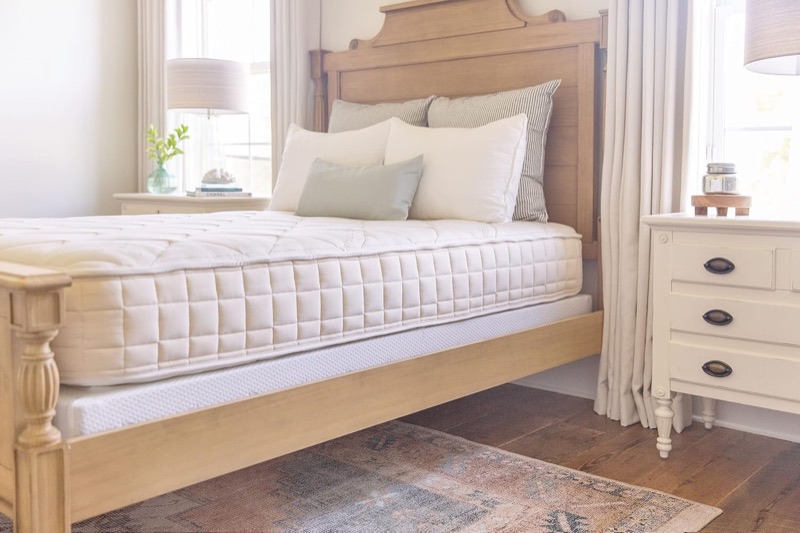
Naturepedic Chorus organic mattress on a carved wooden bed in a bright bedroom
Certified
GOTS
Build
Microcoil hybrid
Firmness
Medium-firm
Trial
100 nights

Naturepedic has made certified organic mattresses since 2003, starting with crib mattresses, and its adult range is built in the same certified factory. The Chorus is its entry-level adult mattress: GOTS-certified, GREENGUARD Gold, with organic cotton, organic wool, organic latex and PLA over a glue-free encased coil core.

It sleeps medium-firm with a cushioned top, and the microcoil comfort layer gives it more airflow than solid foam or latex of the same thickness.

Owners on Reddit call it firm for a mattress sold as medium, and hot sleepers like it for that airflow. The new-mattress smell gets described as earthy rather than chemical, though one owner found the organic cotton cover’s scent strong enough to return it. Naturepedic staff answer questions openly in the threads, which is useful to know when you read them.

Naturepedic sells mostly through its own site and showrooms, so its Amazon listing has only a handful of ratings. The brand’s 100-night trial and 25-year warranty apply either way.

5. My Green Mattress Kiwi Organic Mattress

Kids and couples
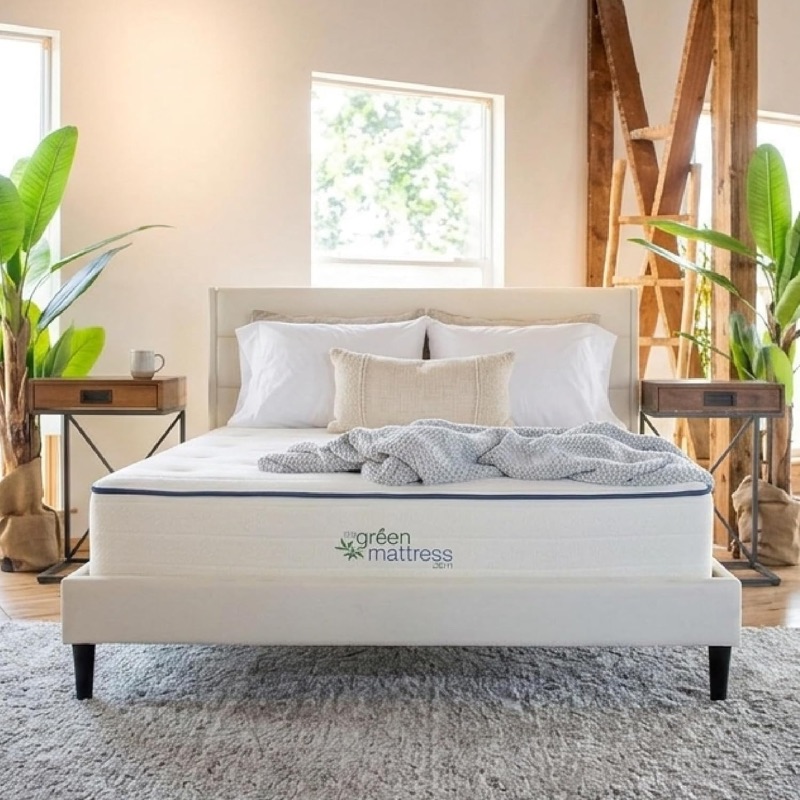
My Green Mattress Kiwi organic mattress on an upholstered bed in a bright room
Certified
GOTS · GOLS
Build
Zoned hybrid
Firmness
Medium, firm
Trial
365 nights

The Kiwi comes from a small family-run company, and it’s the pick for children’s rooms. It’s built from GOTS-certified organic cotton and wool, GOLS-certified Dunlop latex and up to 1,140 pocketed coils in seven zones, hand-tufted so the layers hold without adhesives.

It carries GREENGUARD Gold and MADE SAFE and comes in medium and firm. It’s also one of the few organic mattresses sold in twin and twin XL for children’s rooms. The company also makes a crib mattress to the same standard.

My Green Mattress comes up less often on Reddit than the bigger brands. The mentions it does get are mostly from parents who shortlisted it with Naturepedic and Happsy for the same reason: full certification at a lower price.

Rated 4.1 stars from a small group of Amazon buyers, with a 365-night trial and a 20-year warranty.

As an Amazon Associate we earn from qualifying purchases, at no extra cost to you.
What owners say after months on an organic mattress

Brand pages describe certifications and layers. Owner threads describe what the bed felt like six months in, and the same points come up across brands.

Organic mattresses run firm. Latex doesn’t sink the way memory foam does, and most organic brands tune their mediums firmer than the rest of the market. Side sleepers coming from memory foam report the sharpest adjustment, and the people happiest with these beds are the ones who wanted firm in the first place. A soft latex topper is the common fix, and a firm mattress that turns out too hard can be softened, while a soft one can’t be firmed up.

The smell is earthy, and it fades. Natural latex and wool arrive with a rubbery, farm-like smell that owners describe as nothing like foam off-gassing. Most say it fades within days to a few weeks with the bed uncovered.

Latex softens before it sags. Where owners report wear, it’s usually a general loss of firmness after several years rather than a dip. Hybrids with coils get the occasional report of a soft spot in the middle after months. Rotating the mattress on the maker’s schedule is the first thing those owners are told.

Service decides the second half of the experience. Owners rate Sleep On Latex’s free pickup and refund as the easiest exit in the category. Avocado’s trial draws the most frustration, with owners describing photo requirements for returns and a one-return limit. Reading the return and warranty terms before buying saves more grief than any spec sheet.

Brand staff post in the threads. Naturepedic and Avocado representatives answer questions on Reddit under their company names. The advice is often sound, but it reads differently once you know who wrote it.

Two independent read-throughs of Reddit back this up. Mattress Skeptic read 297 Sleep On Latex mentions across 128 threads and found 32 of 59 decided owners would buy again, with firmness the dominant complaint. RedditRecs tallied 127 Avocado Green reviews at 35 positive and 18 negative, with price, firmness and customer service as the main objections.

Which non-toxic mattress for which sleeper

Side sleepers. The Avocado Green in plush or medium, or the Sleep On Latex medium. Both give the shoulder and hip somewhere to sink without memory foam.

Stomach and back sleepers. The Sleep On Latex firm, or the Avocado Green firm.

Couples. The Kiwi or the Pure Green. The Kiwi’s zoned coils support two different body weights, and solid latex barely transmits movement.

Children. The Kiwi in twin, or Happsy in twin. Both are certified organic at a price that suits a bed a child will outgrow.

Hot sleepers. Any of the hybrids. Coils and wool move heat and moisture out faster than solid foam, and latex sleeps cooler than memory foam.

A tight budget. The Sleep On Latex Pure Green or Happsy. Both cost well under the organic hybrids from larger brands.

Chemical sensitivity or recovering from mold exposure. Avocado, whose fire barrier is wool alone, or Naturepedic, whose whole factory is GOTS-certified. Airing the new mattress for a few days before the first night helps even with a certified bed.

The best mattress protector for allergies

A dust mite encasement and a waterproof protector solve different problems, so the best mattress protector for allergies is often both, one over the other.

Zippered encasement

A zippered encasement wraps all six sides of the mattress and blocks dust mites and their allergen from reaching you. Research in the Journal of Allergy and Clinical Immunology found that fabric with pores under 10 microns blocks dust mite allergen. Pores of 6 microns or less also block cat allergen.

Waterproof protector

A fitted waterproof protector sits on top and keeps sweat, spills and accidents out of the mattress. Wool and latex resist mold only while they stay dry, so this layer protects the mattress itself.

Vinyl and PVC protectors put a layer of plastic and plasticisers back between you and an organic mattress. The three below use organic cotton with either a tight weave or a thin, phthalate-free waterproof film.

Naturepedic Organic Waterproof Mattress Protector

Waterproof
Naturepedic organic waterproof mattress protector folded beside its cotton storage bag
Fabric
GOTS cotton
Fits
9–16″ deep
Rating
4.3 (300+)

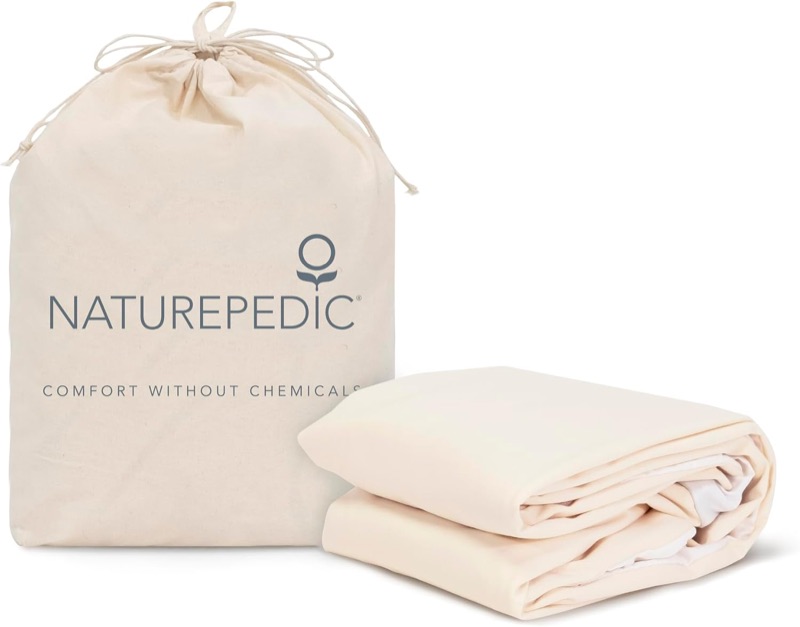
Two layers of GOTS-certified organic cotton jersey surround an ultra-thin waterproof polyurethane film that lets water vapour through but not liquid. It’s free of vinyl, PVC, phthalates and latex, fits mattresses 9 to 16 inches deep, and goes in the washing machine.

It doesn’t crinkle or trap heat the way vinyl protectors do. Rated 4.3 stars from more than 300 buyers.

National Allergy 100% Cotton Zippered Mattress Encasement

Dust mite encasement
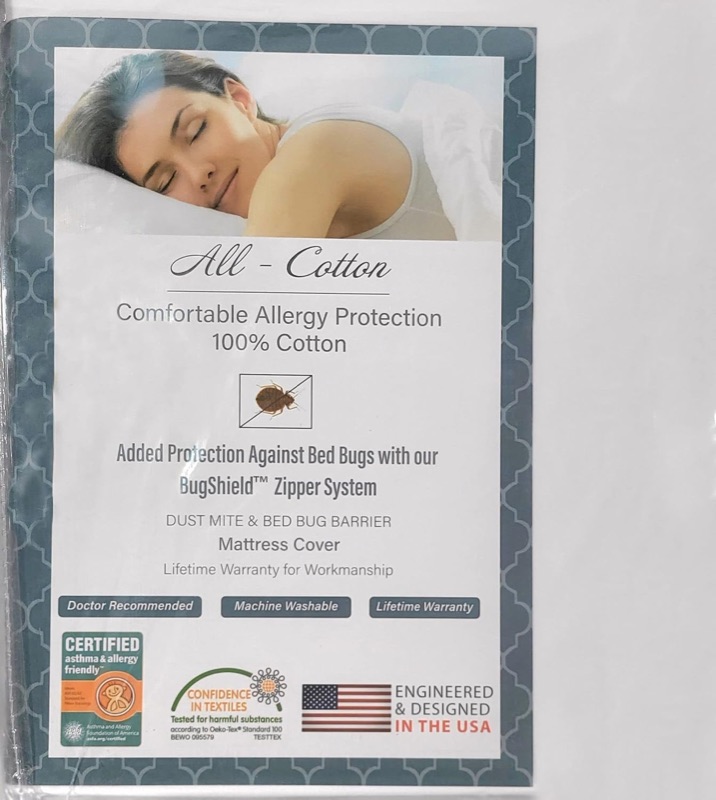
National Allergy all-cotton zippered mattress encasement in its retail packaging
Weave
2.6 microns
Sides
Six, zippered
Rating
4.2 (1,400+)

A six-sided cotton encasement with a 2.6-micron weave, well under the 10-micron threshold for dust mite allergen. The auto-lock zipper has an internal fabric flap, and there’s no membrane, so it stays silent and breathable.

It isn’t waterproof, so it pairs with a fitted protector on top for anyone who sweats heavily or has young children. Rated 4.2 stars from more than 1,400 buyers, in sizes from twin to California king.

Avocado Organic Waterproof Mattress Protector

PFAS-free
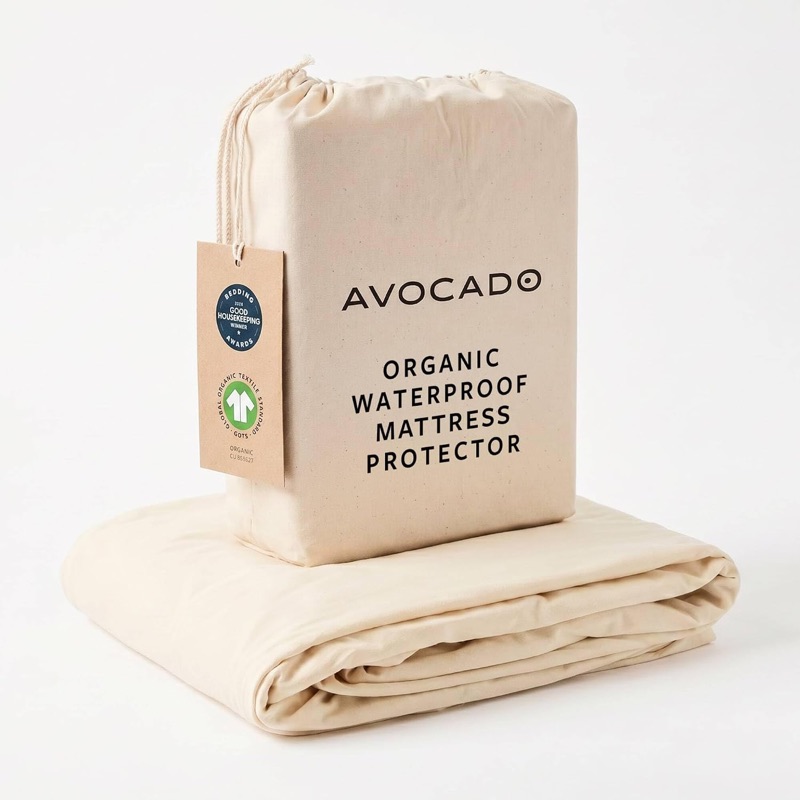
Avocado organic waterproof mattress protector folded under its drawstring storage bag
Fabric
GOTS cotton
Layer
Plant-based
Rating
4.8 (8)

Avocado’s protector uses GOTS-certified organic cotton on both faces around a plant-based, PFAS-free water-resistant layer, and it carries GREENGUARD certification. It’s the natural match for the Avocado mattress, and it fits other brands just as well.

It’s newer to Amazon, so only a few buyers have rated it so far, at 4.8 stars.

Keeping a natural mattress dry and mold-free

Wool and latex resist mold because they let moisture escape, and the base and the room decide whether that moisture has anywhere to go.

  • Use a slatted base. A solid platform or the floor traps humidity under the mattress, and the underside is where mold on a mattress nearly always starts. Slats a few inches apart let air move beneath it.
  • Keep bedroom humidity under 50%. Dust mites and mold both struggle below that line. A small hygrometer shows where you stand, and a dehumidifier brings a damp bedroom down.
  • Air it regularly. Pulling the duvet back for an hour each morning lets the night’s moisture leave the mattress. Standing it on its side for an afternoon every few months airs the underside.
  • Wash the protector often. Hot washes every couple of weeks remove skin flakes and sweat before dust mites can feed on them.
  • Watch a bed against an outside wall. Cold walls condense moisture behind headboards and under mattresses, especially in winter. A few inches of gap, or moving the bed, keeps that corner dry.

If your mattress is making you feel unwell

Waking with a headache, blocked sinuses or itchy eyes that ease during the day points at the bedroom. The mattress is the closest thing to your face for eight hours.

A new foam mattress is the simplest case. The smell comes from VOCs, emissions fall fastest in the first weeks, and a purifier with several pounds of activated carbon speeds up what ventilation starts.

An older mattress or a damp room points elsewhere. Dust mites thrive in a mattress that’s never been encased, and mold grows underneath one that never dries. A musty smell in the house that follows you from room to room suggests the problem is bigger than the bed.

The screening runs in your browser and takes about fifteen minutes from calibration to result.

Start the test now

Frequently asked questions

What is the best non-toxic mattress?

The Avocado Green Mattress holds the widest set of certifications, including GOTS for the finished mattress and GOLS for the latex. Its fire barrier is wool, with no foam or glue anywhere inside. The Sleep On Latex Pure Green is the best all-latex option at a lower price, and Happsy the best organic mattress in a box.

What makes a mattress non-toxic?

No polyurethane or memory foam, no chemical flame retardants, no fiberglass and no adhesives. Organic latex, wool and cotton take their place, and the mattress passes the federal fire test with wool rather than chemicals. GOTS and GOLS certification in the brand’s own name confirms it.

Is memory foam toxic?

Memory foam is polyurethane with additives, and it releases VOCs, most heavily when new. CertiPUR-US foam limits those emissions and bans certain chemicals, but it’s still a petroleum foam that breaks down into dust with age.

Are latex mattresses non-toxic?

Natural latex from rubber trees is, when it carries GOLS certification. "Natural latex" with no certificate can be a blend of natural and synthetic latex, and synthetic latex is made from styrene.

Which mattresses have no fiberglass?

Every mattress above uses wool, or wool with PLA, as its fire barrier. Fiberglass appears mostly in budget foam mattresses, and California’s AB 1059 bans it in mattresses sold there from 2027. A 2023 industry survey for California found fiberglass inside about 8.6% of US-made mattresses, with silica-treated rayon far more common.

Do non-toxic mattresses off-gas?

Far less than foam. Natural latex and wool have a faint, earthy smell when new that fades within days. Airing the mattress in a ventilated room before the first night clears most of it.

Is CertiPUR-US good enough?

It’s a useful minimum for a foam mattress, since it bans PBDEs and formaldehyde and limits VOCs. It doesn’t make a mattress organic or foam-free, and the standard was written by the foam industry.

What is the best mattress protector for allergies?

For dust mite allergy, a six-sided zippered encasement with a weave under 10 microns, such as the National Allergy cotton encasement. For sweat, spills and mold prevention, an organic cotton waterproof protector such as Naturepedic’s. Many people use both.

Can a mattress grow mold?

Yes, usually on the underside, when it sits on a solid platform or the floor in a humid room. Foam holds moisture longest. A slatted base, humidity under 50% and regular airing keep a mattress dry.

Are organic mattresses good for allergies?

Wool and latex stay drier than foam, which gives dust mites and mold less to live on, and certified materials carry no chemical finishes that irritate skin. Pairing a non-toxic mattress with a dust mite encasement gives the fullest protection.