Sick Building Syndrome: How to Tell What Your Building Is Doing to You
Sick building syndrome describes symptoms that follow you into a building and fade when you leave it, with no single cause anyone can point to. Four things produce most cases: too little outdoor air, chemicals released by the building's own contents, polluted air drawn in from outside, and damp feeding biological growth.

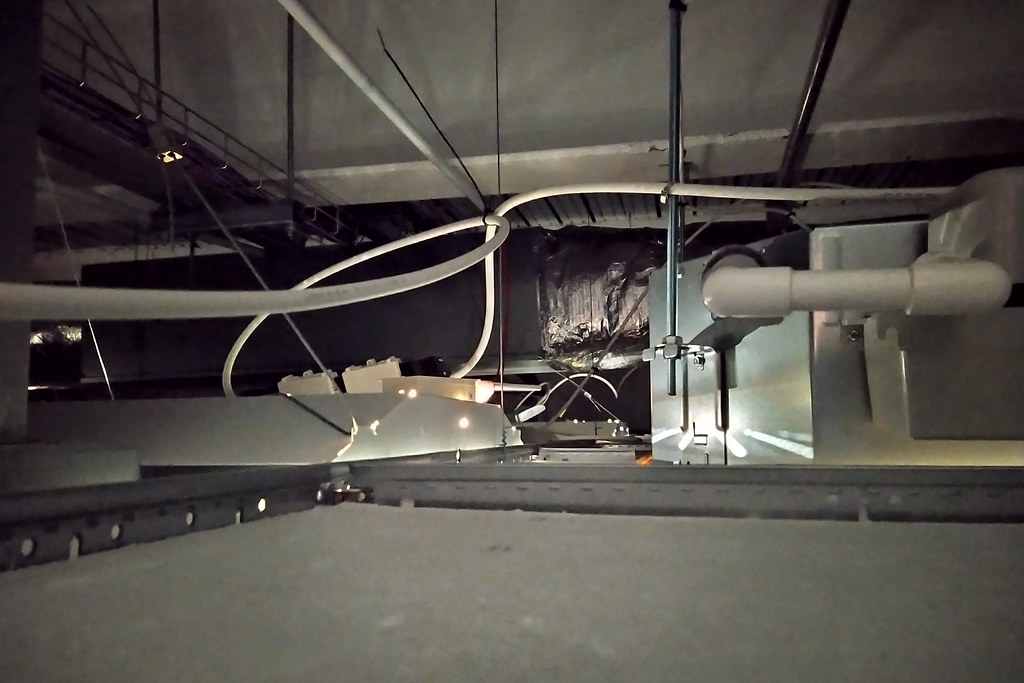
Sealed, mechanically ventilated floor plates like this one are where the complaints cluster. Photo by K2 Space, Flickr, CC BY 2.0.
Most of us spend around 90% of our lives indoors, and for nearly all of that time a building does its job without being noticed. It holds the weather off, keeps the temperature somewhere comfortable, and supplies enough fresh air that breathing never becomes something you think about.
When that last part slips, people notice it before any instrument does. Headaches that arrive mid-morning. Eyes that feel gritty by lunchtime. A heaviness that lifts on the drive home and settles again on Monday. Several colleagues describing the same thing without having compared notes.
If you have ever worked somewhere that left you foggy by two in the afternoon and clear again by Saturday, you already know the shape of it.
But knowing the shape does not tell you which of four quite different problems you have. And the obvious next step, getting the air tested, is the one the EPA says usually fails to find anything.
The most common cause, and the easiest to measure. A carbon dioxide monitor settles it in a day.
Adhesives, carpet, upholstery, pressed wood, photocopiers and cleaning agents, all emitting at once.
Intakes near a loading bay, car park or busy road, or a building re-breathing its own exhausts.
Water in ductwork, drain pans, ceiling tiles or carpet. The usual answer where a building stays sick for years.
What sick building syndrome means
The term covers situations where people in a building have acute health and comfort effects that seem tied to the time they spend there. No specific illness or cause can be identified.
The World Health Organization introduced the term in 1983 after a report on how buildings affect the people inside them. A committee report the following year suggested that up to 30% of new and remodelled buildings worldwide were generating excessive complaints about indoor air quality.
The buildings drawing those complaints were the newer, tighter, more mechanically ventilated ones rather than the draughty old stock.
Sick building syndrome or building related illness
Sick building syndrome means the cause has not been identified and people feel better soon after they leave. Building related illness means the opposite: a diagnosable condition, a clearly identifiable cause, and recovery that can take a long time even after the person stops going in.
| Sick building syndrome | Building related illness | |
|---|---|---|
| Cause | Not identified | Clearly identifiable |
| Diagnosis | No specific illness | A diagnosable condition |
| Symptoms | Irritation and discomfort: headaches, dry cough, itchy skin, poor concentration, sensitivity to smells | Closer to disease: fever, chills, chest tightness, muscle aches |
| Recovery | Soon after leaving the building | Can take a long time even after exposure stops |
| Example | A floor of people with headaches and no explanation | Legionnaires' disease |
Legionnaires' disease is the textbook case of building related illness. It comes from a building, it has a name, a test and a treatment, and nobody would call it a syndrome of unknown origin.
The symptoms, and the timing that matters more than the list
On its own that list could describe a dozen things, and what separates it is timing. Symptoms should appear or worsen during time in the building, ease within hours of leaving, and turn up in more than one person who uses the same space.
The third point carries the most weight, since a problem affecting one person in an office is more likely to be personal, whether that is an allergy, a virus or something unrelated, and a problem affecting six people who sit near the same air handler is telling you about the air handler.
A simple log over two weeks settles it. Note the symptom, the time, and where you were. The pattern either appears or it does not, and either answer is useful.
Too little outdoor air
Inadequate ventilation causes more sick building syndrome than anything else, and it is also the easiest cause to measure.
Through the early and mid twentieth century, building ventilation standards called for roughly 15 cubic feet per minute of outdoor air per occupant, mostly to dilute body odour. After the 1973 oil embargo, national energy conservation measures cut that to 5 cfm per person.
Buildings got tighter and cheaper to heat. They also started making their occupants ill, and the complaints that followed are the reason the term sick building syndrome exists at all. ASHRAE eventually revised the standard back up to 15 cfm per person, and 20 in office spaces.
Plenty of buildings still run below what their own design intended. A system specified correctly in 1995 often has its outdoor air damper wound shut now, to save on heating.
Carbon dioxide is how you check this without hiring anyone. People exhale it constantly, so indoor CO2 rises when outdoor air supply falls behind the number of people in the room. It works as a direct proxy for ventilation rate.
Outdoor air sits at roughly 420 ppm. ASHRAE guidance suggests indoor levels should stay within about 700 ppm of outdoor, which puts the target under roughly 1,120 ppm. Research on cognitive performance has found measurable decline starting around 1,000 ppm, and California's health department recommends classrooms stay below 800 ppm.
A monitor with an NDIR sensor costs well under $100. Leave it on your desk for a working week and watch what happens between nine and five. A reading that climbs past 1,200 by mid-afternoon and drops overnight has answered your question.
Chemicals from the building's own contents
If ventilation checks out, the next category is chemical contaminants from indoor sources, meaning whatever the building and its contents release into the air.
Most indoor air pollution comes from inside rather than outside. Adhesives, carpeting, upholstery, manufactured wood products, photocopiers, pesticides and cleaning agents all emit volatile organic compounds, formaldehyde among them.
Some VOCs cause health effects at high concentrations and a few are known carcinogens. What produces sick building syndrome is usually different: low to moderate levels of many compounds at once, none of which would register as a problem alone. Tobacco smoke belongs here too where it is present, since it contributes both VOCs and respirable particulate matter.
New carpet, fresh paint, new furniture and recent joinery all off-gas hardest in the first weeks and taper over months. Symptoms that started within a month of a refurbishment point at this category strongly enough to act on.
Pressed wood products deserve particular attention in a new fit-out, since urea-formaldehyde adhesives release formaldehyde steadily, and warmth and humidity both speed that up.
Poor artificial lighting and glare sit alongside these as contributing factors, since they produce headaches and eye strain that read as part of the same picture.
Air drawn in from outside
Chemical contaminants from outdoor sources are the category people miss, because they have been looking indoors the whole time.
Air intakes placed badly do this reliably. An intake near a loading bay, a rubbish store, a car park or a busy road pulls vehicle exhaust straight into the supply. Plumbing vents and the building's own bathroom and kitchen exhausts can be re-entrained the same way if the outlets sit close to an intake.
An attached garage does it in houses. Start a car under a bedroom and combustion products follow the pressure difference indoors.
Timing gives this category away, since it tracks outside activity rather than occupancy. Symptoms worse during deliveries, worse at rush hour, or worse when the wind comes from one particular direction all point outward rather than inward.
Damp and biological growth
Bacteria, moulds, pollen and viruses make up the biological contaminants category. Where sick building syndrome persists in a building for years rather than weeks, this is the one that most often turns out to be the real answer.
These need standing water or sustained damp. In a mechanically ventilated building that usually means water sitting in ductwork, humidifiers, cooling coils or condensate drain pans, which is where growth in an HVAC system tends to start. In any building it can mean water that has reached ceiling tiles, carpet or insulation and stayed there.
Once cellulose material stays wet for a week or two, the species involved change. Stachybotrys chartarum, the growth people call black mold, needs that sustained saturation before it establishes, and it produces mycotoxins rather than only allergens. A building in that state has moved from a ventilation complaint to a water-damaged building, which is a different scale of problem.
Symptoms shift slightly when biology is involved. Alongside the usual irritation, people report cough, chest tightness, fever, chills and muscle aches. At that point the pattern starts resembling building related illness instead.
Legionella is the serious end of this category, causing both Legionnaires' disease and Pontiac fever, and it breeds in exactly these stagnant-water conditions.
A persistent musty smell is the cheapest indicator you have, because the gases a growing colony releases travel further than the colony does. Our guide to tracing a musty smell covers how to follow it back, and the mold identification guide covers what dust testing can confirm.
Why air testing usually comes back clean
Standard advice when a building makes people ill is to have the air tested. It is also the step most likely to waste money and leave everyone more confused.
Air sampling seldom provides information about possible causes, and can even be misleading. Contaminant concentration levels rarely exceed existing standards and guidelines even when occupants continue to report health complaints.
Sick building syndrome is usually produced by many compounds at low concentration rather than one at high concentration, and each individual reading comes back within limits. Air sampling is a snapshot, so it misses anything that varies by hour or by weather. And the guideline values themselves were mostly set for industrial exposure rather than for eight hours a day in an office.
Temperature, relative humidity, CO2 and air movement give a useful picture of how the building is operating, and all four are cheap to take.
The sequence investigators use works better, starting with a walkthrough that covers four things: the building occupants, the HVAC system, the pollutant pathways, and the possible contaminant sources. You form a hypothesis, test it, and repeat until the problem resolves.
Working out which one you have
A version of that sequence runs at home over a couple of weeks for very little money.
- 01Start with the log. Two weeks of symptom, time and location, plus a note of whether anyone else nearby is reporting the same thing. This establishes whether the building is implicated at all.
- 02Add a CO2 monitor. It is the cheapest instrument that answers a real question. A working week of readings tells you whether ventilation is adequate. Readings that stay under 800 ppm move ventilation down your list and push you toward the chemical and biological categories.
- 03Pick up a hygrometer at the same time. Relative humidity between 40 and 60% is the comfortable range, and readings sustained above that support biological growth while readings below it dry out eyes and airways directly.
- 04Check the building's recent history. Anything installed, painted, laid or refurbished in the past six months puts chemical sources at the top of the list. Any leak, flood or roof problem in the past two years puts biology there instead.
- 05Walk the outside and find the air intakes. Note what sits within about fifteen feet of them.
- 06Then use the weekend test deliberately. A long weekend away, or better a fortnight, tells you more than any instrument. Complete recovery points at the building. Partial recovery points somewhere else.
What actually fixes it
Pollutant source removal is the most effective approach where the source is known. Replacing water-stained ceiling tiles and carpet. Cleaning or replacing HVAC filters on schedule. Venting a specific emission outdoors. Storing paints, adhesives and solvents somewhere ventilated. Allowing new materials to off-gas before a space is reoccupied.
Increasing ventilation and improving air distribution is the next lever, and often the cheapest. Many systems are capable of meeting their design standard and simply are not being run that way. Local exhaust helps where a specific area generates pollutants, so print rooms, kitchens and toilets benefit from extracting directly rather than relying on general dilution.
Air cleaning helps at the margins and gets oversold. Ordinary furnace filters do not capture small particles. High-performance filters do, at a cost. Neither removes gases, which need adsorbent media that is expensive and needs frequent replacement. A HEPA air purifier earns its place against particles and spores while doing nothing about a ventilation deficit.
Humidity control belongs alongside these. Holding relative humidity between 40 and 60% removes the conditions biological growth needs, and a dehumidifier is the usual tool where damp is the driver.
When it is not sick building syndrome
Everything above assumes you feel better when you leave. For some people that does not happen.
Where a building has had a water problem, some occupants develop an inflammatory response that continues after the exposure ends. Roughly a quarter of the population carries HLA-DR immune variants that make clearing mycotoxins and other biotoxins difficult. In that group, inflammation keeps running on its own once started.
That condition has a name. Chronic inflammatory response syndrome, usually shortened to CIRS, is what people mean when they talk about mold sickness or mold toxicity rather than a mold allergy.
That is not sick building syndrome, because the cause is identifiable and the recovery is not prompt. It sits in building related illness, and it is the reason two people can share an office for three years with only one of them becoming unwell.
Our guide to mold toxicity symptoms covers the full picture, how dangerous black mold exposure is covers the mechanism, and the mold vs other conditions comparison covers what it gets mistaken for.
If that pattern fits, a mold toxin test measures the effect on you rather than the contents of the air, which is the gap air sampling leaves open. Our free VCS test screens for the visual contrast deficit associated with biotoxin exposure, alongside the symptom questionnaire, and takes about fifteen minutes with no account needed.
Where you already hold results from an environmental panel or a urine mycotoxin test, the free test interpreter reads them in plain language.
The screening runs in your browser and takes about fifteen minutes from calibration to result.
Start the test nowFrequently asked questions
Is sick building syndrome real?
The symptom pattern is well documented and the World Health Organization has recognised it since 1983. What remains contested is the mechanism, since no single agent explains every case. A building that produces clustered complaints which resolve on leaving has a problem regardless of what label gets attached.
How do you prove sick building syndrome?
Through pattern rather than through a test. Symptoms tied to time in the building, relief on leaving, and clustering among people who share the space are the three indicators the EPA lists. A dated symptom log across several occupants carries more weight with a building manager than any single air sample.
What is the difference between sick building syndrome and building related illness?
Sick building syndrome has no identified cause and people recover soon after leaving. Building related illness has a diagnosable condition, a clear cause, and recovery that can take much longer. Legionnaires’ disease is building related illness. A floor full of people with headaches and no explanation is sick building syndrome.
Can sick building syndrome cause permanent damage?
The syndrome itself describes acute, reversible effects. Prolonged exposure to some underlying causes is a different question, since dampness and mould are linked to asthma onset rather than only to symptom flares. Symptoms that no longer resolve on leaving suggest the situation has moved past the reversible stage.
How long does sick building syndrome last?
Individual symptoms usually ease within hours to a day of leaving. The building problem can be temporary, clearing once a refurbishment finishes off-gassing. It persists for years where a ventilation system runs outside its design.
Why do I only get headaches at work?
Three explanations cover most cases. Carbon dioxide accumulating faster than ventilation clears it, VOCs from furnishings or equipment, or dry air irritating airways. A CO2 monitor separates the first from the other two within a week.
What CO2 level causes symptoms?
Studies have found cognitive performance declining from around 1,000 ppm. ASHRAE guidance suggests keeping indoor levels within roughly 700 ppm of outdoor air, which lands near 1,120 ppm. California recommends classrooms below 800 ppm. Outdoor air is about 420 ppm for comparison.
Can a house have sick building syndrome?
Yes, though the causes weight differently. Homes see more combustion sources, more damp, and less mechanical ventilation, while offices see more VOCs from equipment and furnishings and more shared-system problems. The diagnostic sequence is the same.
Who is responsible for fixing it?
In a workplace, the employer or building owner generally carries a duty to provide a safe environment. A documented complaint from several occupants is what usually triggers an investigation. In a rented home, responsibility sits with the landlord for ventilation, damp and structural causes.
What tests diagnose sick building syndrome?
None, in the sense of a test that returns a positive result. Assessment looks at ventilation rate, CO2, temperature, humidity and the presence of damp or contaminants, alongside the occupant symptom pattern. Where the question is what has happened to a person rather than what is in the air, symptom scoring and visual contrast sensitivity testing measure the response directly.
Sources: the EPA on sick building syndrome and the World Health Organization on dampness and mould.