Black Mold (Stachybotrys chartarum): All the Facts
Black mold is a colour rather than a species. The phrase attaches to any dark growth on a wall, and the fungus most people mean by it is Stachybotrys chartarum, a greenish-black mould that cannot establish at all unless material stays soaked for a week or more.
That water requirement is the single most useful fact about it. Ordinary humidity will not produce black mold, so finding a colony tells you a leak ran unnoticed rather than that a room got steamy.
What black mold actually is
Stachybotrys chartarum is a cellulose-eating fungus that appears wherever paper, cardboard, plasterboard facing or timber has been wet long enough. Roughly fifty species sit in the Stachybotrys genus, and chartarum is the one carrying the reputation, alongside its close relative Stachybotrys chlorohalonata, which is visually identical without laboratory work.
Growth needs a water activity around 0.94, meaning the material must sit close to saturation rather than merely damp, and it needs to stay there for seven to fourteen days. Faster colonisers such as Cladosporium and Penicillium arrive within two days of a spill and often occupy the same wall first, which is why black mold usually turns up underneath or behind other growth rather than on its own.
The organism is not rare and not exotic. Surveys of water-damaged buildings find it regularly, and it lives outdoors in soil and decaying plant matter, so the spores reaching your home are ordinary. What is uncommon is a surface wet enough for long enough to let it take hold.
What black mold looks like
Colour runs from dark olive-green to a charcoal that reads as true black, and it changes with age and moisture. A colony that is actively growing looks wet, and the surface has a slimy or greasy sheen that distinguishes it from most household growth. Left to dry, the same patch turns matte, sooty and powdery, and it will smudge if you touch it.
Edges tend to be well defined rather than feathered, and the patch often follows the shape of the water rather than spreading evenly, so you see it tracking down a stud line, along a skirting board, or in a ring below a ceiling leak. Under a hand lens the surface has no visible fuzz, which separates it from the cotton-wool texture of white mold and Mucor.
Smell arrives before sight in most cases. Established colonies produce a strong earthy, musty odour, and where the growth is inside a wall cavity that smell may be the only sign available. Tracing it is covered in our guide to finding a musty smell in the house.
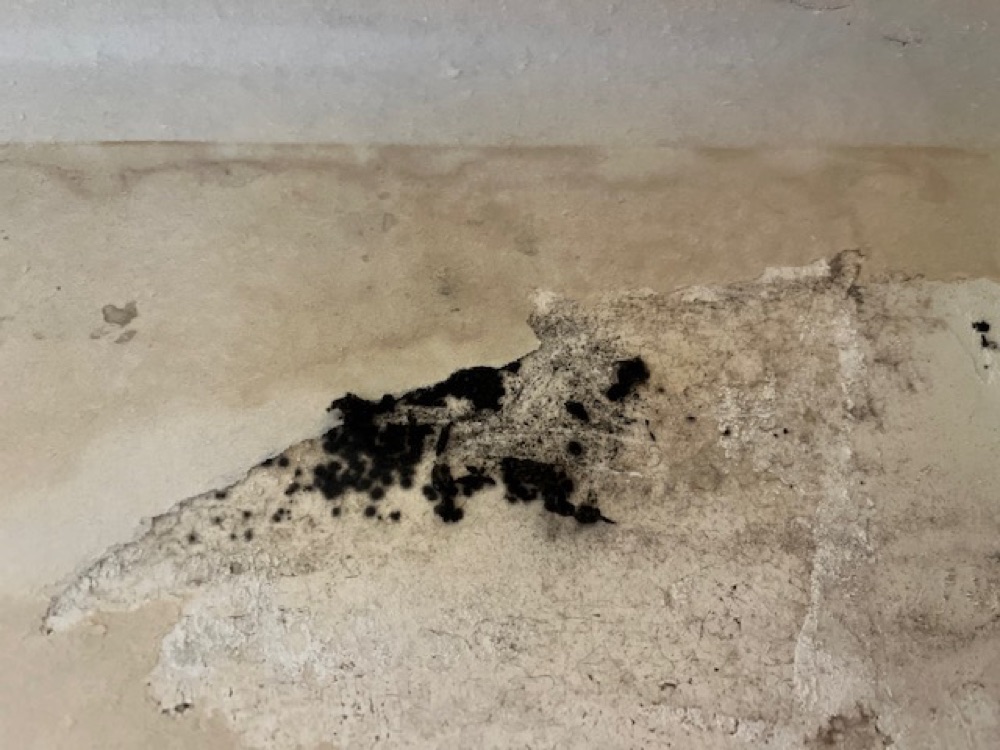
How to tell black mold from the molds it resembles
Colour alone confirms nothing, and most dark patches in homes are not Stachybotrys. Only a laboratory can name the species, but four things narrow it down quickly: what the material is, how long it stayed wet, the texture, and whether the growth sits on the surface or has rooted into it.
Where black mold grows in a house
Plasterboard is the classic host, and specifically its paper facing, which is close to pure cellulose. Check the back of walls after plumbing or roof leaks, saturated ceiling tiles, wet timber framing, cardboard stored in damp basements, and the underside of flooring after a flood.
Hidden growth is the norm rather than the exception. Because the material has usually been wettest inside the cavity, the patch you can see is often the smallest part of the colony, and up to half of water-damaged buildings carry growth not visible from any room. Ductwork adds its own version of the problem, covered in black mold in air vents.
The pattern of a leak is worth reading. Growth that fans out from a single point suggests a pipe or roof penetration, whereas an even band along the base of a wall points at rising damp or a failed slab, and each one changes the repair rather than the cleaning.
Is black mold really toxic?
Stachybotrys produces trichothecene mycotoxins, chiefly satratoxin H and G, which are genuinely potent compounds. In laboratory conditions they are cytotoxic and immunosuppressive at low concentrations, and that pharmacology is not in dispute.
What remains contested is how much of that translates to a person living in a house with a colony. The 2004 Institute of Medicine review found sufficient evidence linking damp indoor spaces to respiratory symptoms, asthma and hypersensitivity pneumonitis, and insufficient evidence for most of the systemic claims attached to black mold specifically. The CDC takes a similar line, noting that a proposed link between Stachybotrys and acute pulmonary haemorrhage in infants was not established when the original Cleveland investigation was reviewed.
Set against that, the World Health Organization concluded in 2009 that dampness and mould raise the risk of respiratory illness, and later work has shown that inhaled fragments of mould provoke inflammation whether or not they carry toxins. The reasonable reading is that black mold is a real hazard through irritation, allergy and inflammation, and that the popular image of a poison that harms everyone who meets it outruns the evidence.
Whichever framing you prefer, the practical conclusion is unchanged. A colony large enough to see marks a building problem serious enough to fix, and the argument over mycotoxins does not alter the repair. How dangerous black mold exposure actually is sets the risk out in more detail.
Trichothecene mycotoxins, notably satratoxin H and G. See trichothecenes for how they behave in the body and how they are measured.
Black mold symptoms
Symptoms attributed to black mold are the symptoms of mold exposure generally, since no complaint is unique to this species. Effects build with time spent in the affected room and usually ease within a day or two of leaving it, which is the pattern worth paying attention to.
Symptoms that lift after a few days away and return within a day of coming home point at the building rather than at an infection. The full picture is in our reference on mold toxicity symptoms, and the free visual contrast sensitivity test measures one neurological marker of biotoxin exposure in about fifteen minutes.
How to confirm it is black mold
Visual identification cannot name a species, and no home test kit changes that. Settle-plate kits sold for a few pounds grow whatever was already in the air and tell you nothing about what is in your wall.
Dust testing is the practical route. HERTSMI-2 scores five water-damage species, Stachybotrys chartarum among them, from a settled-dust sample, and ERMI covers thirty-six species against an outdoor baseline. Our mold identification guide explains what each one measures and which to order, and the free mold test interpreter reads a result you already hold in plain language.
Species identification matters less than most people expect, because the response is the same for any growth of the same size on the same material. It becomes worth paying for when an insurer or a landlord disputes the finding, or when a clearance test after remediation needs to show the species is gone.
Removing black mold
Because black mold grows on porous material that has been saturated, the affected plasterboard, ceiling tile or timber is usually cut out and replaced rather than cleaned. Fix the water first, contain the area before disturbing anything, and keep an N95 or better on, since scrubbing raises airborne spore counts sharply.
Anything past roughly ten square feet, any growth inside an HVAC system, and any contamination following major water damage belongs with a certified remediator. The full method, from containment and equipment specifications through to clearance testing, is in the black mold remediation guide.
For the full method, see our mold removal guide and the guide to black mold remediation.
If Stachybotrys chartarum has been growing in your home and you have symptoms without an obvious cause, the free Visual Contrast Sensitivity test checks for a measurable sign of biotoxin exposure in under 15 minutes. Screening tools are not a diagnosis, and anything concerning is worth raising with a qualified healthcare provider.
Frequently asked questions
What is black mold?
Black mold is a common name rather than a scientific one, applied to any dark growth indoors. It usually refers to Stachybotrys chartarum, a greenish-black fungus that feeds on cellulose materials such as plasterboard paper, cardboard and timber, and that requires those materials to stay close to saturation for a week or more before it can grow.
What does black mold look like?
It appears dark olive-green to charcoal, with a slimy or wet-looking surface while growing and a sooty, powdery texture once dry. Edges are usually well defined, the patch often follows the path the water took, and there is no visible fuzz. An established colony carries a strong earthy, musty smell.
Does black mold always mean Stachybotrys?
No, and most of the time it does not. Cladosporium, several Aspergillus species and Alternaria all appear black or very dark, and they grow in far drier conditions than Stachybotrys needs. Colour cannot identify a species, which requires laboratory analysis of a dust or surface sample.
Is black mold dangerous?
It produces trichothecene mycotoxins that are potent in laboratory conditions, and exposure is associated with respiratory irritation, allergic reactions, headaches and fatigue. Major reviews accept the respiratory evidence while finding the systemic claims weaker. Risk rises with the size of the growth, whether it is being disturbed, and whether anyone exposed is very young, elderly, asthmatic or immunocompromised.
How fast does black mold grow?
Slower than most household molds. Common species colonise wet material within 24 to 48 hours, whereas Stachybotrys needs the surface held near saturation for roughly 7 to 14 days before it establishes. Seeing it means the water problem is old rather than new.
Can black mold grow from humidity alone?
Not realistically. It requires a water activity around 0.94, which means liquid water in the material rather than moisture in the air. High humidity readily grows Cladosporium, Penicillium and Aspergillus, so growth appearing in a merely humid room is far more likely to be one of those.
Worried About Mold Exposure?
The Visual Contrast Sensitivity test screens for the neurological effects of biotoxin exposure in under 15 minutes. Free, online, no account required.
Start the test now